
Two-hundred fifty years after the founding of our nation, I often find myself disconnected from the spirit and dreams of the early Americans — the ones who build the nation. The daily lives of Americans now would be so foreign, and the nation would be unrecognizable, to the Founders if they were living today.
Perhaps some things have improved, but behind the facade of technology and development lies a superficial happiness that is the deteriorating shell of what once was a happy life in the land of the free. I personally believe that we would experience true joy and live more meaningful lives if we could go back to the days of our founding, sacrificing our technology and comfort to regain joy and purpose. Most push back against this idea because it would mean that we would have to forfeit our conveniences, as we are so wrapped up in materialism and entertainment — I admit, I also would struggle without modern conveniences, but I desperately wish to return to a time when we had true independence, prosperity, and freedom.
Rather than speculate about what the founders would have thought about our modern age, I decided to read their quotes, and I was surprised to find that they had the foresight to accurately predict our current condition. After reading their words, it seemed as though my perspective on my country had shifted once again, and I started to see things through the eyes of the ones who built America. I now see just how many times we have ignored their warnings and become complacent with the consequences.
I would like to share with you a list of several of my favorite quotes from several of the most prominent Founding Fathers:
John Adams (1735 – 1826)
“Be not intimidated… nor suffer yourselves to be wheedled out of your liberties by any pretense of politeness, delicacy, or decency. These, as they are often used, are but three different names for hypocrisy, chicanery and cowardice.”
September 30, 1765, in ‘A Dissertation on the Canon and the Feudal Law No. 3’
“We Recognize no Sovereign but God, and no King but Jesus!”
April 18, 1775, when ordered by a British soldier to ‘disperse in the name of George the Sovereign King of England’
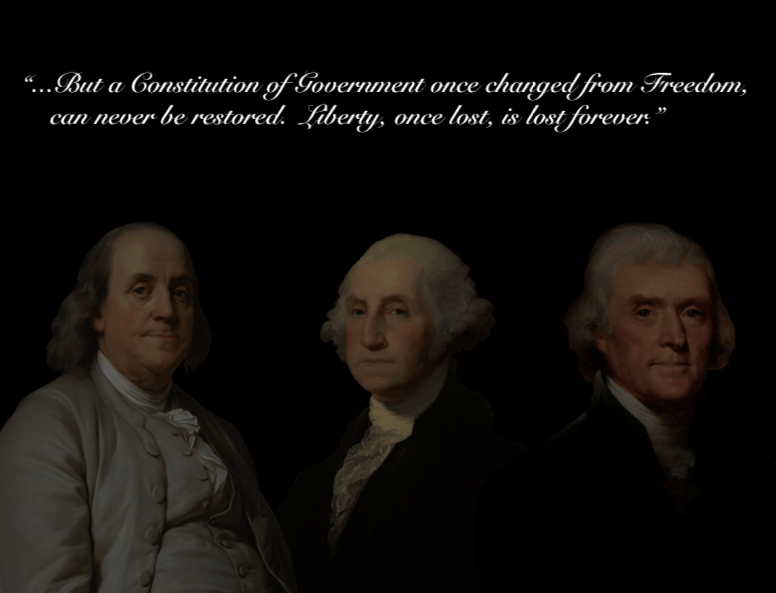
“But a Constitution of Government once changed from Freedom, can never be restored. Liberty, once lost, is lost forever.”
July 7, 1775, in a letter to Abigail Adams
“Posterity! You will never know, how much it cost the present Generation, to preserve your Freedom! I hope you will make a good Use of it. If you do not, I shall repent in Heaven, that I ever took half the Pains to preserve it.”
April 26, 1777, in a letter to Abigail Adams
“Our Constitution was made only for a moral and religious people. It is wholly inadequate to the government of any other.”
October 11, 1798, in a letter to the Massachusetts Militia
“Power always thinks it has a great soul and vast views beyond the comprehension of the weak; and that it is doing God’s service when it is violating all his laws.”
February 2, 1816, in a letter to Thomas Jefferson
Benjamin Franklin (1706 – 1790)
“If everyone is thinking alike, then no one is thinking.”
“Common sense without education, is better than education without common sense.”
“Security without liberty is called prison.”
“Search others for their virtues, thyself for thy vices.”
1738, in ‘Poor Richard’s Almanack’
“Those who would give up essential Liberty, to purchase a little temporary Safety, deserve neither Liberty nor Safety.”
November 11, 1755, in a reply to the Governor of Pennsylvania
“In 200 years will people remember us as traitors or heroes? That is the question we must ask.”
March 16, 1775, in a letter to Thomas Jefferson
“This [the US Constitution] is likely to be administered for a course of years and then end in despotism… when the people shall become so corrupted as to need despotic government, being incapable of any other.”
September 17, 1787, at the Constitutional Convention
Nathan Hale (1755 – 1776)
“I only regret that I have but one life to lose for my country.”
September 22, 1776, just before being hanged by the British
Alexander Hamilton (1755 or 1757 – 1804)
“Man is either governed by his own laws — freedom — or the laws of another — slavery. Are you willing to become slaves? Will you give up your freedom, your life, and your property without a single struggle? No man has a right to rule over his fellow creatures.”
“Give all the power to the many, they will oppress the few. Give all the power to the few, they will oppress the many.”
June 18, 1787, in a speech during the Constitutional Convention
“One great error is that we suppose mankind more honest than they are.”
June 22, 1787, during the Constitutional Convention
“We are now forming a republican government. Real liberty is never found in despotism or the extremes of democracy, but in moderate governments. Those who mean to form a solid republican government, ought to proceed to the confines of another government. As long as offices are open to all men, and no constitutional rank is established, it is pure republicanism. But if we incline too much to democracy, we shall soon shoot into a monarchy.”
June 26, 1787, during the Constitutional Convention
“What is the most sacred duty and the greatest source of our security in a Republic? An inviolable respect for the Constitution and Laws.”
August 28, 1794, in ‘Tully No. 3’
John Hancock (1737 – 1793)
“The more people who own little businesses of their own, the safer our country will be, and the better off its cities and towns; for the people who have a stake in their country and their community are its best citizens.”
“People who pay greater respect to a wealthy villain than to an honest, upright man in poverty, almost deserve to be enslaved; they plainly show that wealth, however it may be acquired, is, in their esteem, to be preferred to virtue.”
March 5, 1774, during his Boston Massacre Oration
“There! His Majesty can now read my name without glasses. And he can double the reward on my head!”
Believed by some that Hancock spoke this phrase after signing the Declaration of Independence on August 2, 1776
“I congratulate you and my country on the singular favor of heaven in the peaceable and auspicious settlement of our government upon a Constitution formed by wisdom, and sanctified by the solemn choice of the people who are to live under it. May the Supreme ruler of the world be pleased to establish and perpetuate these new foundations of liberty and glory… Thank God, my country is saved and by the smile of Heaven I am a free and independent man.”
1787, during Massachusetts’ Constitution ratification convention
Patrick Henry (1736 – 1799)
“Bad men cannot make good citizens. It is when a people forget God that tyrants forge their chains. A vitiated state of morals, a corrupted public conscience, is incompatible with freedom. No free government, or the blessings of liberty, can be preserved to any people but by a firm adherence to justice, moderation, temperance, frugality, and virtue; and by a frequent recurrence to fundamental principles.”
“Were my soul trembling on the wing of eternity, were this hand freezing to death, were my voice choking with the last struggle, I would still, with the last gasp of that voice, implore you to remember the truth: God has given America to be free.”
“Should I keep back my opinions at such a time, through fear of giving offense, I should consider myself as guilty of treason toward my country, and of an act of disloyalty toward the Majesty of Heaven, which I revere above all earthly Kings… It is in vain, sir, to extenuate the matter. Gentlemen may cry, “Peace! Peace! — but there is no peace. The war is actually begun! The next gale that sweeps from the north will bring to our ears the clash of resounding arms! Our brethren are already in the field! Why stand we here idle? What is it that gentlemen wish? What would they have? Is life so dear, or peace so sweet, as to be purchased at the price of chains and slavery? Forbid it, Almighty God! I know not what course others may take; but as for me, give me liberty, or give me death!”
March 23, 1775, in a speech during the Second Virginia Convention
“Guard with jealous attention the public liberty. Suspect everyone who approaches that jewel. Unfortunately, nothing will preserve it but downright force. Whenever you give up that force, you are inevitably ruined.”
June 5, 1788, during Virginia’s Constitution ratification convention
“The militia is our ultimate safety. We can have no security without it. The great object is that every man be armed.”
June 14, 1788, during Virginia’s Constitution ratification convention
“United we stand, divided we fall. Let us not split into factions which must destroy that union upon which our existence hangs.”
March 4, 1799, at the Charlotte County Courthouse in his final public address
Thomas Jefferson (1743 – 1826)
“When the people are afraid of the government, that’s tyranny. But when the government is afraid of the people, that’s liberty.”
“There is no justification for taking away individuals’ freedom in the guise of public safety.”
“The Bible is the cornerstone of liberty.”
“The federal government is our servant, not our master.”
“No generation has a right to contract debts greater than can be paid off during the course of its own existence.”
September 6, 1789, in a letter to James Madison
“…for I have sworn upon the altar of God eternal hostility against every form of tyranny over the mind of man.”
September 23, 1800, in a letter to Benjamin Rush
“…If we can but prevent the government from wasting the labours of the people, under the pretence of taking care of them, they must become happy.”
November 29, 1802, in a letter to Thomas Cooper
“I think myself that we have more machinery of government than is necessary, too many parasites living on the labor of the industrious. Government big enough to supply everything you need is big enough to take everything you have… The course of history shows that as a government grows, liberty decreases. The two enemies of the people are criminals and government, so let us tie the second down with the chains of the constitution so the second will not become the legalized version of the first.”
September 6, 1824, in a letter to William Ludlow
James Madison (1751 – 1836)
“The future and success of America is not in this Constitution, but in the laws of God upon which this Constitution is founded.”
“Resistance to tyranny is service to God.”
“A Government resting on a minority, is an aristocracy not a Republic, and could not be safe with a numerical [and] physical force against it, without a standing Army, and enslaved press, and a disarmed populace.”
1830s, in an unpublished essay
Thomas Paine (1737 – 1809)
“He who dares not offend cannot be honest.”
April, 1776, in ‘The Forester’s Letters,’ Letter III
“These are the times that try men’s souls. The summer soldier and the sunshine patriot will, in this crisis, shrink from the service of his country; but he that stands it now, deserves the love and thanks of man and woman.”
December 19, 1776, in The ‘American Crisis’
“If there must be trouble, let it be in my day, that my child may have peace.”
December 19, 1776, in The ‘American Crisis’
“The harder the conflict, the more glorious the triumph. What we obtain too cheap, we esteem too lightly; it is dearness only that gives everything its value. I love the man that can smile in trouble, that can gather strength from distress and grow brave by reflection. ’Tis the business of little minds to shrink; but he whose heart is firm, and whose conscience approves his conduct, will pursue his principles unto death.”
December 19, 1776, in The ‘American Crisis’
“To argue with a person who has renounced the use of reason is like administering medicine to the dead.”
March 21, 1778, in ‘The American Crisis V’
“A body of men holding themselves accountable to nobody ought not to be trusted by anybody.”
1791, in ‘Rights of Man’
John Parker (1729 – 1775)
“Stand your ground. Don’t fire unless fired upon, but if they mean to have a war, let it begin here.”
April 19, 1775, spoken to the 77 Minute Men after getting up from his death bed and walking two miles to face the 700 British regulars in Lexington.
Roger Sherman (1721 – 1793)
“Sad will be the day when the American people forget their traditions and their history, and no longer remember that the country they love, the institutions they cherish, and the freedom they hope to preserve, were born from the throes of armed resistance to tyranny, and nursed in the rugged arms of fearless men.”
Joseph Warren (1741 – 1775)
“The voices of your fathers’ blood cries to you from the ground; MY SONS SCORN TO BE SLAVES! In vain we met the frowns of tyrants; in vain, we crossed the boisterous ocean, found a new world, and prepared it for the happy residence of LIBERTY; in vain, we toiled; in vain, we fought; we bled in vain, if you, our offspring, want valour to repel the assaults of her invaders! Stain not the glory of your worthy ancestors; but like them resolve, never to part with your birthright; be wise in your deliberations, and determined in your exertions for the preservation of your liberties. Follow not the dictates of passion, but enlist yourselves under the sacred banner of reason; use every method in your power to secure your rights; at least prevent the curses of posterity from being heaped upon your memories.”
March 5, 1772, in the second ‘Boston Massacre Oration’
“May [God] graciously preside in all our councils.— May he direct us to such measures as he himself shall approve, and be pleased to bless. May we ever be a people favoured of GOD. May our land be a land of liberty, the seat of virtue, the asylum of the oppressed, a name and a praise in the whole earth, until the last shock of time shall bury the empires of the world in one common undistinguished ruin!”
March 5, 1772, in the second ‘Boston Massacre Oration’
“…We profess to be his [King George III’s] loyal and dutiful subjects, and so hardly dealt with as we have been, are still ready, with our lives and fortunes, to defend his person, family, crown, and dignity. Nevertheless, to the persecution and tyranny of his cruel Ministry we will not tamely submit; appealing to Heaven for the justice of our cause, we determine to die or be free.”
April 26, 1775, in a letter to the Inhabitants of Great Britain
George Washington (1732 – 1799)
“If all else fails, I will retreat up the valley [of Tennessee], plant my flag on the Blue Ridge, rally around the Scotch-Irish of that region, and make my last stand for liberty amongst a people who will never submit to tyranny whilst there is a man left to draw a trigger.”
Believed by some that Washington said these words at Valley Forge in 1777
“Be Americans. Let there be no sectionalism, no North, South, East or West. You are all dependent on one another and should be one in union. In one word, be a nation. Be Americans, and be true to yourselves.”
September 19, 1796, in Washington’s Farewell Address
“Do not let anyone claim tribute of American patriotism if they even attempt to remove religion from politics.”
September 19, 1796, in Washington’s Farewell Address
Noah Webster (1758 – 1843)
“Before a standing army can rule, the people must be disarmed; as they are in almost every Kingdom in Europe. The Supreme power in America cannot enforce unjust laws by the sword; because the whole body of the people are armed…”
October, 1787, in ‘An Examination into the Leading Principles of the Federal Constitution’
What is your favorite quote of the Founding Fathers?
Onward American 🇺🇸
Source: Quotes from John Adams
Source: John Adams April 26, 1777, Letter
Source: 25 Quotes from Benjamin Franklin
Source: Advice from the First American
Source: Statues of Nathan Hale
Source: Quotes of Alexander Hamilton
Source: Quotes of John Hancock
Source: Quotes of Patrick Henry
Source: Thomas Jefferson to Benjamin Rush (Sep. 23, 1800)
Source: Thomas Jefferson to Thomas Cooper (Nov. 29, 1802)
Source: Quotes from Thomas Jefferson
Source: Quotes of James Madison
Source: Quotes of Thomas Paine
Source: Quotes of Joseph Warren
Source: Appealing to Heaven for the Justice of Our Cause
Source: Quotes of George Washington
Source: George Washington’s Last Stand Quote
Source: What the Framers Intended: A Linguistic Analysis of the Right to “Bear Arms”

