
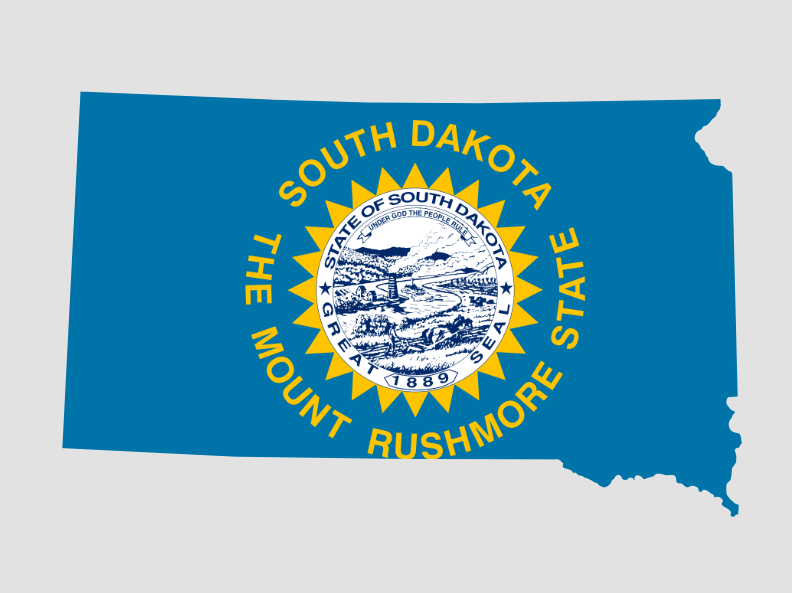
South Dakota is a state in the midwestern region of the United States with the abbreviation of SD. South Dakota became the 40th state on November 2, 1889, making the state 136 years old, as of November, 2025. South Dakota got its name when Congress split Dakota Territory in two and President Benjamin Harrison signed the two halves into statehood as the states of North Dakota and South Dakota. The name Dakota itself is an American Indian word meaning allies.
South Dakota is the 17th largest state and the 46th most populous; the capital of South Dakota is Pierre and its demonym is South Dakotan. South Dakota is bordered by the states of Minnesota, Iowa, Nebraska, Wyoming, Montana, and North Dakota.
The motto of the state of South Dakota is Under God the People Rule.
The official nickname of South Dakota is the Mount Rushmore State, due to the fact that Mount Rushmore is located in the state. South Dakota’s previous nicknames are the Coyote State and the Sunshine State.
The landscape of South Dakota has fertile prairies and farms in the east that fade into buttes, badlands, and the Black Hills in the west.
South Dakota is known for Mount Rushmore, the iconic Badlands and Custer State Park, and for having the point of land that is the geographic center of the entire United States near Belle Fourche. South Dakota’s land is rich in metals such as tin, lithium, beryllium, uranium, silver, and gold.
In 1907, Oscar Fladmark Sr. moved from Ålsesund, Norway, to South Dakota, and on June 23, 1922, his son, Oscar Randolph Fladmark, was born in Moe Township, Lincoln County, South Dakota. Oscar Fladmark Jr. later moved to Sioux Falls, South Dakota, where he attended Augustana College, but his education there was interrupted as he was inducted into the US Army Air Corps in 1942. During the latter half of 1942, Fladmark was trained in as an aviator at various military bases in California, Arizona, Texas, Florida, and Virginia; in 1943, Fladmark was transferred to the European Theater of Operations in England for active duty. Fladmark originally flew the P-47 Thunderbolt along with the rest of the 359th Fighter Group, but they were later given the P-51 Mustang. Fladmark flew many combat missions, including ones over Munich, Saarbrücken, Regensburg, Schweinfurt, Ebelsbach, Neuaubing, Hanover, Normandy, Méry-la-Bataille, Oise River, Sens. St. Ouen, and Genevillers. In 1944, Fladmark flew during the Battle of Merseburg with an armada of 1,100 allied bombers and 900 allied fighters when they encountered 400 Luftwaffe fighters; Fladmark and his group proceeded to set a new record after destroying more than half of the Luftwaffe fighters. Fladmark completed a total of 64 combat missions over Nazi Germany before he was transferred back to the United States in 1945; soon after, Fladmark was discharged from the Air Corps and he returned to Sioux Falls. In 1946, Fladmark was appointed captain in the Air National Guard 175th Fighter Squadron in Sioux Falls, and in 1948, he finally earned a degree at the Augustana College. With the outbreak of the Korean War, Fladmark was recalled into the now US Air Force in 1950, and during the Korean War, Fladmark flew 100 combat missions over North Korea; he received the Distinguished Flying Cross for his valor during the Korean War. Fladmark returned from war once again and was appointed the Assistant Professor of Air Science and Tactics for the Reserve Officers Training Corps program in St. Olaf College in Northfield, Minnesota, and was later reassigned to active duty status at Scott Air Force Base in Belleville, Illinois. In 1954, Fladmark was even awarded with the Mach Busters Club Citation for breaking the sound barrier in a North American F-86 Sabre fighter jet. Sadly, on July 27, 1955, while riding in a 1955 Ford Fairlane near Yuma, Arizona, Fladmark was killed at the age of 33 when the Fairlane overturned on an access road. He was survived by his wife Phyllis, son Gary, and daughter Vicki.
While the armored car had technically already been invented, Waldo A. Ross of Sioux Falls, South Dakota, filed a patent in 1920 that greatly improved armored cars for the military. Ross’ improvements allowed amor to be applied to the chassis of a regular motor vehicle, which also added greater protection for the driver and the vital components of the vehicle. Furthermore, Ross included a swiveling turret for a gunner on top of the vehicle that allowed the vehicle to be defended much more safely than those with a fixed turret.
From September 9 to September 10, 1876, the Battle of Slim Buttes occurred in Dakota Territory, which is now part of Harding County, South Dakota. After the American defeat at the Battle of Little Bighorn, which resulted in the deaths of Lieutenant Colonel George Custer and First Lieutenant James Calhoun, attempts were made to convince hostile American Indians to return to the reservations, but they ultimately failed. General George Crook and his troops pursued the American Indians. Running low on supplies, a detachment of Crook’s troops under the command of Captain Anson Mills was sent to Deadwood to find supplies, but along their way, they came across the village of the Oglala Lakota warrior chief American Horse near the present-day town of Reva, South Dakota. On September 8, Captain Mills attacked the village by surprise; most of the American Indian escaped and alerted other Indian warriors. American Horse was wounded and surrendered to the US soldiers during this attack, but he refused treatment by the army surgeon and passed away shortly after. Lakota leader Crazy Horse returned the following day with hundreds more warriors that opened fire on the US troops from some hilltops, but by that point, Crook had arrived with roughly 1,000 more troops. Crook’s men drove the warriors from the hilltops. Crook decided to destroy the village, and on the 10th of September, Crook successfully led his men to a supply column, though they were attacked by the warriors most of the way. The Battle of Slim Buttes resulted in an American Victory.
An interesting fact about South Dakota is that the state is home to Black Elk Peak in the Black Hills, which is the highest peak in the United States east of the Rocky Mountains at 7,242’. On a perfectly clear day, you can see four states from the peak: South Dakota (the state in which the peak is located), Wyoming (26 miles away), Nebraska (60 miles away), and Montana (83 miles away).
A strange fact about South Dakota is that the state is home to the world’s fastest temperature increase ever recorded. On the morning of January 22, 1943, the air temperature in the city of Spearfish, SD, was -4ºF, but just two minutes later, the temperature had shot up to 45ºF — a 49-degree temperature increase in just two minutes! However, the residents of Spearfish couldn’t enjoy that sudden spring weather for long as the temperature dropped by 54 degrees two hours later to -9ºF.
What fact about South Dakota most interests you?
Onward American 🇺🇸
Source: Origins of State Names
Source: Demonyms for US States
Source: The Mount Rushmore State
Source: Oscar Randolph Fladmark

