
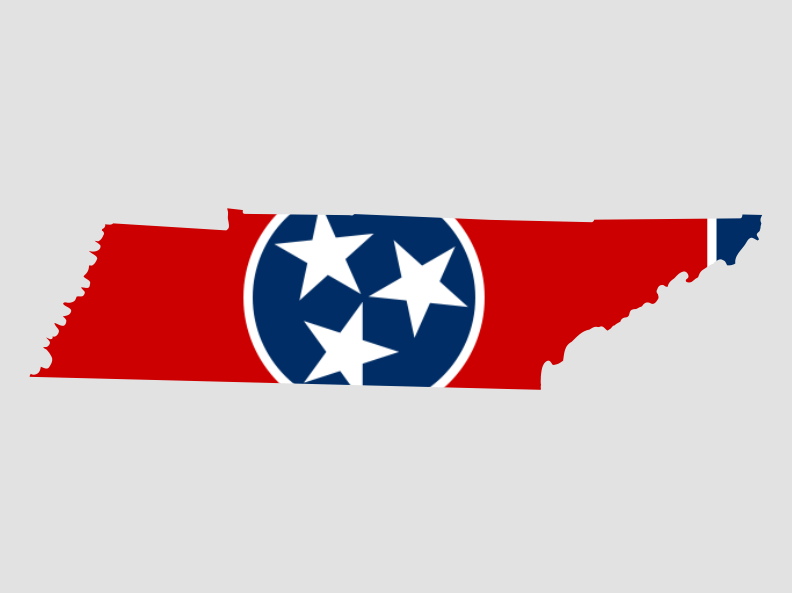
Tennessee is a state in the southern region of the United States with the abbreviation of TN. Tennessee became the 16th state on June 1, 1796, making the state 230 years old, as of June, 2026. The state of Tennessee was named after the Tennessee River, which was named after a Cherokee village called Tanasse or Tennese. This Cherokee name is sometimes said to mean bend in the river, but its true meaning is considered lost.
Tennessee is the 36th largest state and the 15th most populous; the capital of Tennessee is Nashville and its demonym is Tennessean. The states of Tennessee and Missouri both border 8 states, which is more than the number of states that the other states border. Tennessee is bordered by the states of North Carolina, Georgia, Alabama, Mississippi, Arkansas, Missouri, Kentucky, and Virginia.
The motto of Tennessee is Agriculture and Commerce.
The most popular nickname for Tennessee is the Volunteer State, which was given to the state during the War of 1812 as Tennessean soldiers played a vital role during the war. The nickname was later reinforced when the secretary of state requested 2,800 Tennesseans to fight in the Mexican-American War, but instead 30,000 Tennesseans volunteered.
The state of Tennessee spans from the Great Smoky Mountains and Appalachian Mountains in the east; to the rolling hills, limestone caves, and river gorges in the middle; to the fertile plains and bluffs near the Mississippi River in the west.
Tennessee is known for Music City (Nashville), for being instrumental in the development of music such as blues and rock and roll, for the beauty of the Great Smoky Mountains, for Memphis-style barbecue, and for being the last state to join the Confederate States and the first state to be readmitted to the United States. Tennessee’s land possesses metals such as iron, copper, zinc, lead, manganese, cadmium, germanium, and gold.
On August 17, 1786, one year before the founders wrote the US Constitution, a man named David Crockett was born near the town of Limestone in the unrecognized state of Franklin, however, this town was officially located in North Carolina, though this portion of North Carolina became the state of Tennessee only 10 years after Crockett’s birth — this means it could be said that Crockett was born in the states of North Carolina, Franklin, and Tennessee! In 1813, Crockett joined the Tennessee militia and served during the Creek War under Major General Andrew Jackson and Colonel John Coffee. In 1817, Crockett moved his family to Lawrence County, Tennessee, where he became a county commissioner. Crockett was elected lieutenant colonel of the 57th Regiment of the Tennessee Militia in 1818. Crockett became a member of the National Republican Party, who were sometimes called Anti-Jacksonians as they opposed the policies of president Andrew Jackson (the major general under whom Crockett served during the War of 1812); Crockett later joined the Whig Party in 1833. From 1833 to 1835, Crockett served as a member of the US House of Representatives from Tennessee; Crockett ran for reelection in 1835, but after losing the election, Crockett angrily cursed out his constituents and added that he would go to Texas. Soon after, Crockett followed through with his threat and headed for Texas, where he and several other armed men explored the land with the intent of liberating Texas from Mexico. On February 8, 1836, Crockett arrived at the Alamo Mission near San Antonio, Texas. A couple weeks later, an army of Mexican soldiers under the command of General Santa Anna surprised the American garrison and initiated a siege. In the early morning of March 6, 1836, the Mexican army finally attacked the Alamo while the defenders were sleeping. The defenders quickly awakened and fended off the attackers for 90 minutes until every defender was killed. It was reported that Davy Crockett stopped briefly in the chapel to say a prayer, then he went to his station, where he was among the last of the men out in the open as he was too far from the barracks to take shelter there with the rest of the defenders. It is believed that Crockett made his last stand defending the low wall in front of the church. Santa Anna ordered his men to burn the bodies of the defenders. It is claimed that the coffin in the entrance of the San Fernando Cathedral contains the ashes of the defenders, including those of Jim Bowie, William Travis, and Davy Crockett.
In 1897, cotton candy was invented in Nashville when dentist William Morrison teamed up with confectioner John Wharton to invent the candy, which they originally called fairy floss.
From August 1 to 2, 1946, the Battle of Athens occurred in McMinn County, Tennessee. In the 1930s, E. H. Crump established a political machine in Memphis that eventually controlled much of Tennessee. When Crump’s influence reached McMinn County, Paul Cantrell beat his political opponent in what was known as the vote grab of 1936 and became sheriff of McMinn County. In the early 1940s, Cantrell was elected to the state senate and Pat Mansfield became sheriff. A system was established that payed the sheriff and his deputies for each person that was incarcerated and released, and soon after, many people simply passing through McMinn county were pulled over and randomly ticketed for drunkenness, even though they were most often not intoxicated; the fees acquired by this random ticketing over ten years reached nearly $300,000, which is equivalent to more than $3.7 million today! Whenever Cantrell was up for reelection, he would intimidate voters if they voted against him, and votes from dead voters were frequently counted. When most of McMinn County’s young men went off to fight in WWII during the early 1940s, many ex-convicts were appointed as deputies. During the war, two servicemen returned to McMinn County on leave, but were shot and killed by Cantrell’s supporters; this caused the remaining servicemen from McMinn County to be anxious to return home to do something about the corruption, and some claimed they thought about McMinn County more than they thought about the Japanese and Germans they were actively fighting. When the war finally concluded in 1945, around 3,000 GIs returned home with their lump sum payments, known as mustering-out pay, however, the GIs were immediately targeted by the deputies and continually ticketed until they were robbed of their money from the war. In 1946, Cantrell and Mansfield were running for reelection once again, but this time a group of nonpartisan GIs ran against Cantrell and Mansfield, promising a fraud-free election. On August 1st, the polls opened in McMinn County; Sheriff Mansfield had 200 armed deputies patrolling the county, with about 15 deputies patrolling each precinct. In the city of Etowah, a GI poll watcher requested the ballot box be opened to certify it was empty before any ballots were cast, which was a legal request, but the deputies arrested the GI and brought him to jail. Another GI poll watcher in the city of Athens was arrested. Around 3 PM in Athens, an elderly farmer named Tom Gillespie attempted to cast his ballot, but a deputy prevented him from voting. When Gillespie and a GI poll watcher protested, the deputy struck Gillespie with brass knuckles, causing him to drop his ballot and run; the deputy then shot Gillespie in the back. Gillespie survived the shot and was brought to jail. Sheriff Mansfield ordered the polls to be closed early and the ballot boxes be brought to the jail for counting. In the ensuing commotion, several arrested GIs jumped through a glass window and escaped, causing the deputies to open fire on the GIs. Several deputies were sent to recapture the GIs, but they were soon captured themselves, disarmed, and tied to trees. Shortly after, the GIs broke into the National Guard Armory and stole 70 rifles, 2 Thompson submachine guns, and ammunition. At this point, Mansfield and his deputies were barricaded in the jail with 3 of the ballot boxes. The GIs, decided they needed to resolve the issue before Mansfield got reinforcements in the morning, so they decided to attack the jail. The GIs demanded that the deputies surrender the ballot boxes, but the deputies refused. A line of up to 2,000 battle-hardened GIs then opened fire on the roughly 50 deputies who knew very little of warfare; the deputies ran in the jail for cover, but several were struck. Each hour, the GIs ceased fire and demanded the deputies surrender. Hours later, dynamite was used to breach the jail door, at which point the deputies surrendered and yielded the ballot boxes. The ballots were counted, which revealed that the GIs had not only won the race for sheriff, but also the other offices, in a landslide victory — there were also fraudulent ballots and fake tally sheets found in the jail where the deputies had barricaded themselves. This was the only time in history that US citizens successfully overthrew local government in an armed conflict, and miraculously, not one person had been killed that day.
An interesting fact about Tennessee is that Tennessee has North America’s largest underground lake. The Lost Sea is located in Sweetwater, Tennessee, and has 4.5 acres of visible surface, with approximately 13 acres of submerged rooms and passageways. The Lost Lake is estimated to hold up to 30 million gallons of water.
A strange fact about Tennessee is that the state is home to the shortest tunnel in the world. The tunnel, known as Backbone Rock Tunnel, allows Tennessee State Route 133 to go through the 80-foot tall rock structure, however, the structure is very narrow, which strangely causes the tunnel to only be 20 feet long.
What fact about Tennessee most interests you?
Onward American 🇺🇸
Source: Origins of State Names
Source: Demonyms for US States
Source: Inventions of Tennessee

