
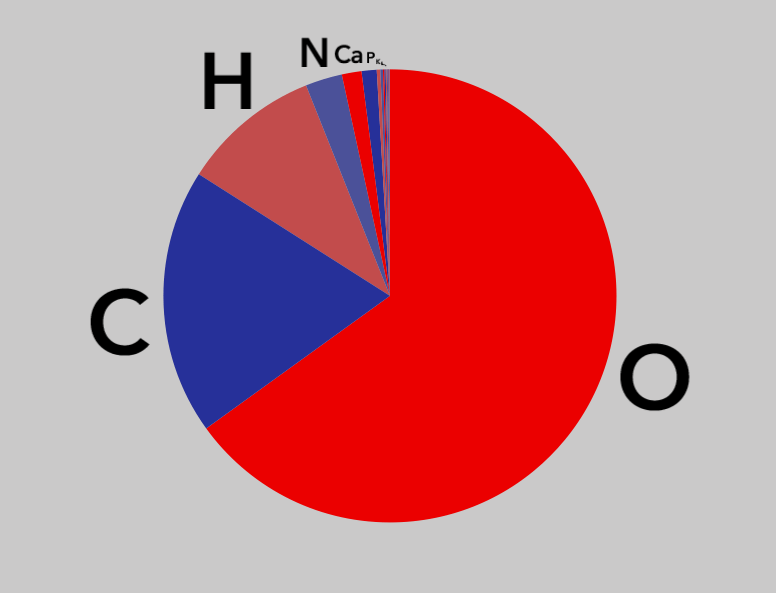
It is widely known that life is carbon-based, meaning that most of the molecules that make up living organisms are built on chains of carbon atoms. I’ve also been told that living organisms are mostly composed of carbon, hydrogen, and oxygen — that’s where carbohydrate gets its name: carbo- (carbon) + –hydrate (water, which is made of hydrogen and oxygen).
I’ve often wondered how many other elements are found in the human body, and how much calcium or magnesium is present in my own body. This led me to research this topic and then discover that there are numerous elements found in a human body, some of which are vital, while others are trace contaminates.
Let’s look at each element that is typically found in a human body as well as the average amount found in a 150-pound human. The elements that are essential for human life are in bold. The elements will be measured in the US Customary System using pounds (lbs.), ounces (oz.), and grains (gr.).
Bulk Elements in the Human Body
| Element | Quantity | Percent by Weight |
|---|---|---|
| Oxygen | 99.2 lbs. | 65% |
| Carbon | 28.7 lbs. | 19% |
| Hydrogen | 15.4 lbs. | 10% |
| Nitrogen | 3.97 lbs. | 2.6% |
| Calcium | 2.20 lbs. | 1.4% |
| Phosphorous | 1.72 lbs. | 1.1% |
| Potassium | 4.94 oz. | 0.2% |
| Sulfur | 4.94 oz. | 0.2% |
| Sodium | 3.52 oz. | 0.1% |
| Chlorine | 3.35 oz. | 0.1% |
| Magnesium | 0.67 oz. | 0.03% |
Trace Elements in the Human Body
| Element | Quantity | Percent by Weight |
|---|---|---|
| Iron | 0.15 oz. | 0.006% |
| Fluorine | 0.09 oz. | 0.004% |
| Zinc | 35.5 gr. | 0.003% |
| Silicon | 15.4 gr. | 0.001% |
| Gallium | 10.8 gr. | 0.001% |
| Rubidium | 10.5 gr. | 0.001% |
| Strontium | 4.94 gr. | 0.0005% |
| Bromine | 4.01 gr. | 0.0004% |
| Lead | 1.85 gr. | 0.0002% |
| Copper | 1.11 gr. | 0.0001% |
Ultra Trace Elements in the Human Body
| Element | Quantity | Percent by Weight |
|---|---|---|
| Aluminum | 0.93 gr. | 0.00009% |
| Cadmium | 0.77 gr. | 0.00007% |
| Cerium | 0.62 gr. | 0.00006% |
| Barium | 0.34 gr. | 0.00003% |
| Tin | 0.31 gr. | 0.00003% |
| Iodine | 0.31 gr. | 0.00003% |
| Titanium | 0.31 gr. | 0.00003% |
| Vanadium | 0.31 gr. | 0.00003% |
| Boron | 0.28 gr. | 0.00003% |
| Selenium | 0.23 gr. | 0.00002% |
| Nickel | 0.23 gr. | 0.00002% |
| Chromium | 0.22 gr. | 0.00002% |
| Manganese | 0.19 gr. | 0.00002% |
| Arsenic | 0.11 gr. | 0.00001% |
| Lithium | 0.11 gr. | 0.00001% |
| Ruthenium | 0.11 gr. | 0.00001% |
| Mercury | 0.09 gr. | 0.000008% |
| Cesium | 0.09 gr. | 0.000008% |
| Molybdenum | 0.08 gr. | 0.000007% |
| Germanium | 0.05 gr. | 0.000005% |
| Cobalt | 0.05 gr. | 0.000005% |
| Antimony | 0.03 gr. | 0.000003% |
| Silver | 0.03 gr. | 0.000003% |
| Niobium | 0.02 gr. | 0.000002% |
| Zirconium | 0.02 gr. | 0.000002% |
| Lanthanum | 0.01 gr. | 0.0000009% |
| Tellurium | 0.01 gr. | 0.0000009% |
| Yttrium | 0.009 gr. | 0.0000008% |
| Bismuth | 0.008 gr. | 0.0000007% |
| Thallium | 0.008 gr. | 0.0000007% |
| Indium | 0.006 gr. | 0.0000006% |
| Gold | 0.003 gr. | 0.0000003% |
| Scandium | 0.003 gr. | 0.0000003% |
| Tantalum | 0.003 gr. | 0.0000003% |
| Thorium | 0.002 gr | 0.0000002% |
| Uranium | 0.002 gr | 0.0000002% |
| Samarium | 0.0008 gr. | 0.00000007% |
| Beryllium | 0.0006 gr. | 0.00000006% |
| Tungsten | 0.0003 gr. | 0.00000003% |
| Radium | 0.0000000005 gr. | 0.00000000000005% |
| Helium | 0.0000000004 gr. | 0.00000000000004% |
| Neon | 0.0000000002 gr. | 0.00000000000002% |
| Argon | 0.00000000008 gr. | 0.000000000000007% |
| Krypton | 0.00000000004 gr. | 0.000000000000004% |
It’s crazy to me to see that it is often believed that 25 of these elements are necessary in the human body. I’m also quite surprised that there are a number of transition metals which are necessary for human life, but only in such minute quantities!
Fun fact: though there is practically no krypton in the average human — only forty trillionths of a grain — the amount of krypton that is present still equates to 18 billion (18,000,000,000) krypton atoms in the average human; compare that to the 4 octillion (4,000,000,000,000,000,000,000,000,000) hydrogen atoms in a human of the same weight!
Which element’s presence in the human body most surprised you?

