
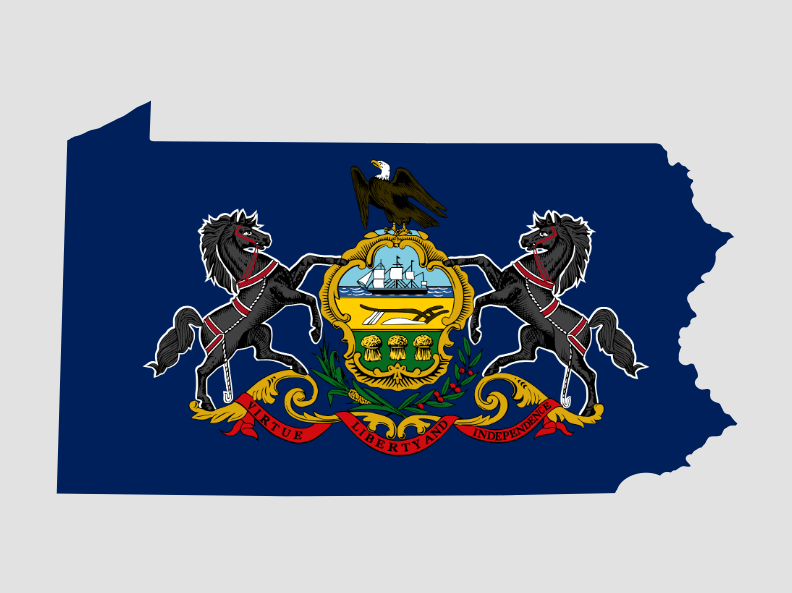
Pennsylvania is a state in the northeastern region of the United States with the abbreviation of PA. Pennsylvania became the 2nd state on December 12, 1787, making the state 238 years old, as of December, 2025. Pennsylvania is named after William Penn, which makes Pennsylvania the only state to be named after its founder. Penn wanted to name his colony Sylvania (which is derived from the Latin word silva, meaning forest)in honor of its extensive forests, but it was eventually named by combining Penn and Sylvania — this causes the name Pennsylvania to have the meaning Penn’s Forest.
Pennsylvania is the 33rd largest state and the 5th most populous; the capital of Pennsylvania is Harrisburg and its demonym is Pennsylvanian. Pennsylvania is bordered by Lake Erie and the states of New York, New Jersey, Delaware, Maryland, West Virginia, and Ohio. Pennsylvania is one the thirteen original states and one of four states to legally define themselves as a commonwealth and not a state.
The motto of Pennsylvania is Virtue, Liberty, and Independence.
The nickname of Pennsylvania is The Keystone State, which references the fact that Pennsylvania was the middle colony of the thirteen colonies and the fact that Pennsylvania has held a key economic, social, and political position in the United States since our founding — the Declaration of Independence and the Constitution were written and signed in Pennsylvania and several Founding Fathers came from Pennsylvania, such as Benjamin Franklin and Thomas Mifflin.
More than half of Pennsylvania’s land is covered in forest; Pennsylvania’s landscape ranges from rolling hills, to deep valleys, to the Appalachian mountains.
Pennsylvania is known for the Philly cheesesteak, for being the birthplace of Hershey’s, for being home to the Liberty Bell and Independence Hall (where the Declaration of Independence was signed), and for being the state in which the infamous battle of Gettysburg occurred. The land of Pennsylvania possesses metals such as iron, zinc, lead, nickel, copper, and chromium.
On November 14, 1765, Robert Fulton was born in Little Britain Township, Lancaster County, in the British province of Pennsylvania. Early in his life, Fulton expressed interest in engineering, and it was around the year 1777, when Fulton was 12 years old, that he became interested in the idea of using steam engines to power boats. In early July, 1778, Fulton intended to light candles in his home to celebrate the second anniversary of the United States’ independence, but due to the scarcity of candles, it was requested that the citizens of Lancaster did not light candles to celebrate Independence Day. Therefore, Fulton took his candles back to the store and exchanged them for gunpowder; Fulton used this gunpowder to make fireworks, which he fired off in the streets of Lancaster, Pennsylvania, on July 4, 1778. Fulton later moved to Philadelphia, where he painted portraits and landscapes and drew houses and machinery, which earned him money to send back home to help support his mother. Fulton eventually bought a farm in Hopewell Township, Washington County (near Pittsburgh) for £80 — the equivalent to nearly $18,000 today — where he moved his mother and family. In the late 1780s, Fulton moved to Europe, where he resided for twenty years. While in Europe, Fulton developed the first naval torpedoes and he was even commissioned by Napoleon Bonaparte to produce history’s first practical submarine. In the year 1807, shortly after returning to the United States, Fulton designed the first successful commercial steamboat, which carried passengers 300 miles from New York City to Albany and back in 62 hours. In early 1815, Fulton was walking with a friend, Thomas Addis Emmet, on the frozen Hudson River when Emmet fell through the ice. Fulton was soaked with icy water after rescuing Emmet, which is believed to have led to Fulton’s contracting pneumonia; soon after, Fulton succumbed to consumption (tuberculosis). In 1844, the portion of Little Britain Township in which Fulton was born was broken off and established as Fulton Township in honor of Robert Fulton.
After the second world war began, the United States Army put a call out for an all-purpose, all-terrain four-wheel vehicle. The company to answer the call was the American Bantam Car Company from Butler, Pennsylvania. This vehicle was tested by then-Colonel and future president Dwight D. Eisenhower; after the testing phase was completed, this vehicle was mass produced and used extensively throughout the war. The vehicle was marked with the letter G (indicating a government contract vehicle) and P (indicating its 80” wheelbase). The GP was rarely called by its name as troops corrupted its name, instead calling it the Jeep.
Throughout the 1740s and 1750s, troops occupying French colonies in North America became more aggressive in their attempts to expel British colonists in the area surrounding the Ohio River. In May of 1754, British colonial forces under the command of 22-year-old British Lieutenant Colonel George Washington were sent to protect a fort that was under construction near the present-day cities of Hopwood and Farmington, Pennsylvania, after the French had driven off the crew that was constructing the fort. The French sent a commander by the name of Joseph Coulon de Jumonville to warn Washington that he was encroaching on land claimed by New France, but Washington was alerted that Jumonville was on his way by Tanacharison, an American Indian ally. On the 28th of May, Washington’s troops ambushed the French camp and killed Jumonville and killed or captured most of Jumonville’s troops. This battle, which is known as the Battle of Jumonville Glen, resulted in a British-Colonial Victory. Jumonville Glen was the first battle of the French and Indian War and the first battle in which George Washington served.
An interesting fact about Pennsylvania is that it is often believed that the first national flag of the United States to feature stars and stripes — the Betsy Ross flag — was sewn in Philadelphia in the spring of 1776 (250 years ago this spring!) The flag was named after Betsy Ross, a seamstress who is credited with being the first to sew the flag which became the national flag of the United States on June 14, 1777.
A strange fact about Pennsylvania is that, due to the fact that so many sports players left to serve in World War II, the Philadelphia Eagles and the Pittsburgh Steelers merged for the 1943 season to form the Steagles.
What fact about Pennsylvania most interests you?
Onward American 🇺🇸
Source: Origins of State Names
Source: Demonyms for US States
Source: Robert Fulton, Inventor of the Steamboat
Source: Inventions of Pennsylvania
Source: How the Jeep Got Its Name
Source: The Battle of Jumonville Glen

