
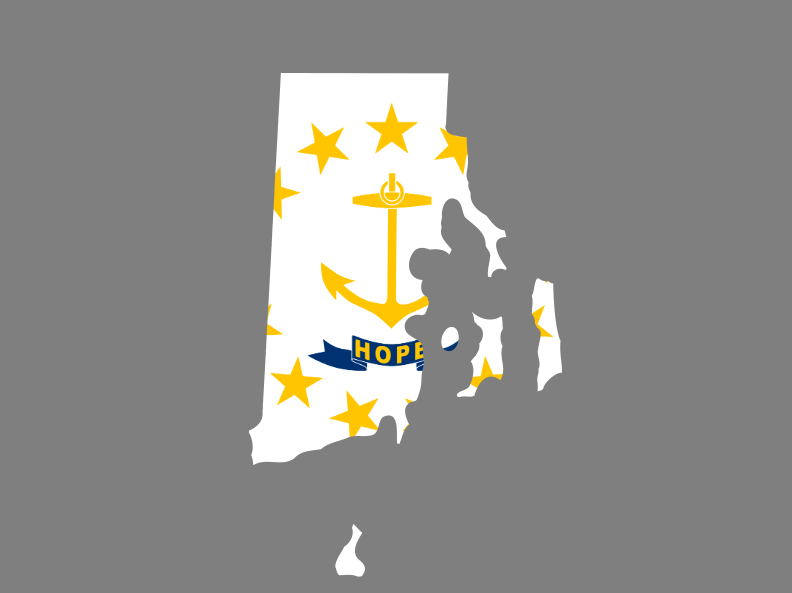
Rhode Island is a state in the northeastern region of the United States with the abbreviation of RI. Rhode Island became the 13th state on May 29, 1790, making the state 236 years old, as of May, 2026. In 1614, Dutch navigator Adrian Block (after whom Block Island is named) explored this land and, likely after seeing the red clay along its shores, named the land Roode Eylandt, which is Dutch for red island. The name was later anglicized to Rhode Island.
Rhode Island is the smallest largest state and the 44th most populous; the capital of Rhode Island is Providence and its demonym is Rhode Islander. Rhode Island is bordered by the states of New York (over water), Connecticut, and Massachusetts, and the Atlantic Ocean. Rhode Island is one of the thirteen original states. Rhode Island is a state whose full name is rarely used; in 1636, the colony of Rhode Island and Providence Plantations was established, and in 1776, the colony officially became the state of Rhode Island and Providence Plantations.
The motto of Rhode Island is Hope.
The official nickname of Rhode Island is the Ocean State, due to the fact that the state has lots of shoreline (400 miles) relative to its small size (1,045 square miles).
The landscape of Rhode Island is covered in coastal lowlands, rocky hills, and forests.
Rhode Island is known for its beaches, coastlines, and maritime history, for being one of the New England states, and for producing silverware and jewelry. Rhode Island’s land contains metals such as iron, nickel, lead, zinc, copper, and even some gold.
On August 7, 1742, Nathanael Greene was born on Forge Farm near Warwick, Rhode Island Colony. In the early 1770s, Greene became active in the opposition to the British and he even took part in establishing a state militia unit. After the War of Independence (Revolutionary War) began in 1775, the Rhode Island legislature established an army and appointed Greene to command it, and soon after, Greene became a general in the Continental Army. Greene served under George Washington during the Boston Campaign, New York and New Jersey Campaign, and the Philadelphia Campaign. Greene was then appointed quartermaster general of the Continental Army in 1778, and by late 1780, Washington even appointed Greene the commander of the Continental Army in the southern theater, where Greene engaged in the successful campaign of guerrilla warfare against British General Charles Cornwallis in Virginia, Georgia, and South Carolina. After the end of the war in 1783, Greene moved to Georgia, where he became a plantation owner. Sadly, in 1786, at the age of 43, Greene passed away due to heatstroke in Chatham County, Georgia; numerous places in the United States have since been named Greene in honor of the man who was considered Washington’s most gifted officer.
In 1872, Walter Scott of Providence, Rhode Island, invented a horse-drawn lunch wagon that he would park outside newspaper offices in order to provide the employees with quick and affordable meals. During the 20th century, these so-called lunch cars became small, stationary buildings. As time went on, these businesses began offering more home-style meals geared toward families, and they even embraced the art deco and then midcentury modern styles of the time. These establishments that Scott invented would come to be known as diners.
On August 29, 1778, the Battle of Rhode Island occurred in, well… Rhode Island; more specifically, Aquidneck Island. In December of 1776, British Lieutenant General Henry Clinton and Brigadier General Richard Prescott landed in Rhode Island and seized the city of Newport. Two years later, Continental Army forces under the command of Major General John Sullivan and Major General Nathanael Greene were sent to Rhode Island where they held the British troops in Newport under siege. On August 29th, the American forces finally abandoned their siege and withdrew from the city, but with the support of the Royal Navy, the British sortied, meaning they left their defensive positions and pursued the retreating Americans. While the American troops left Aquidneck Island in the hand of the British, the American forces successfully escaped the attack without being annihilated. The battle may have had no clear winner, but it did mark the first time in the war that French and American forces attempted to fight together as allies.
An interesting fact about Rhode Island is that, despite the fact that Rhode Island was the last of the thirteen states to ratify the Constitution in 1790, Rhode Island was actually the first state to declare independence from Great Britain, which it did on May 4, 1776, exactly two months before the Declaration of Independence was signed.
A strange fact about Rhode Island is that the first jail sentence given for speeding happened in Rhode Island. On August 28, 1904, the very reckless man was caught speeding through the streets of Newport, Rhode Island, at the breakneck speed of 15 miles per hour! Rest assured, that foolhardy man spent five days in jail for the crime.
What fact about Rhode Island most interests you?
Onward American 🇺🇸
Source: Origins of State Names
Source: Demonyms for US States
Source: The History of the Diner
Source: The Battle of Rhode Island

