
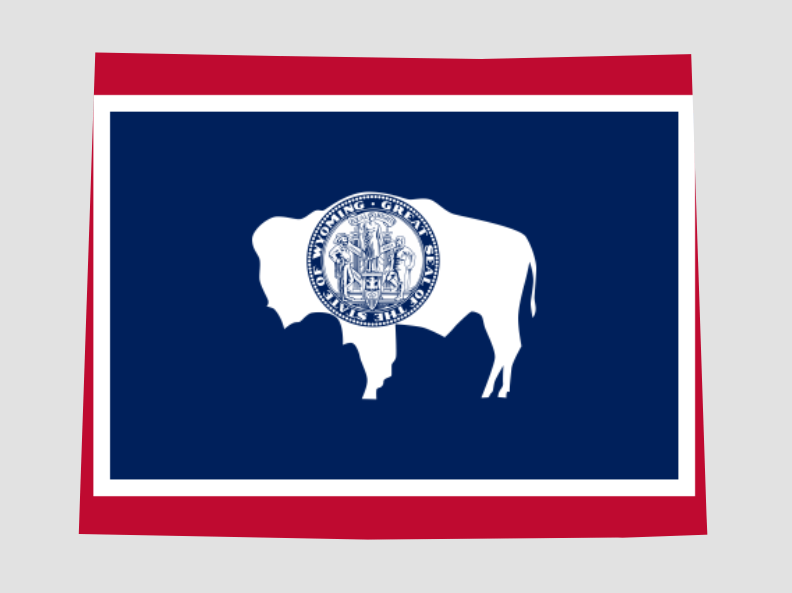
Wyoming is a state in the western region of the United States with the abbreviation of WY. Wyoming became the 44th state on July 10th, 1890, making the state 136 years old, as of July, 2026. The state of Wyoming was named after the Wyoming Valley in northeastern Pennsylvania, whose name is believed by some to have come from the Delaware or Leni-Lenape word maugh-wau-wama, meaning extensive plains, while others say the name means mountains with valleys alternating.
Wyoming is the 10th largest state and the least populous; the capital of Wyoming is Cheyenne and its demonym is Wyomingite. Wyoming is bordered by the states of South Dakota, Nebraska, Colorado, Utah, Idaho, and Montana.
The motto of Wyoming is Equal Rights.
The nickname of Wyoming is the Equality State, which refers to the fact that Wyoming was the first state to allow women to vote (in order to have a large enough voting population to meet the requirement for statehood) and the fact that Wyoming was the first state to have a female governor. Wyoming is sometimes called the Cowboy State, which refers to the state’s official registered trademark that features a cowboy on a bucking horse.
The landscape of Wyoming is covered in shrublands, high-elevation grasslands, rugged mountains, conifer forests, and deep gorges and canyons.
Wyoming is known for Devils Tower, for its wide-open plains, for producing more coal than any other state, and for being home to Yellowstone National Park — the first national park. Wyoming contains many metals such as iron, nickel, copper, gold, platinum, palladium, rare earth elements, and uranium, in fact, Wyoming has the United States’ largest reserve of uranium.
On December 28th, 1865, Edward Lee Baker Jr. was born in Laramie County, Dakota Territory, which is now in the state of Wyoming. In 1882, at the age of 16, Baker enlisted in the 9th Cavalry Regiment, and before his enlistment expired, Baker was promoted to trumpeter. In late August of 1887, Baker re-enlisted in the 10th Cavalry Regiment, where he attained the positions of chief trumpeter and quartermaster sergeant; Baker later became the highest ranking enlisted man in his regiment when he was promoted to sergeant major. In 1898, Baker fought in the Battle of San Juan Hill in Cuba, which was a major battle during the Spanish-American War; during this battle, Baker distinguished himself when he rescued a wounded soldier from drowning while under fire — a deed for which he would receive the medal of honor. Baker was mustered out of service in early 1899, and later that year, he was promoted to captain of the 49th US Volunteer Infantry. In 1902, Baker was commissioned as second lieutenant with the Philippine Scouts, and was eventually promoted to captain in 1908. In late 1909, Baker resigned from the army after 27 years of service — at the time of his retirement, Baker was one of the highest ranking African-American officers in the US Army. Sadly, on August 26, 1913, Baker passed away in Los Angeles, California; he was just 47 years old. Baker is also notable for being the grandfather of jazz saxophonist Dexter Gordon.
In 1867, the first US patent to be granted in Wyoming was granted to Colonel Anson Mills for his improved cartridge belt. In 1877, Mills perfected his design which was now a belt with cartridge loops that was a single piece of woven canvas web produced on a single milling loom. This technique greatly saved on time and materials during the production of cartridge belts. In 1880, the US military contracted Mills’ canvas web belt design.
Between April 11th and 13th, 1892, the Siege of the TA Ranch occurred in Johnson County, Wyoming. Large ranchers in the county, known as cattle barons, were competing with homesteaders for limited land, water, and cattle in Wyoming. The cattle barons attempted to monopolize the limited resources, but this was challenged by the homesteaders who were small, independent farmers and ranchers. Cattle barons began lynching and assassinating anyone whom they suspected of being a thief or competition. The homesteaders united under the leadership and protection of cowboy and rancher Nate Champion. The cattle barons finally made an attempt to exterminate the homesteaders by hiring 23 gunmen from Texas; soon after, the gunmen killed Nate Champion during the infamous Battle of KC Ranch. After the cattle barons failed to kill homesteader Jack Flagg, Flagg warned Sheriff William “Red” Angus about the invading cattle barons. Sheriff Angus then formed a posse of 200 men and brought them to TA Ranch, where the cattle barons were last spotted. When the posse arrived at TA Ranch, the cattle barons began firing from doors, windows, and makeshift gunports in the walls, after which the posse returned fire. The ensuing siege lasted for three days, however, many members of the posse were Civil War veterans who knew how to properly conduct a siege. The posse killed the cattle barons’ horses and cattle, and they even built trenches. Well-equipped and well-armed, the posse managed to inflict several casualties on the cattle barons over the next few days while suffering zero casualties themselves. The siege finally ended when Governor Barber and President Benjamin Harrison sent the 6th Cavalry from Fort McKinney. The cavalry negotiated with Angus and took custody of the cattle barons. Skirmishes would continue until 1893, however, most of the cattle barons left the area and no longer bothered the homesteaders.
An interesting fact about Wyoming is that the state is home to fewer escalators than any other state. Reportedly, Wyoming only has 2 escalators within its boundaries, both of which are located in the city of Casper.
A strange fact about Wyoming is that part of the state used to belong to Texas. When Texas first joined the Union, it was much larger than it is today, however, during the Compromise of 1850, Texas yielded its northwestern land to the US government in exchange for the government’s paying off Texas’ public debt. The northernmost portion of Texas’ former claim reached as far north as southern Wyoming, and if Texas had maintained its former borders, the city of Rawlins, Wyoming, would technically be in Texas.
What fact about Wyoming most interests you?
Onward American 🇺🇸
Source: Origins of State Names

