
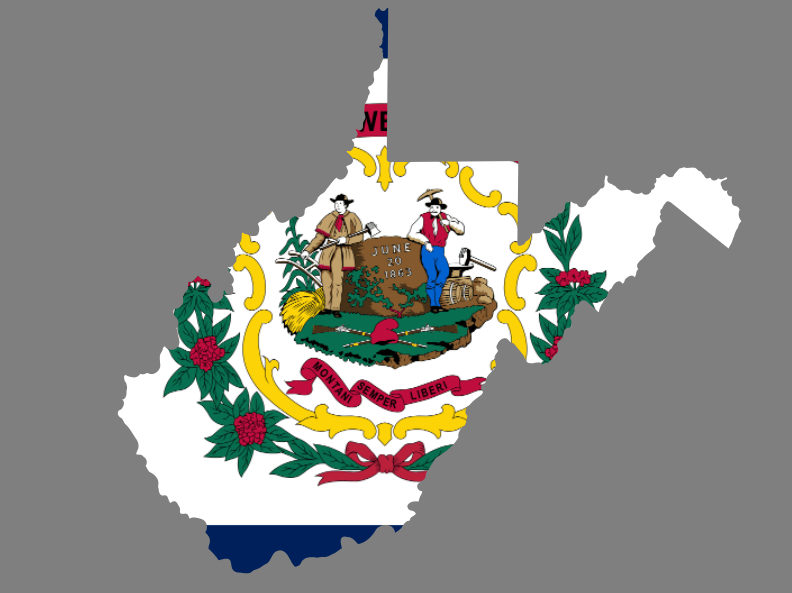
West Virginia is a state in the southern region of the United States with the abbreviation of WV. West Virginia became the 35th state on June 20th, 1863, making the state 163 years old, as of June, 2026. West Virginia was given its name because it was the western portion of the state of Virginia, but it broke away from Virginia a couple years after Virginia succeeded from the Union and it was readmitted as the new state of West Virginia.
West Virginia is the 41st largest state and the 39th most populous; the capital of West Virginia is Charleston and its demonym is West Virginian. West Virginia is bordered by the states of Maryland, Virginia, Kentucky, Ohio, and Pennsylvania.
The motto of West Virginia is Montani Semper Liberi, which is Latin for Mountaineers are Always Free.
The official nickname of West Virginia is the Mountain State, which was given to the state because it is the only state located entirely within the Appalachian Mountain region.
The landscape of West Virginia contains rolling hills, rugged mountains, dense forests, and the Cumberland and Allegheny Plateaus.
West Virginia is known for its natural beauty, its scenic mountains, its history of coal mining, for being the site where abolitionist John Brown raided Harpers Ferry, and for its traditional bluegrass and Appalachian folk music. The land of West Virginia possesses metals such as iron, aluminum, manganese, and rare earth elements, including scandium, yttrium, lanthanum, neodymium, terbium, and europium.
On October 2, 1923, Hershel Woodrow Williams was born in Quiet Dell, Harrison County, West Virginia, as the youngest of 11 children. Williams weighed only three and a half pounds at birth and was not expected to live, however, Williams would survive. Williams was raised on the family’s dairy farm, but tragically, when he was only 11, his father died of a heart attack and several of his siblings died from the flu. Williams took on several odd jobs around the area, but when the Japanese attacked Pear Harbor in 1941, he decided to join the military. Williams knew very little about the US Marine Corps, but after seeing men around town wearing the Army’s brown wool uniform and the Marine Corps’ dress blues, he was drawn to the appearance of the dress blues, saying the Army’s uniform was “…the ugliest thing in town… I decided I did not want to be in that thing. I want to be in those dress blues.” Standing at just 5’6”, Williams was told he was too short when he tried to enlist in the Marine Corps, but when they lowered their height regulations a couple years later, Williams successfully enlisted in the Marine Corps Reserve in Charleston, West Virginia. In 1944, Williams joined Company C, 1st Battalion, 21st Marine Regiment, 3rd Marine Division at Guadalcanal. In August of that year, he participated in the battle of Guam. In early 1945, Williams served during the vicious battle of Iwo Jima. A couple days into the battle, Williams landed on the beach of Iwo Jima; two days later, American tanks were attempting to open a lane through which infantry might advance when they encountered a network of reinforced concrete pillboxes manned by Japanese machine-gunners. The American soldiers were pinned down by enemy gunfire when the company commander asked one of the men to attack a pillbox with a high explosive charge on a pole, supported by several riflemen and Williams with his flamethrower. During the attack, all of the men were either killed or wounded, except Williams. Despite this, Williams continued the attack, and when he reached the pillbox, he shoved the nozzle of his flamethrower in the opening through which the enemy was firing and pulled the trigger, killing all the enemy soldiers inside. Williams returned to his company to refuel and launched an attack five more times, eliminating the remaining pillboxes. Throughout the day, Williams continually returned to friendly lines to prepare demolition charges and obtain new flamethrowers and then clear out enemy bunkers. While Williams was clearing out enemy bunkers, other marines on Mount Suribachi 1,000 yards away famously raised the US flag over the mountain, which Williams watched as it happened. Williams continued fighting for several more weeks even though he was wounded in the leg; of the more than 300 American flamethrower operators on Iwo Jima, Williams was one of the fewer than 20 to survive. Williams returned to the United States in September of 1945, and on October 5th, he was presented with the Medal of Honor by President Harry Truman at the White House. After the war, Williams joined the Organized Marine Reserve, reaching the rank of Chief Warrant Officer 4; he also served as the veterans service representative in the US Department of Veteran Affairs. In early 2018, Williams was one of the 14 Medal of Honor recipients honored at the Super Bowl LII coin toss, and in 2021, he attended his great-grandson’s graduation from the US Marine Corps boot camp, giving him advice “to do the very best he could and then to do a little more.” Sadly, on June 29th, 2022, Williams passed away in Huntington, West Virginia, at the age of 98 — he was the last surviving Medal of Honor recipient from World War II.
In 1870, the world’s first brick road was constructed on Summers Street in Charleston, West Virginia. Though it takes significantly more money and labor to construct a brick road than it does to construct an asphalt road, a brick road will typically last much longer and will not form potholes. Summers Street has since been covered with asphalt, however, there are still historic brick streets across the United States.
On October 10th, 1774, the Battle of Point Pleasant occurred in Point Pleasant, Virginia Colony, which is now Point Pleasant, West Virginia. Virginia colonel Andrew Lewis and 1,000 militiamen were sent to invade the Ohio River Valley and defend Virginia’s claim to the area. Several hundred Shawnee warriors under the command of Cornstalk attacked Lewis’ camp. After several hours, the fighting became brutal hand-to-hand combat. The Virginians eventually sent a few companies to attack the rear of the Shawnee, which weakened their attack, and after a flanking maneuver, Cornstock’s men began to retreat. Cornstock and his men withdrew back across the Ohio River at nightfall, leaving the Virginians victorious. Shortly after the battle, Cornstock was forced to cede his claim of the land south of the Ohio River to Virginia. This was the only major conflict of Dunmore’s War.
An interesting fact about West Virginia is that it is the only state to have entered the Union by a presidential proclamation. On April 20, 1863, president Abraham Lincoln issued a proclamation that declared that the act of Congress which approved the state of West Virginia would take effect 60 days from the date of the proclamation, making June 20th, 1863, the day that West Virginia officially joined the Union.
A strange fact about West Virginia is that Cecil Underwood served as the state’s youngest governor, yet he was the state’s oldest governor. Underwood was elected as West Virginia’s 25th governor in 1957 at the age of 34, serving until 1961. Underwood was elected again 40 years later as the state’s 32nd governor in 1997 at the age of 74, serving until 2001.
What fact about West Virginia most interests you?
Onward American 🇺🇸
Source: Origins of State Names
Source: Demonyms for US States
Source: Battle of Point Pleasant
Source: List of West Virginia Governors
Source: President Lincoln’s Proclamation Establishing West Virginia

