
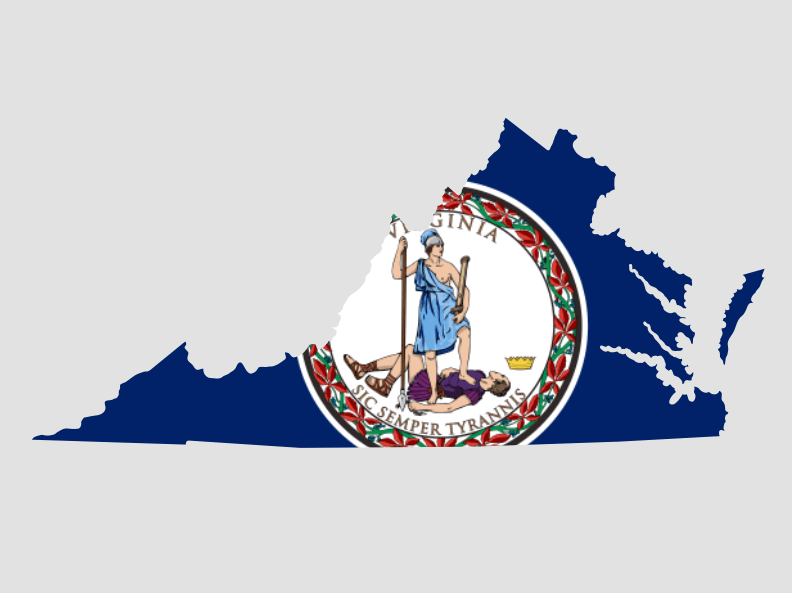
Virginia is a state in the southern region of the United States with the abbreviation of VA. Virginia became the 10th state on June 25, 1788, making the state 238 years old, as of June, 2026. Virginia acquired its name during its colonial days, when Sir Walter Raleigh named the colony after queen Elizabeth I, who was known as the Virgin Queen.
Virginia is the 35th largest state and the 12th most populous; the capital of Virginia is Richmond and its demonym is Virginian. Virginia is bordered by the states of North Carolina, Tennessee, Kentucky, West Virginia, and Maryland, as well as the Atlantic Ocean. Virginia is one of four states that legally classify themselves as a commonwealth and not a state.
The motto of Virginia is Sic Semper Tyrannis, which is Latin for Thus Always to Tyrants, which refers to the Virginia state seal that depicts the Roman goddess Virtus standing over a fallen tyrant.
The nickname of Virginia is the Old Dominion State, which was given to the state by king Charles II after the colony of Virginia remained loyal to the crown during the English Civil War.
The landscape of Virginia ranges from coastal lowlands and tidal marshes in the east to hills, mountains, ridges, and valleys in the west.
Virginia is known for being the first state to ratify the Articles of Confederation, for being the birthplace of more presidents than any other state, for being the place where the first successful English colony was established, for Colonial Williamsburg, and for playing a large role in the War for Independence, War of 1812, and Civil War. Virginia possess many useful metals such as iron, lead, copper, nickel, zinc, titanium, manganese, silver, and gold.
On February 22nd, 1732, George Washington was born in Popes Creek, Westmoreland County, Virginia Colony. Washington had five siblings and four half-siblings; when Washington’s father passed away in 1743, Washington inherited his father’s Ferry Farm near Fredericksburg, Virginia. Washington’s half-brother inherited Little Hunting Creek, which was renamed Mount Vernon, which Washington often visited along with the plantation of William Fairfax, who was Washington’s half-brother’s father-in-law. Fairfax became Washington’s surrogate father, and when Washington was 17 years old, Fairfax’s cousin appointed Washington the surveyor of Culpeper County, Virginia. A couple years later, Washington’s half-brother died, after which Washington leased Mont Vernon from his widow until he inherited it from her upon her death in 1761. Washington’s half-brother had inspired him to join the Virginia militia, and in 1752, Washington was appointed an officer in the Virginia militia, where he commanded one of the four militia districts. In the 1750s, Washington fought during several battles of the French and Indian War, including the opening battle and the Battle of Monogahela — during the latter battle, a column of British troops were attacked by French regulars and Indian warriors in a forest, and after several hours of attempting to withstand the attack, the British officer in command, Major General Braddock, was killed and the British troops began a disorderly retreat; though he was not in the chain of command, 23-year-old George Washington assumed command and brought order to the retreat and even formed a rear guard, which allowed the remaining troops to escape the attack. Though 4 bullets had struck Washington’s coat, he miraculously survived the battle unscathed, writing in his July 18th, 1755, letter “…by the All-powerful Dispensations of Providence, I have been protected beyond all human probability or expectation; for I had four Bullets through my Coat, and two Horses shot under me; yet escaped unhurt, although Death was leveling my Companions on every side of me!” After the war, Washington married Martha Custis and they lived at Mount Vernon. Washington was elected to several local offices in Virginia and became known for his opposition to the British taxation policies, and when tensions rose in 1774, he was appointed a delegate to the First Continental Congress. Once war broke out in 1775, Washington quickly joined the Second Continental Congress, and in June of 1775, Congress unanimously elected Washington as the commander-in-chief of the newly-formed Continental Army; upon accepting the position, Washington declined a salary. Washington lead the army throughout the War of Independence, including the Siege of Boston, the Battle of Long Island, the crossing of the Delaware River and the Battle of Trenton, the winter at Valley Forge, and the Battle of Yorktown. After the war ended and the British finally recognized American independence in 1783, Washington bade farewell to his men and returned home to Mount Vernon, where he was met with financial struggles and poor crop yields. In 1788, Washington was unanimously elected president of the United States by all 10 of the 13 states that cast votes during that election, and in 1792, Washington was reelected unanimously by all 15 states. During his presidency, Washington refused to get the United States involved in a war between England and France; signed the states of Vermont, Kentucky, and Tennessee into statehood; and even led troops to quell the Whiskey Rebellion. At the end of his second term in 1797, Washington retired once again to Mount Vernon, but he would only enjoy this final retirement for 2 years. In December of 1799, Washington was inspecting his farms in inclement weather and did not change into dry clothes while dining that evening, and shortly after, he began experiencing cold symptoms. Doctors began to treat Washington, but on December 14th, 1799, after several doses of calomel (a mercury-containing salt) and extensive bloodletting, George Washington sadly passed away at the age of 67 just after speaking his last words: “ ’Tis well.”
While Patrick Henry may not have invented a material thing, it could be said that Henry invented, or perhaps inspired, the American spirit of fighting for freedom. In March of 1775, about a month before the Revolutionary War began, Henry gave his famous speech at St. John’s Church in Richmond, Virginia, urging Americans to be prepared to fight for their liberties, and stating “…We must fight!” The most well-known portion of Henry’s speech is his closing statement: “It is in vain, sir, to extenuate the matter. Gentlemen may cry, Peace, Peace— but there is no peace. The war is actually begun! The next gale that sweeps from the north will bring to our ears the clash of resounding arms! Our brethren are already in the field! Why stand we here idle? What is it that gentlemen wish? What would they have? Is life so dear, or peace so sweet, as to be purchased at the price of chains and slavery? Forbid it, Almighty God! I know not what course others may take; but as for me, give me liberty or give me death!”
Between September 28th and October 19th, 1781, the Siege of Yorktown occurred in Yorktown, Virginia. British general Henry Clinton had given General Charles Cornwallis some confusing orders, but later ordered Cornwallis to build a defensible port, which Cornwallis did in Yorktown. French and American forces then began moving from New York toward Virginia, which caused the British to falsely believe that a siege would occur in New York. A French fleet arrived at Yorktown and formed a blockade, which denied Cornwallis any chance of reinforcement or retreat by sea. In late September, Washington landed near Yorktown and brought his troops near the British fortifications. The Americans and French bombarded the first line of British defense until it was weakened, then they stormed and captured the line. The allied artillery was moved near this line, and because the artillery was now much closer to Yorktown, the following bombardment was significantly more destructive. Cornwallis finally realized that his situation was hopeless and sent out an officer waving a white handkerchief to discuss the terms of surrender. The British requested the traditional honors of war, which would allow the British army to march out with their flags flying, bayonets fixed, and their band playing an American tune as a tribute to the ones who defeated them, but Washington refused to grant them those honors because the British previously denied the defeated Americans the honors at the Siege of Charleston, therefore the British were forced to march with their flags furled while playing a British tune — some claim that they played the song The World Turn’d Upside Down. Cornwallis claimed to be ill and refused to attend the surrender ceremony, instead sending General O’Hara to surrender his sword. Because the British viewed Washington and his troops as rebels and not a legitimate army, O’Hara marched to French general Rochambeau and offered Cornwallis’ sword, but Rochambeau shook his head and pointed to Washington (some believe the French played Yankee Doodle at this point to humiliate the British); O’Hara then offered the sword to Washington, but Washington also refused the sword and pointed to his second-in-command, Benjamin Lincoln. O’Hara finally surrendered the sword to Lincoln. The British soldiers marched out and laid down then arms between the Americans and French. Some British soldiers wept; some threw down their muskets attempting to destroy them; and an American drummer boy, Alexander Millener, recalled that one of the British soldiers angrily threw his musket down, swore, and shouted “you are not going to have my gun!” Thousands of muskets, hundreds of artillery pieces, dozens of ships and wagons, and more than 7,000 British and Hessian soldiers were captured. The Americans invited the British officers to a dinner to celebrate the victory, however, the infamous British lieutenant colonel Banastre Tarleton was not invited because of the atrocities he committed against the American troops and civilians. The Siege of Yorktown was the last major conflict of the American War of Independence and is considered to have effectively ended the war.
An interesting fact about Virginia is that, while no major wars started in Virginia, two major wars ended in Virginia. The War of Independence effectively ended in 1781 when British Lieutenant General Cornwallis surrendered to General George Washington (who later became president), and 84 years later, the Civil War effectively ended in 1865 when Confederate General Lee surrendered General Ulysses Grant (who later became president).
A strange fact about Virginia is that, not only does Virginia reach further east than West Virginia does, but Virginia also extends further west than West Virginia!
What fact about Virginia most interests you?
Onward American 🇺🇸
Source: Origins of State Names
Source: Demonyms for US States
Source: The Old Dominion State

