
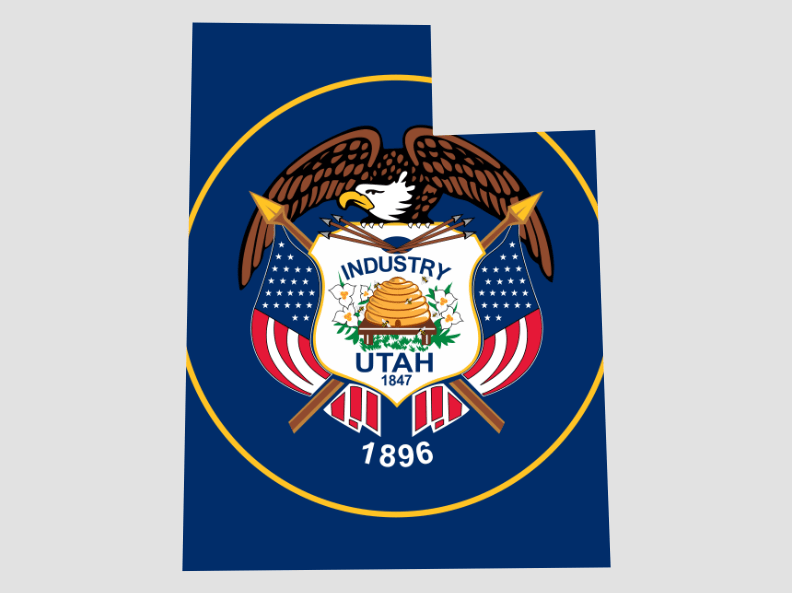
Utah is a state in the western region of the United States with the abbreviation of UT. Utah became the 45th state on January 4, 1896, making the state 130 years old, as of January, 2026. Utah’s name is derived from the Ute Indians, however, the meaning of the name is unknown.
Utah is the 13th largest state and the 30th most populous; the capital of Utah is Salt Lake City and its demonym is Utahn. Utah is bordered by the states of Wyoming, Colorado, New Mexico, Arizona, Nevada, and Idaho.
The motto of Utah is Industry.
The official nickname of Utah is the Beehive State; the beehive was chosen as the symbol of hard work and industry.
The landscape of Utah ranges from the salt flats, to snowy mountains, to high-desert basins and ruddy canyons.
Utah is known for the Great Salt Lake, its popular ski resorts, its five national parks, and for being the site where the first transcontinental railroad was completed. The land of Utah contains many metals such as iron, lead, zinc, magnesium, copper, silver, gold, beryllium, molybdenum, vanadium, uranium, and some rare earth elements.
On January 23, 1855, John Moses Browning was born in Ogden, Utah Territory. At the age of 13, Browning designed his first firearm in his father’s gun shop; Browning was awarded with his first firearm patent on October 7, 1879, at the age of 24 — he would accumulate 128 firearm patents throughout his life. Browning became a renowned firearms designer, and many of his cartridges (such as the .25 ACP, .45 ACP, and .50 BMG) and firearms (such as the M1911, Winchester Model 1897, and M1918 Browning Automatic Rifle “BAR”) are still in production today. Browning’s firearms were used extensively by the United States military throughout many major conflicts: the M1895 Machine Gun was used in the Spanish-American War; the M1911 and BAR were used in WWI, WWII, and the Korean War; and the M1911 also served as the US standard military side arm from 1911 to 1986. In 1926, at the age of 71, John Browning was working at the Fabrique Nationale (FN) gun shop in Liège, Belgium, tinkering with a design that would become the Browning Hi-Power when, sadly, he suddenly died of heart failure. Browning was survived by 8 of his 10 children, one of which was Val Browning, who served as a First Lieutenant in WWI and took on John Browning’s firearm company after his death.
In 1912, a police officer of Salt Lake City named Lester Wire invented the first electric traffic light. The traffic light had a red light and a green light, to indicate whether traffic should stop or go, and a buzzer to warn motorists when the light was about to change.
In June of 1862, the Morrisite War occurred near South Weber, Utah Territory. Joseph Morris, who had recently converted to the Church of the Latter-Day Saints, had claimed that he received a revelation stating he was the seventh angel from the book of Revelations, but was soon after excommunicated from the church. Morris then formed his own sect of the Latter-Day Saints, which were known as the Morrisites, and gathered hundreds of followers in the abandoned Kington Fort. Morris told his followers that the Second Coming was about to occur and that they should not bother planting crops. Several months later, most of their food had been consumed, and Morris had claimed numerous times that the Second Coming would occur on a specific day, just for the day to pass uneventfully. This caused many of his followers to leave; at one point, Morris captured three followers who left, holding them prisoner in a cabin, but the wives of the prisoners contacted the territorial government for help. Once the news reached John Kinney, who had been appointed as chief justice of Utah Territory by US President James Buchanan, Kinney issued a habeas corpus that commanded the release of the prisoners. The Morrisites refused this order, and after refusing a second order weeks later, Kinney acquired the assistance of the Utah territorial militia. Kinney and his forces eventually ordered the Morrisites to surrender within thirty minutes, but Morris promised his followers that the troops would be destroyed. Once thirty minutes were up, two cannons were fired as a warning, but one of the cannon balls ricocheted and crashed into the fort, killing two. The Morrisites fired back, killing a 19-year-old among Kinney’s forces. A couple days later, a group of militia under the command of deputy marshal Robert Burton rode into the fort, at which point Morris approached Burton in what appeared to be a threatening manner, causing Burton to fatally shoot Morris. A melee ensued, in which several more Morrisites were killed; 90 Morrisites were taken prisoner and brought to Salt Lake City to stand trial. The battle, which was part of the Mormon Wars, resulted in a Utah Territorial victory.
An interesting fact about Utah is that most outright land speed records were set in the Bonneville Salt Flats in Utah. The fastest land speed recorded in the salt flats was achieved by Gary Gabelich in 1970 at 630 MPH! Interestingly, land speed records were not the only type of records broken here, because in 1964, Craig Breedlove reached 526 MPH, but then his parachute breaks failed and he crashed into a row of telephone poles then crashed into a brine pond at 200 MPH, leaving a world-record skid mark stretching nearly 6 miles! Breedlove exited the wreckage uninjured.
A strange fact about Utah is that, though Colonel Sanders first sold his fried chicken in Kentucky, the first Kentucky Fried Chicken restaurant was opened in South Salt Lake, Utah.
What fact about Utah most interests you?
Onward American 🇺🇸
Source: Origins of State Names
Source: Demonyms for US States

