
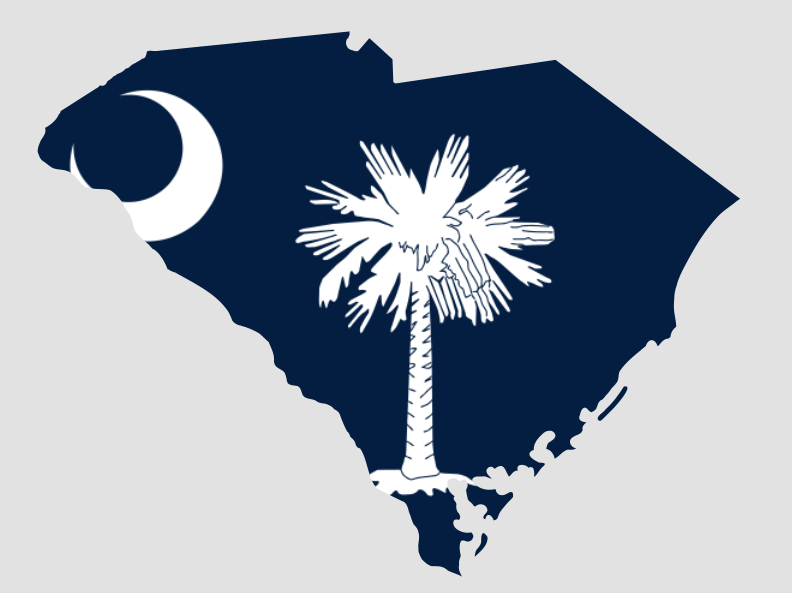
South Carolina is a state in the southern region of the United States with the abbreviation of SC. South Carolina became a state on May 23, 1788, making the state 238 years old, as of May, 2026. In 1663, an English colony in North America was established and named after King Charles I of England by using the Latin name for Charles (Carolus). This colony was originally called Carolana, but was later named Carolina. In 1712, the colony of Carolina was split into the colonies of North Carolina and South Carolina, which became the states of North Carolina and South Carolina in 1776.
South Carolina is the 40th largest state and the 23rd most populous; the capital of South Carolina is Columbia and its demonym is South Carolinian. South Carolina is bordered by the states of Georgia and North Carolina as well as the Atlantic Ocean. South Carolina is one of the thirteen original states.
South Carolina has two official mottos, which were both adopted 250 years ago, in the year 1776. South Carolina’s mottos are Dum Spiro Spero and Animis Opibusque Parati, which are Latin for While I Breathe, I hope and Ready in Soul and Resource, respectively. Fun fact, the latter motto (Animis Opibusque Parati) uses Latin’s fancy, optional -que enclitic that functions the same way the article and does between the two nouns; in short, the motto technically could also be written Animis et Opibus Parati.
The official nickname of South Carolina is the Palmetto State, which refers to South Carolina’s state tree. The palmetto was first featured on South Carolina’s flag in 1861, which the state called the national flag of South Carolina, as the state was the first to secede from the United States and attempt to form a new nation. The palmetto is still on the South Carolinian flag, it is also in the state’s seal and salute to the state flag, which reads “I salute the flag of South Carolina and pledge to the Palmetto State love, loyalty and faith.” Furthermore, Fort Moultrie was built from palmetto trunks, and the spongy structure of the palmetto trunks caused British cannonballs to deflect off the fort, shielding the Americans from the cannon fire and helping them to fend off the British.
The landscape of South Carolina features three distinct regions, which are the coastal plains on the Atlantic, the Piedmont region, and the Blue Ridge Mountains.
South Carolina is known for southern hospitality, its distinct cuisine, and its scenic coasts. The land of South Carolina contains metals such as lead, iron, nickel, cobalt, copper, silver, gold, titanium, and zirconium.
In the late 1600s, a Frenchman named Gabriel Marion moved to the British Province of South Carolina. Around the year 1732, Gabriel’s son, Francis, was born in Berkeley County. Just before his 25th birthday, Francis Marion was recruited to serve in the South Carolina Militia; Marion then served during the French and Indian War and the Anglo-Cherokee War. In the year 1775, Marion was commissioned as an officer in the Continental Army’s 2nd South Carolina Regiment, and he was promoted to lieutenant colonel in 1776. During the War of Independence (American Revolutionary War), Marion was involved in the defense of Charleston during the Siege of Charleston; Marion also led troops in many successful guerrilla campaigns against the British and Loyalists, during which he was known for ruthlessly terrorizing the enemy with sudden attacks and withdrawals — Marion even served under Major General Horatio Gates during the Battle of Camden. The British had managed to garrison many cities across South Carolina, however, when the British attempted to capture Williamsburg, they were driven out by Marion at the Battle of Black Mingo. The British made efforts to neutralize Marion’s forces, but their efforts were thwarted due to the overwhelming Patriot presence around Williamsburg. In late 1780, British Colonel Banastre Tarleton was sent to capture or kill Marion in order to put an end to this nuisance. Tarleton pursued Marion for more than 26 miles through a swamp, but failed to catch Marion, which frustrated Tarleton to the point where he supposedly said “as for this old fox, the Devil himself could not catch him.” This phrase, whether true or false, caused Marion to be given the nickname “the Swamp Fox.” After the war, Marion returned home to Pond Bluff. In the late 1780s, Marion served several terms in the South Carolina State Senate. Marion died in 1795 at the age of 63; still to this day, part of the military doctrine of the US Army 75th Ranger Regiment is based on Francis Marion’s guerrilla warfare tactics.
Sweet tea is certainly an iconic beverage of the south, but did you know that sweet tea was actually invented in Summerville, South Carolina? South Carolina is also home to the United States’ only working tea plantation in Charleston (if I had to guess, this is because the British firmly held Charleston toward the end of the Revolutionary War and Francis Marion was unable to destroy this tea plantation, or so I like to think).
On January 17, 1781, the Battle of Cowpens occurred near the town of Cowpens in Cherokee County, South Carolina. The Patriot forces in the northern colonies proved to be a much more formidable adversary than the British had previously anticipated, which frustrated the British attempt to regain control of New England. Believing that the Loyalist presence was much greater in the southern colonies, the British sent troops to the American south in order to divide American forces and rally Loyalists against the Patriots, however they were surprised to discover that the pro-Patriot sentiment was ever-increasing. On January 17, British Lieutenant Colonel Banastre Tarleton pursued American Brigadier General Daniel Morgan, and when Tarleton saw that Morgan had apparently made the mistake of placing his weak militia formation in the center with his regulars on the flanks, Tarleton eagerly attacked Morgan’s militia. As expected, the militia formation quickly collapsed, leaving the regulars exposed, however, when Tarleton pursued the retreating militia, he realized too late that this was all part of Morgan’s plan as Morgan had concealed regulars behind the terrain which now boxed in Tarleton’s forces. More than 85% of Tarleton’s forces had been killed, wounded, or captured, resulting in an American victory and the worst British defeat in North America since the Saratoga Campaign in 1777.
An interesting fact about South Carolina is that the very first European settlement in North America was located near Georgetown, South Carolina. This Spanish settlement, named San Miguel de Guadalupe, was founded by Lucas Vázquez de Ayllón in 1526. Though the colony only lasted three months, it was founded 59 years before the first British colony in North America, Roanoke, was founded; 94 years before the Pilgrims reached North America; and exactly 500 years ago this year!
A strange fact about South Carolina is that the state is apparently home to the world’s smallest police station, which can be found in Ridgeway, South Carolina. The 120-square-foot building was originally the town’s well house until it became the police station in 1940.
What fact about South Carolina most interests you?
Onward American 🇺🇸
Source: Origins of State Names
Source: Demonyms for US States
Source: 9 Things Invented in South Carolina

