
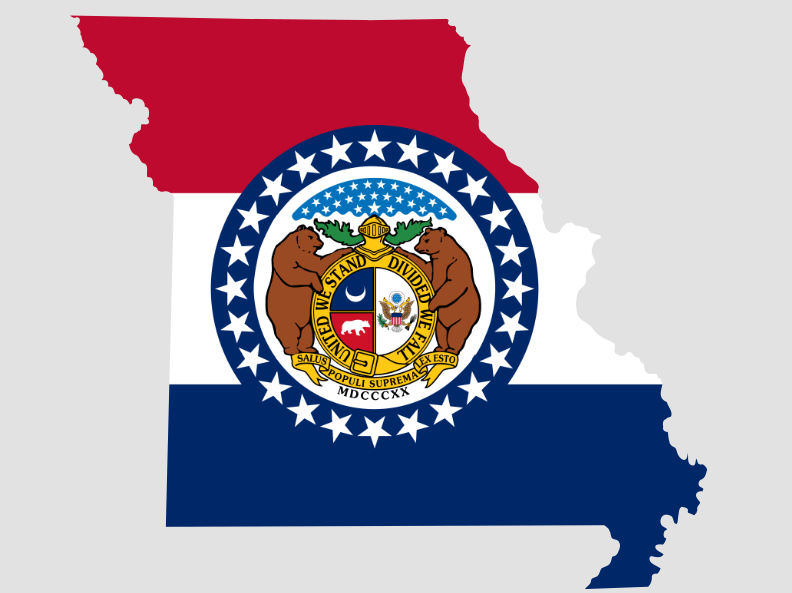
Missouri is a state in the midwestern region of the United States with the abbreviation MO. Missouri became the 24th state on August 10, 1821, making the state 203 years old, as of August, 2024. The state was named after the tribe of Sioux Indians called the Missouris, whose name meant muddy water, referring to the river of the same name.
Missouri is the 21st largest state and the 18th most populous; the capital of Missouri is Jefferson City and its demonym is Missourian. Missouri is tied with Tennessee for bordering more states than any other state; the 8 states that Missouri borders are Illinois, Kentucky, Tennessee, Arkansas, Oklahoma, Kansas, Nebraska, and Iowa.
The motto of Missouri is Salus Populi Suprema Lex Esto, which is Latin for Let the Good of the People be the Supreme Law.
Though Missouri does not have an official nickname, its common nickname is the Show-Me State. This nickname is often said to have come from Missouri’s former US Congressman Willard Vandiver, who, in 1899, said during a speech in Philadelphia “…I am from Missouri. You have got to show me.”
The landscape of Missouri has rolling hills, fertile plains, and well watered prairies north of the Missouri River, and south of the river, the state lies mostly in the Ozark Mountains.
Missouri is known for the Ozark Mountains, Lake of the Ozarks, the Gateway Arch, the National WWI Museum and Memorial, Onondaga State Park, Kansas City-style barbecue, Mark Twain, and Harry S Truman. Missouri’s land also possesses metals such as copper, iron, lead, silver, and zinc.
George Washington Carver was born in Diamond, Missouri. It is often said that Carver was born in the year 1864, but Carver never knew the date of his birth because he was born before January, 1865, which is when slavery was abolished in Missouri. Carver, along with his mother and sister, was kidnapped by raiders from Arkansas when he was only a week old; the raiders then sold the three of them in Kentucky. George Washington Carver’s owner, Moses Carver, hired a man to recover him and his family, but George was the only one he could recover. Once slavery was abolished, Moses Carver and his wife, Susan, raised George and his older brother as their own children; Susan even taught George the basics of reading and writing. George Carver earned a diploma at Minneapolis High School in Minneapolis, Kansas. In 1896, Carver received his Master of Science degree from Iowa State University. From 1915 to 1923, Carver focused on researching and experimenting with new uses for certain crops, including peanuts, sweet potatoes, soybeans, and pecans. Carver also developed techniques to improve soil depleted by repeated cotton planting. Along with other experts, Carver urged farmers to restore nitrogen to their soil by using systematic crop rotation, alternating cotton crops with sweet potatoes or legumes, including peanuts; Carver also helped to prove that these alternate crops were good for human consumption. Based on the quality of a previous presentation that Carver gave, peanut farmers and industry representatives asked Carver to testify before the Ways and Means Committee of the US House of Representatives. To make the case for improved food and industrial uses for peanuts, Carver brought numerous exhibits and samples to the committee. Carver was apparently mocked by some congressmen, but during his testimony, committee members repeatedly extended his time whenever it expired, as they were clearly interested in his testimony. Some of the samples that Carver brought were peanut milk, peanut flour, and industrial dyes made from peanuts. Carver’s testimony played a significant role in passing the Fordney-McCumber Tariff, which protected US peanut farmers from being undercut by cheap peanuts from China. Sadly, on January 5, 1943, Carver succumbed to complications from a fall down a flight of stairs at the age of 78 or 79; he passed away while sitting in bed and painting a Christmas card which read “Peace on earth and goodwill to all men.”
In 1889, the first pancake mix was invented in St. Joseph, Missouri. This pancake mix was invented by the Aunt Jemima Milling Company, which is now known as the Pearl Milling Company.
The Second Battle of Independence occurred in October of 1864 in Independence, Missouri. Confederate Major General Sterling Price lead about 7,000 troops into Missouri, hoping to start an uprising in Missouri against the Union to draw Union troops away from important areas and to also influence the 1864 US presidential election. Price faced a combination of Union Army and Kansas State Militia forces lead by Union Major General Samuel Curtis near Kansas City, as Union cavalry under Major General Alfred Pleasonton approached Price’s troops from the rear. Price’s men made contact with Curtis’s men at the Little Blue River and forced the Union troops to retreat; the Confederates then occupied the city of Independence. On October 22, two Union brigades forced the Confederates through Independence, capturing a couple cannons and 300 men. By the end of October 22, nearly all of the Confederates had been driven back across the Big Blue River. The Second Battle of Independence resulted in a Union victory; Price was defeated in the Battle of Westport the following day, and Price’s men were forced to fall back through Kansas before they could retreat to Texas, suffering more defeats along the way. Remember, Independence was one of the starting locations of the Oregon Trail and this battle took place when the Oregon Trail was technically still in use, though Independence wasn’t the most common starting location of the Oregon Trail anymore by that time.
An interesting fact about Missouri is that the state not only contains the starting location of the Oregon Trail, but also the starting location of the Pony Express. Two of the several locations from which emigrants began their journey along the Oregon Trail were in Missouri: Independence and St. Joseph. The Pony Express also began in St. Joseph, Missouri. The reason why Missouri was chosen for the beginning of these trails is likely due to the fact that Missouri was the furthest northwest state when the Oregon Trail was first used; even during the early 1860s, when the Pony Express was active, there was a vast amount of mostly empty territory between the new states of Oregon and California and the rest of the United States; northwest Missouri was one of the closest points to California and Oregon.
A strange fact about Missouri is that the state has a city that technically contains more functioning fountains than any other city in the world. Rome, Italy, is the city with the most fountains in total, boasting over 2,000 fountains, but most of them are supposedly not functioning anymore. Kansas City, Missouri, sometimes called the City of Fountains, has over 200 fountains, making it the city with the most functioning fountains in the world.
What fact about Missouri most interests you?
Onward American 🇺🇸
Source: Origins of State Names
Source: Demonyms for US States
Source: George Washington Carver


The information about George Washington Carver is more than we were taught in public school. Nicely done! I also appreciate your featured image.
LikeLiked by 1 person