
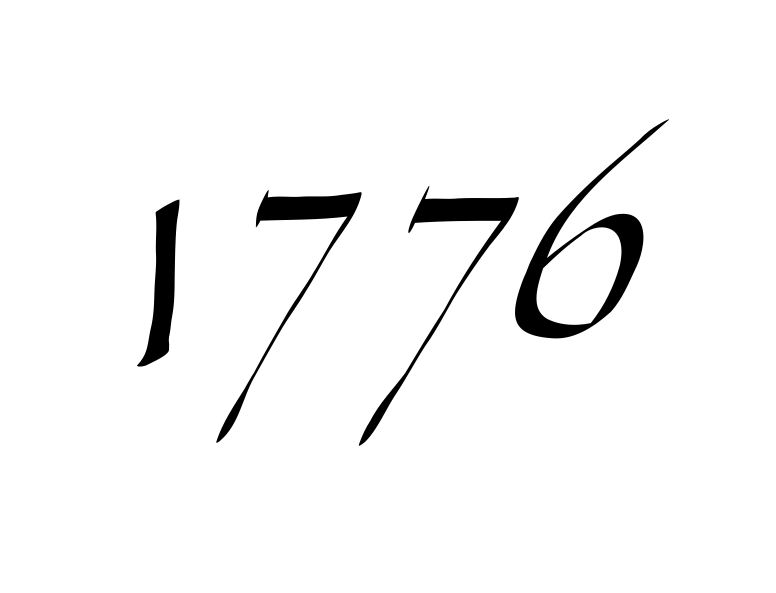
As many of you may have deduced by this point, if I had to choose one year in American history as my favorite, I would undoubtedly choose 1776. In modern times, 1776 has had much renown and commercialization surrounding it, but let’s look into the true events that occurred which influence my decision.
The Year of Freedom
1776 — what an amazing year. I suppose that year wasn’t a walk in the park for the ones that had to endure it, but the significance of that year is outstanding.
It is, after all, the year during which the United States officially declared its independence, however, the year was likely filled with uncertainty; the British fiercely contested the young nation’s independence, which compelled the Patriots to fight tooth and nail for every square inch of land. We obviously now know that the Patriots would ultimately win and secure their freedom and independence, but during 1776, the fledgling nation could not have known that they would eventually win. I imagine the Patriots had to foster ample optimism and faith in God as they fought for a seemingly unattainable victory.
Though the Patriots celebrated early success after winning 72% of the battles in 1775, the British were winding up for retaliation, and in 1776, the British dealt some of the most devastating blows to the Colonies of the entire war. American morale was lower than it had been in 1775, and the future certainly looked bleak. Remember, the countries of France and Spain didn’t form an alliance with the United States until 1778 and 1779, respectively.
The year 1776 also saw the execution of Nathan Hale — a 21 year old Patriot — by the British for being a spy, because the British apparently considered spies to be illegal combatants, despite the fact that they extensively used spies during the war. This must have appalled and dejected not only Hale’s family, but also every other American, yet in spite of such cruelty, Hale’s last recorded words perfectly reflect his love for his country and the American Spirit:
“I only regret that I have but one life to lose for my country.”
Nathan Hale, 1776
American Perseverance
The British expected the Patriots’ struggle for freedom to be nothing more than a short lived rebellion, but as the British repeatedly defeated the Patriots, the British were confounded by the Patriots’ undying determination and grit. Slowly but surely, it dawned on the British that the Patriots were in this fight for nothing short of liberty or death; the Patriots had already resolved that they would either win the war, or they would fight until there was nothing left for the British to oppress.
Even Washington never gave up on the nation, though he was faced with many crushing defeats. Washington continued to face the British on the battlefield again and again, even as New York City burned.
In October of 1776, the British defeated Washington at the Battle of White Plaines, which finally drove Washington out of New York. Soon after, the British chased Washington across New Jersey and over the Delaware River.
Rather than allowing themselves to dwell on their defeats, the Patriots passed Thomas Paine’s The American Crisis around campfires to lift their spirits and reignite their passion for liberty. The American Crisis even begins with the sentence These are the times that try men’s souls, which is further confirmation that 1776 was anything but easy.
Washington camped with his men in Pennsylvania, just west of the Delaware River; this is where the British expected Washington to remain for the rest of the winter, as they were convinced that Washington’s army was now broken. All the British would have to do is annihilate Washington’s shattered army once spring arrived, however, Washington had one more trick up his sleeve.
In the early hours of the morning after Christmas, Washington lead his troops across the freezing Delaware River, partially taking the Hessians in Trenton by surprise and utterly crushing them in the quick battle that ensued. After so many demoralizing defeats, Washington managed to make a comeback just before the end of 1776.
Battles of 1776
To demonstrate what I mean when I say that the Patriots faced many demoralizing defeats, I have provided a list of the battles that occurred in 1776. Pay close attention to the number of times that the battles resulted in a defeat for the Patriots.
| Battle | Date | Location | Result |
|---|---|---|---|
| Battle of Moore’s Creek Bridge | Feb 27, 1776 | North Carolina | Victory |
| Battle of the Rice Boats | Mar 2-3, 1776 | Georgia | Defeat |
| Raid of Nassau | Mar 3-4, 1776 | Bahamas | Victory |
| Siege of Boston (concluded) | Mar 17, 1776 | Massachusetts Bay | Victory |
| Battle of Saint-Pierre | Mar 25, 1776 | Quebec | Victory |
| Battle of Block Island | Apr 6, 1776 | Rhode Island | Defeat |
| Battle of the Cedars | May 18-27, 1776 | Quebec | Defeat |
| Battle of Trois-Rivières | Jun 8, 1776 | Quebec | Defeat |
| Battle of Sullivan’s Island | Jun 28, 1776 | South Carolina | Victory |
| Battle of Turtle Gut Inlet | Jun 29, 1776 | New Jersey | Victory |
| Battle of Gwynn’s Island | Jul 8-10, 1776 | Virginia | Victory |
| Battle of Lindley’s Fort | Jul 15, 1776 | South Carolina | Victory |
| Battle of Long Island | Aug 27, 1776 | New York | Defeat |
| Landing at Kip’s Bay | Sep 15, 1776 | New York | Defeat |
| Battle of Harlem Heights | Sep 16, 1776 | New York | Victory |
| Battle of Valcour Island | Oct 11, 1776 | New York | Defeat |
| Battle of Mamaroneck | Oct 22, 1776 | New York | Defeat |
| Battle of White Plains | Oct 28, 1776 | New York | Defeat |
| Battle of Fort Cumberland | Nov 10-29, 1776 | Nova Scotia | Defeat |
| Battle of Fort Washington | Nov 16, 1776 | New York | Defeat |
| Battle of Fort Lee | Nov 20, 1776 | New Jersey | Defeat |
| Ambush of Geary | Dec 14, 1776 | New Jersey | Victory |
| Battle of Iron Works Hill | Dec 22-23, 1776 | New Jersey | Defeat |
| Battle of Trenton | Dec 26, 1776 | New Jersey | Victory |
Only 46% of the battles in 1776 were victories for the Patriots; image yourself in their shoes, could you continually find the strength to pick yourself back up just to be struck down yet again?
It’s not like the rest of the war was filled with victories for the Patriots, in fact, only about 43% of the remaining battles in the war were victories for the Patriots and their allies. How is it that they could persevere through all of the hopelessness? I believe it can only be attributed to God.
In the year 1777, not only had the Patriots returned to New York and ultimately won the battles of Saratoga, which secured the support of France, but they also did this while flying their newly designed flag: the Betsy Ross.
There are many lessons that we can learn by looking back to 1776 and remembering the courage that the Patriots’ exhibited throughout their struggles.
What is your favorite thing about 1776?
 Onward American