
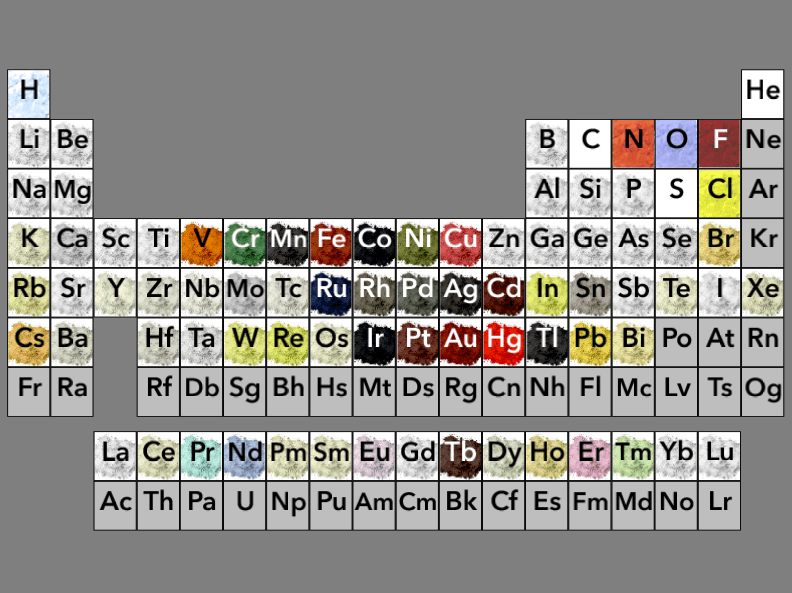
It is no mystery that, when reactive materials are left in air, they will start to react with the oxygen in the air. Dioxygen (O2) is the second most abundant gas in the air, and because oxygen is the second most electronegative element, it will react with most materials. Contrary to some claims on the internet, oxygen is not actually flammable itself, instead, it is one of the strongest oxidizers, which means that it steals electrons from materials and causes them to oxidize and burn. The fire triangle consists of fuel, heat, and an oxidizer; without an oxidizer, such as oxygen, it is impossible to have combustion.
It might seem alarming that oxygen can burn just about anything, but the reason why fuels, metals, buildings, and living organisms don’t burst into flames across the entire world with the smallest spark is due to the fact that the air only consists of 21% oxygen. About 78% of the air is made up of virtually inert, dinitrogen (N2), which dilutes the oxygen so much that most materials require a significant amount of heat in order to combust, as in the case of a campfire.
Despite the dilution of oxygen, some materials are reactive enough to react with oxygen at room temperature. For example, you might notice how fresh copper has a shiny, reddish color, but as it sits in the air, it develops a dull, brownish color. This is due to the formation of a thin layer of copper oxide on the surface of the copper. Most elements on the periodic table can react with oxygen to form compounds known as oxides. An oxide (ox- from oxygen + -ide) is simply an atom or several atoms that are bonded to oxygen, similar to chlorides (chlor- from chlorine + -ide) and sulfides (sulf- from sulfur + -ide).
It’s also fascinating to note that the presence of this strong oxidizing agent in the air is the very reason that we breathe air; our bodies are designed to pull oxygen out of the air, which is then brought to each of our cells, at which point the oxygen is combined with fuels from the foods that we eat (carbohydrates, proteins, and fats) and burned for energy; the byproducts of this combustion, which are mostly water and carbon dioxide, are either used for other reactions or discarded.
Oxides Everywhere
One day, when I was looking at the periodic table and considering all possible oxides for each element, I suddenly realized just how important some of these oxides are in our daily lives. Did you know that you will encounter oxides every second of your life? It’s impossible to completely distance yourself from them.
You may now be wondering where these oxides are if they truly are so ubiquitous. Would it surprise you if I told you that about 60% of your body is made of oxides? The water in your body is an oxide, the air you exhale contains water and carbon dioxide, which are oxides, and if you handle a metal, it’s likely that you are touching a thin oxide layer and not bare metal.
This shouldn’t come as a surprise when you look at the chemical formulae of the previously stated chemicals: water, carbon dioxide, and metal oxides. I will use aluminum oxide as a metal oxide in this example, since aluminum oxide forms almost instantly on the surface of any aluminum that is exposed to the air. These three chemicals can be written in chemistry as H2O (water), CO2 (carbon dioxide), and Al2O3 (aluminum oxide). Notice how each formula has one type of atom — either hydrogen (H), carbon (C), or aluminum (Al) — followed by oxygen(O). The fact that these compounds contain one atom or group of atoms paired with one or more oxygen atoms suggests that these are oxides.
Here is a table with the 83 elements from hydrogen to bismuth along with the formula for their most common oxides and the common name for the oxides, if one exists. The reason why I am excluding the elements after bismuth is that all elements after bismuth are radioactive, and many of the final elements on the periodic table are so radioactive that they often decay before they can react with other elements; the only two radioactive elements that I am allowing are technetium and promethium. Also note how most of the noble gasses (the elements on the rightmost column of the periodic table) are too stable to react with oxygen.
If you do not wish to sift through the table to find oxides that you might know, then simply skip past the table, as I will pay special attention to the most common oxides below the table.
| Element | Oxide Formula | Common Name |
|---|---|---|
| Hydrogen | H2O | Water |
| Helium | HeO (Rare) | |
| Lithium | Li2O | Lithia |
| Beryllium | BeO | Beryllia |
| Boron | B2O3 | |
| Carbon | CO, CO2 | |
| Nitrogen | NO, NO2 | Laughing Gas (NO2) |
| Oxygen* | O2, O3 | Ozone (O3) |
| Fluorine* | OF2, O3F2 | Ozone Difluoride (O3F2) |
| Neon | N/A | |
| Sodium | Na2O | |
| Magnesium | MgO | Magnesia |
| Aluminum | Al2O3 | Alumina |
| Silicon | SiO2 | Silica |
| Phosphorus | P4O6, P4O10 | |
| Sulfur | SO2, SO3 | |
| Chlorine | ClO2 | |
| Argon | N/A | |
| Potassium | K2O | Potash |
| Calcium | CaO | Quicklime |
| Scandium | Sc2O3 | |
| Titanium | TiO2 | Titanium Dioxide |
| Vanadium | V2O5 | |
| Chromium | Cr2O3 | |
| Manganese | MnO2 | Pyrolusite |
| Iron | Fe2O3, Fe3O4 | Rust (Fe2O3), Magnetite (Fe3O4) |
| Cobalt | CoO, Co3O4 | |
| Nickel | NiO | |
| Copper | CuO, Cu2O | Tenorite (CuO) |
| Zinc | ZnO | |
| Gallium | Ga2O3 | |
| Germanium | GeO2 | Germania |
| Arsenic | As2O3 | |
| Selenium | SeO2 | |
| Bromine | BrO2 | |
| Krypton | N/A | |
| Rubidium | Rb2O | |
| Strontium | SrO | Strontia |
| Yttrium | Y2O3 | Yttria |
| Zirconium | ZrO2 | Zirconia |
| Niobium | Nb2O5 | |
| Molybdenum | MoO3 | |
| Technetium | Tc2O7 | |
| Ruthenium | RuO2 | |
| Rhodium | Rh2O3 | |
| Palladium | PdO | |
| Silver | Ag2O | |
| Cadmium | CdO | |
| Indium | In2O3 | India |
| Tin | SnO2 | Cassiterite |
| Antimony | Sb2O3 | |
| Tellurium | TeO2 | |
| Iodine | I2O5 | |
| Xenon | XeO3, XeO4 | |
| Cesium | Ce2O | |
| Barium | BaO | Baria |
| Lanthanum | La2O3 | Lanthana |
| Cerium | CeO2 | Ceria |
| Praseodymium | Pr2O3 | Praseodymia |
| Neodymium | Nd2O3 | |
| Promethium | Pm2O3 | |
| Samarium | Sm2O3 | Samaria |
| Europium | Eu2O3 | Europia |
| Gadolinium | Gd2O3 | Gadolinia |
| Terbium | Tb4O7 | |
| Dysprosium | Dy2O3 | Dysprosia |
| Holmium | Ho2O3 | Holmia |
| Erbium | Er2O3 | Erbia |
| Thulium | Tm2O3 | Thulia |
| Ytterbium | Yb2O3 | |
| Lutetium | Lu2O3 | Lutecia |
| Hafnium | HfO2 | Hafnia |
| Tantalum | Ta2O5 | |
| Tungsten | WO3 | |
| Rhenium | Re2O7 | |
| Osmium | OsO4 | |
| Iridium | IrO2 | |
| Platinum | PtO2 | |
| Gold | Au2O3 | |
| Mercury | HgO | |
| Thallium | Tl2O3 | Avicennite |
| Lead | PbO | Litharge |
| Bismuth | Bi2O3 | Bismite |
*Technically there is no such thing as a “fluorine oxide” since fluorine is more electronegative than oxygen, therefore, the resulting compounds are oxygen fluorides. These compounds are actually fluorides, not oxides. Because fluorine is the only element more electronegative than oxygen, this is the only element with which it is technically impossible to form oxides, besides oxygen itself. There is also no such thing as “oxygen oxide,” instead, the two oxygen compounds I presented are actually known as dioxygen (often called oxygen) and trioxygen (often called ozone).
The Most Common Oxides
The following is a quick list of the most well known oxides.
Water (H2O)
Water is by far the most well known oxide, since everyone knows its simple formula: H2O. Water is everywhere; it’s in the air, ground, oceans, and all living living organisms. Fun fact: water has several different scientific names, one of which is hydrogen oxide.
Carbon Monoxide (CO), Carbon Dioxide (CO2)
Carbon monoxide is a deadly gas that is released when a carbon containing fuel is burned inefficiently or without enough oxygen. The reason carbon monoxide is so dangerous is that it still wants to share more electrons with another atom before it becomes much more stable, therefore, when you breathe in carbon monoxide, it will bond more strongly to the iron from the hemoglobin in your blood than the oxygen that you breathe, causing asphyxiation.
Even though carbon dioxide does not interfere with the bonding of oxygen to your hemoglobin like carbon monoxide does, it can still cause asphyxiation by displacing oxygen and therefore not allowing oxygen to enter your lungs. CO2 is not particularly dangerous in low concentrations, but because CO2 is more dense than oxygen, it can remove oxygen from areas of lower elevation by sinking down to the lowest points of an area and causing oxygen to float above it; this can be especially dangerous in mines.
An interesting fact about CO2 is that the vast majority of a tree’s mass comes from the CO2 that it pulls out of the air.
Oxygen (O2), Ozone (O3)
The very oxygen that we breathe (O2) is a molecule of oxygen bonded to itself, which is structured similarly to an oxide, though it is technically not a real oxide.
The ozone in the atmosphere, which protects us from harmful radiation that is emitted by the Sun, is also a molecule of oxygen that is bonded to itself.
Sapphire (Al2O3)
Sapphires are gemstones that are mostly made of aluminum oxide, but small amounts of metals and impurities give sapphires unique colors. Rubies are also mostly made from aluminum oxide; the only difference between sapphires and rubies is that rubies are made from aluminum oxide that contains a small amount of chromium, which gives rubies their red color, and sapphires are every other gem that is made from aluminum oxide.
Sand (SiO2)
Silicon dioxide is commonly known as sand, silica, or quartz. Silicon dioxide is naturally found in water, plants, and animals. About 59% of the Earth’s curst is made from silicon dioxide and more than 95% of all known rocks on the Earth are made from silicon dioxide.
Rust (Fe2O3), Magnetite (Fe3O4)
Because iron is a transition metal, it can have more than one oxidation state, which corresponds to the number of electrons that it wants to share with other atoms. When iron reacts with water and oxygen in the atmosphere, it often forms iron (III) oxide (Fe2O3), which we call rust. Iron can also be found in the form of iron (II, III) oxide (Fe3O4), called magnetite, which is a mineral that is one of the main ores of iron.
What’s interesting about oxides is that once they have reacted with enough oxygen, they no longer want to react with oxygen. This is why some compounds can be so stable, such as water and carbon dioxide. It is impossible to burn water in oxygen because the hydrogen has already “burned.” This is why my new favorite nickname for water is burnt hydrogen. You could also theoretically refer to any other oxide by placing the word burnt before its name, i.e. sapphires are burn aluminum, but you’ll have to expect everyone to be utterly confused unless they are also passionate about chemistry and oxides.
Please note that this does not mean that water and carbon dioxide will not burn, since some materials, like magnesium, are so reactive that they can rip the oxygen away from the hydrogen and carbon in water and carbon dioxide, resulting in a furious combustion or explosion.
What is your favorite oxide?
 Onward American