
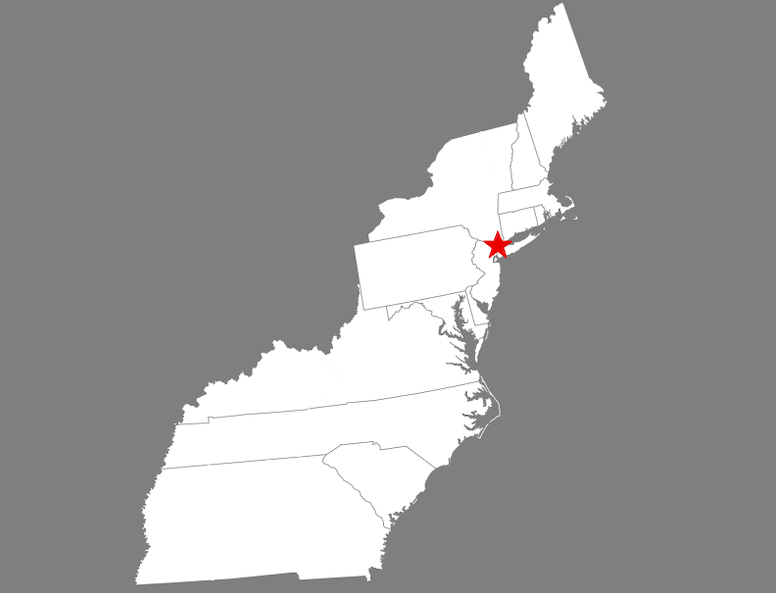
Did you know that New York City once was the capital of the United States? Though New York City was never officially designated the capital of the United States, it served as a de facto capital for nearly 6 years while Congress convened there. George Washington even served as President of the United States while residing in New York.
There have been quite a few de facto capitals throughout early American history as Congress moved around the country while avoiding British attacks and even a protest: the Pennsylvania Mutiny of 1783.
Let’s take a look at the historical capitals of the United States, starting from the very beginning.
The Colonial Capitals
There never was a central capital of the 13 colonies, since Great Britain mostly treated them as 13, separate colonies, but each colony did have its own capital.
Here is a list of the Colonial Capitals:
- Hartford, CT
- New Haven, CT
- New Castle, DE
- Savannah, GA
- St. Mary’s City, MD
- Annapolis, MD
- Boston, MA
- Portsmouth, NH
- Exeter, NH
- Elizabethtown, NJ
- Perth Amboy, NJ
- Burlington, NJ
- New York, NY
- Bath, NC
- Edenton, NC,
- Brunswick, NC
- Newbern, NC
- Philadelphia, PA
- Newport, RI
- Providence, RI
- Charlestown, SC
- Williamsburg, VA
- Jamestown, VA
| Colony | Capital(s) |
|---|---|
| Connecticut | Hartford (1636-1776); New Haven (joint capital with Hartford, 1701-1776) |
| Lower Counties on Delaware | New Castle (1664-1776) |
| Georgia | Savannah (1732-1782) |
| Maryland | St. Mary’s City (1634-1695); Annapolis (1695-1776) |
| Massachusetts Bay | Boston (1632-1776) |
| New Hampshire | Portsmouth (de facto 1630-1774; de jure 1679-1775); Exeter (de facto 1774-1776) |
| New Jersey | Elizabethtown (1664-1673); Perth Amboy (East Jersey capital 1674-1702; New Jersey capital 1702-1776); Burlington (West Jersey capital 1674-1702; New Jersey capital 1702-1776) |
| New York | New York (1664-1776) |
| North Carolina | Bath (1712-1722); Edenton (1722-1743); Brunswick (1743-1770); Newbern (1770-1776) |
| Pennsylvania | Philadelphia (1681-1776) |
| Rhode Island and Providence Plantations | Providence (1636?-1776), Newport (1639?-1776) |
| South Carolina | Charlestown (1712-1776) |
| Virginia | Jamestown (1607-1699); Williamsburg (1699-1776) |
The Search for a Permanent Capital
After the colonies united to declare and secure their independence, they were functioning as a singular nation. Once the United Colonies of North America, later renamed the United States of America, was established, they were in need of a capital in which the federal government would be housed. Several cities across the emerging nation served as the de facto capital of the United States until a permanent capital could be built.
In early 1791, a 100 square mile section of land in the shape of a diamond was ceded by the states of Maryland and Virginia to become the permanent capital of the United States. At this point in time, this portion of land hadn’t been given a name and was simply referred to as the federal district; in September of the same year, the district was given the name the Territory of Columbia.
In November of 1800, more than 9 years after Maryland and Virginia ceded land for the federal district, the US Congress was moved to the city of Washington in the Territory of Columbia, which was finally built and ready to become the permanent capital of the United States. Though President George Washington oversaw the construction of the White House, he neither resided within it nor lived to witness its completion. The second US President, John Adams, was the first to reside within the White House.
In 1847, the portion of land that Virginia ceded to the federal district was retroceded to Virginia, leaving the Territory of Columbia with only 61 square miles. The retroceded land is now part of Virginia’s county of Arlington and independent city of Alexandria.
The Territory of Columbia appears to have been formally named the District of Columbia no later than the Organic Act of 1871, which is an Act of Congress that repealed the individual charters of the cities of Georgetown and Washington and established a new territorial government for the entirety of the District of Columbia.
The Former and Present Capitals of the US
Philadelphia, Pennsylvania (5 Months, 16 Days)
Philadelphia became the de facto capital of the United States when the Declaration of Independence was adopted by the Second Continental Congress on July 4, 1776, in the Pennsylvania State House, later renamed Independence Hall, until Congress was moved on December 20, 1776.
Baltimore, Maryland (2 Months, 12 Days)
On December 20, 1776, Baltimore became the de facto capital of the United States when the Continental Congress began meeting in Baltimore until March 4, 1777, to avoid British forces that were advancing on Philadelphia.
Philadelphia, Pennsylvania (6 Months, 23 Days)
On March 4, 1777, the Continental Congress began meeting in Philadelphia again, after the threat of British troops had ended, making Philadelphia the de facto capital until September 27, 1777.
Lancaster, Pennsylvania (3 Days)
After the American defeat at the Battle of Brandywine, the Continental Congress fled Philadelphia again, briefly meeting in Lancaster from September 27, 1777, making it the de facto capital until September 30, 1777.
York, Pennsylvania (1 Year, 9 Months, 2 Days)
The Continental Congress continued to move away from Philadelphia, and from September 30, 1777, to July 2, 1779, the Continental Congress settled in York, making it the facto capital.
Philadelphia, Pennsylvania (3 Years, 11 Months, 28 Days)
Following the British withdrawal from Philadelphia, the Continental Congress once again returned to Philadelphia, making it the de facto capital from July 2, 1779, to June 30, 1783.
Princeton, New Jersey (4 Months, 27 Days)
The Pennsylvania Mutiny of 1783 caused the Congress of the Confederation (which is what the Continental Congress became after adopting the Articles of Confederation) to leave Philadelphia and begin meeting in Princeton, making Princeton the de facto capital from June 30, 1783, to November 26, 1783.
Annapolis, Maryland (11 Months, 6 Days)
Annapolis became the de facto capital when the Congress of the Confederation moved to Annapolis from November 26, 1783, to November 1, 1784.
Trenton, New Jersey (2 Months, 10 Days)
The Congress of the Confederation briefly met in Trenton from November 1, 1784, to January 11, 1785, making Trenton the de facto capital.
New York, New York (5 Years, 10 Months, 25 Days)
On January 11, 1785, the Congress of the Confederation settled in New York, making the city the de facto capital; Congress would stay here until December 6, 1790. New York was the last city to serve as a de facto capital of the United States. The first President of the United States, President George Washington, spent the first portion of his presidency in this de facto capital.
Philadelphia, Pennsylvania (9 Years, 11 Months, 11 Days)
As per the Residence Act of 1790, which established a temporary and permanent capital for the United States, Philadelphia became the temporary capital of the US. The Congress of the United States (which is what the Congress of the Confederation became after adopting the US Constitution) was relocated to Philadelphia from December 6, 1790, until the District of Columbia was ready to become the permanent capital of the US, which occurred on November 17, 1800. President Washington spent the remainder of his presidency in this city and President John Adams even spent the first portion of his presidency here.
Washington, District of Columbia (223 Years, 8 Months, 23 Days, as of August 8th, 2024)
The city of Washington in the newly formed District of Columbia became the permanent capital of the United States on November 17, 1800, and it is still the capital of the United States to this day. President John Adams urged Congress to move to the District of Columbia 2 weeks earlier than the December 1 date established by the Residence Act in hopes of securing enough southern votes to be elected for a second term, however, this ultimately failed and Adams was succeeded by Thomas Jefferson; Adams only ever served one term as President.
Brookeville, Maryland (1 Day)
During the War of 1812, British troops burned Washington, DC, including the White House. This forced President James Madison to flee Washington and find refuge elsewhere. President Madison stayed in Brookeville for one day (August 26, 1814), where he even carried out the duties of President within the city, which earned Brookeville the title of US Capital for a Day. If you exclude the 1 day that Washington was vacant, then Washington would be the capital from November 17, 1800, to August 26, 1814, (13 years, 9 months, 9 days) and then August 27, 1814, to the present day (209 years, 11 months, 13 days, as of August 8, 2024).
There have only been 4 states that have housed the capital of the United States before the District of Columbia became the federal district: Pennsylvania, Maryland, New Jersey, and New York.
Pennsylvania has held the capital 6 times, Maryland 2 times (3 times if you include Brookeville), New Jersey 2 times, and New York 1 time.
Pennsylvania has held the capital for 16.8 years, New York for 5.9 years, Maryland for 1.2 years, and New Jersey for 0.6 years. The District of Columbia has held the capital for the longest time by far, at 223.8 years, nearly 2 and a quarter centuries, as of the writing of this post.
Which capital is your favorite?

