
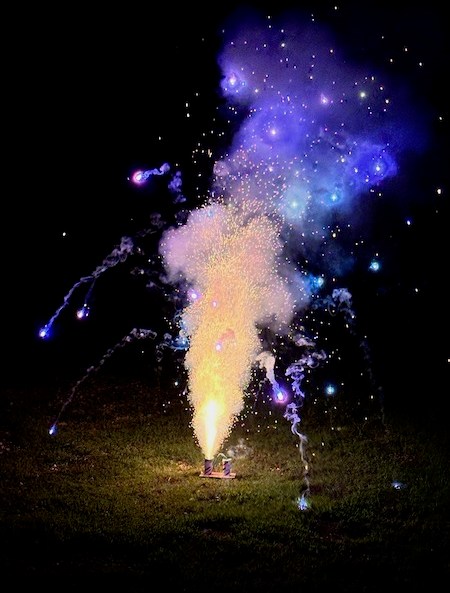
About a year ago, I began my journey in metallurgy as I experimented to see if I could actually melt and cast metal; I even started a metallurgy series on this blog months ago. Now, I am expanding into a new category!
Accelerating the Combustion of Charcoal
Only a couple months ago, I was preparing some of my homemade charcoal for metallurgy when I thought about how the charcoal in my furnace only burns by blowing air over it, which allows some of the oxygen in the air to react with the charcoal. The reason why charcoal only slowly smolders in the air is because only about 21% of the air is oxygen; if you could increase the amount of oxygen that blows onto the charcoal, it would burn much faster, however, using pure oxygen is dangerous since it causes even things which are not typically flammable to burn vigorously, meaning that attempting to place pure oxygen onto burning charcoal would be extremely dangerous at best, and potentially explosive at worst.
There is another method of providing extra oxygen which does not involve the use of pressurized oxygen gas: oxidizing chemicals. When an oxidizing chemical is burned with a fuel, it releases some oxygen, which causes more fuel and oxidizer to burn, releasing even more oxygen. I suddenly remembered that when charcoal is ground to a fine powder and mixed with a specific oxidizer and a small amount of sulfur, which acts as a modifier, the resulting mixture is called black powder, which is sometimes still called gunpowder even though it has almost completely been replaced by modern smokeless gunpowder in firearms.
Black Powder
I checked all the laws which applied to me to figure out if I was allowed to make black powder, and it turns out that I am allowed to make small amounts of black powder on my private property for personal use only, as long as I do not exceed a predetermined amount, attempt to transport any black powder or pyrotechnic material, or store any black powder improperly.
While making sure to follow all of the safety precautions I knew about and all of the laws, I mixed and tested my first black powder, which was very crude, but I was surprised to see how forgiving black powder really is; my chemicals were ground to a very coarse powder and the ratio was terribly measured, but it still burned, albeit slowly.
I perfected my process, materials, and ratios, and I even began screening my powder to make sure it was mixed much better than before. After all of my experimentation and effort, my black powder burned much faster and more evenly.
Fireworks
I then spent weeks researching what fireworks were legal to manufacture, possess, and discharge in my area, what chemicals were needed to make such fireworks, the health hazards of those chemicals, and how to safely manufacture the fireworks. I spent a few more weeks testing each stage and piece of the fireworks in small scales.
After many successful tests, I finally decided it was time to make a firework and see if it would work when I combined all of the pieces. Here is the first firework I have ever made.
I cannot tell you how many dozen times I have watched this video and videos from my other tests; I learned that it helps to video each test so that you can analyze the entire experiment frame by frame in order to learn from every part of the experiment that went according to plan and every part that did not.
I figured out how to safely increase pressure in my fireworks so that my stars and effects would become airborne and how to properly size the stars (star is the pyrotechnic name for the part of the firework that is seen as colors and other effects). After several more tests and many more hours of work, I finally produced a couple decent fireworks.
The type of fireworks that I made are called fountains; in my area, the only fireworks I can legally use are ones that neither explode nor become airborne, such as rockets; examples of legal fireworks in my area are fountains, smoke bombs, and sparklers. My fireworks are by no means perfect, but they are definitely a great improvement from where I started only a couple months ago.
I thoroughly enjoy making fireworks, since I see it as the perfect combination of fire, art, and chemistry. I intend to continue perfecting my technique and even to test new colors and effects that are legal in my area.
WARNING: it is generally not advised to manufacture your own black powder or fireworks. Do not attempt to manufacture your own black powder, pyrotechnic material, or fireworks if you do not know the laws, hazards, and proper procedures. Improper storage and handling of chemicals and pyrotechnic material may result in bodily harm or even death. Never store black powder, pyrotechnic material, or fireworks in your house. Never release chemicals into the environment. Always check and comply with your local laws, including federal, state, county, and city. Always read Safety Data Sheets on each chemical you intend to use to understand its properties, storage requirements, health hazards, firefighting measures, and incompatibilities. Always wear proper Personal Protective Equipment (PPE). Always test each new mixture or pyrotechnic composition in quantities not exceeding 1 gram to reduce any damage done by an unexpectedly violent composition. Always use a long enough fuse to allow yourself enough time to retreat after lighting a firework or pyrotechnic material, as fireworks are dangerous and may explode if not properly assembled. Never burn metal powders or use metal powders as the primary or sole fuel, especially if you are not a professional with professional equipment. Only use cardboard tubes; a rigid material such as metal or fiberglass will become shrapnel if the firework catastrophically fails and may result in severe bodily harm or death. If you are ever unsure, then simply do not attempt to manufacture fireworks. This hobby is not worth your health or life.
What are your thoughts on pyrotechnics?

