
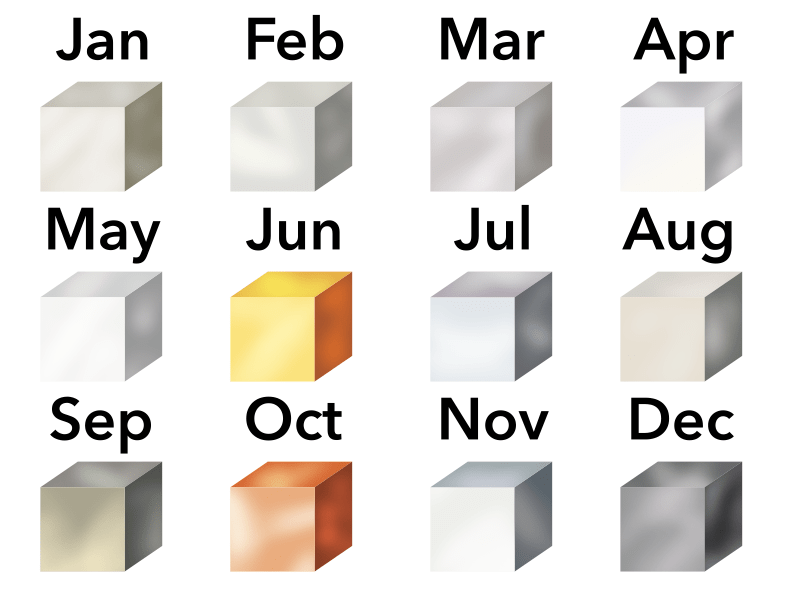
I’m sure you have heard of birthstones, the gemstones that represent the month in which someone is born, but have you heard of birthmetals? No, you have not, and neither have I… that is, until I made it up.
I was never satisfied with the gem that my birth month was given, especially since other months were given diamond, ruby, or garnet; due to this frustration, I have mostly dissociated myself from birthstones, but as I may have stated before, I’ve always been fascinated by the beauty and luster of metals. Therefore, I was recently given the idea to assign a metal to each month as a parallel of birthstones, which I am calling “birthmetals,” a term which I believe I’m the first to coin.
For the twelve birthmetals, I will do my best to choose metals that are nontoxic, nonreactive, and nonradioactive; I’ll also try to avoid choosing any metals that are mostly unknown to the average person, like praseodymium. These parameters limit my selection of metals significantly, but I will do my best to only choose interesting metals, even if some of them are more basic than precious metals; there are only several precious metals, after all, and a few of them are uncommon, like osmium and rhenium.
I’ll provide a link to Luciteria, my favorite website that offers pure element samples, so that you can view or purchase a sample of your birthmetal. Don’t worry, some of the more expensive metals have an option to purchase a 1 gram sample or less which is sent in a small box so that you won’t spend a fortune on your sample.
January: Platinum

Platinum is a precious metal that is in the platinum group metals. It is the least reactive metal, and it is about ten time more rare on the surface of the Earth than gold. It has one of the highest melting points and it is the third most dense element; only iridium and osmium are more dense than platinum; the density of platinum is about 89% greater than that of lead (almost twice the density of lead) and about 11% greater than that of tungsten.
The name platinum comes from the Spanish word platina, meaning little silver. The Spaniards gave the name platina to the platinum they encountered, which they regarded as an unwanted impurity in the silver that they were mining in South America. Sadly, this platinum was often discarded and even thrown overboard from ships that were heading to Spain in order to not weigh them down; as of early April, 2024, platinum is over 35 times more valuable than silver.
February: Niobium
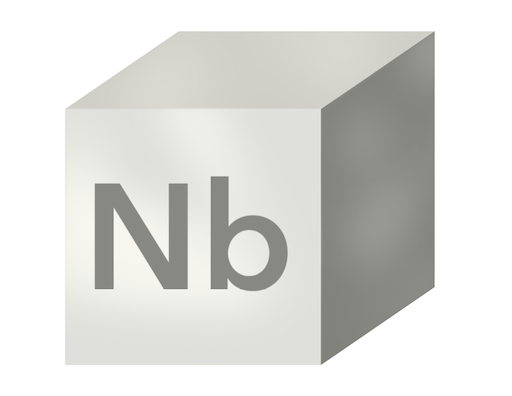
Niobium is a fairly rare metal with one of the highest melting points. It was originally named after the United States (Columbia) and given the name columbium with the symbol Cb, but it was later renamed niobium and given the symbol Nb. If you are wondering how it is possible that Columbia could be a name for the United States, then you might want to check out this post.
A unique property of this metal is that it can be placed in an electrolytic bath, which causes the metal to form a microscopically thin layer of oxidation that appears as a bright color. Luciteria offers their niobium cubes without a color, but they have the option to choose green, yellow, purple, and blue niobium. In my experience, their images are slightly over saturated, and I have heard that the purple and blue appear to have a more brilliant color than the green and yellow.
The name niobium comes from Niobe, the goddess of snow and winter in Greek mythology.
March: Bismuth

Bismuth is a very brittle metal with a low melting point, and it is well known for its terraced crystals; its density is only a little less than that of lead. It is often considered the last stable element on the periodic table, right before polonium, which is when all subsequent elements become radioactive, however, it has recently been discovered that bismuth is radioactive, but its half life is about 20 quintillion (20,000,000,000,000,000,000) years. Assuming my calculations are correct, this means that of the 28 sextillion (28,000,000,000,000,000,000,000) bismuth atoms in a 1 cm3 cube from Luciteria, you could expect 1 atom to decay every 2 days; in comparison, for the same number of atoms of uranium (uranium-238), which would only have the volume of 0.58 cm3, you could expect 1 atom to decay every 10 microseconds, or roughly 100,000 atoms per second!
The name bismuth originated from the German phrase weiße Masse, meaning white mass, which was corrupted to Wismut (the modern German name for bismuth), which was Latinized to bisemutum, and finally anglicized to bismuth.
April: Silver

Silver has been one of the cheapest precious metals for a while. The melting point of silver is 1,763ºF, which 1763 is also the year that the French and Indian War, a conflict fought in Colonial America, ended. Silver has a silvery color, in fact, the color silver is named after the metal silver. For the most part, silver is not very reactive, but it will tarnish when exposed to sulfur particles in the air. One thing about silver that most people don’t mention is that the density of silver is very similar to that of lead.
The name silver comes from the Old English word seolfor, which is related to the Dutch zilver and the German Silber. Silver has the symbol Ag, which comes from the Latin word for silver, argentum, which comes from the Indo-European root arg, meaning white or shining. Argentina was even named after the Latin word for silver by the Spaniards because it was a rich source of silver.
May: Magnesium

When choosing the birthmetal for May, I thought Maybe I should choose beryllium — which is one of the major components in the mineral beryl (beryllium aluminum silicate), the primary constituent of emerald, which is the birthstone of May — but I reasoned that beryllium was too toxic, therefore I settled for magnesium.
Magnesium is an interesting metal, which is a necessary element in the human body, and it is one of the least dense metals. If it is heated to the point of catching fire, it will burn white hot, around 5,600ºF. This is hot enough to produce ultraviolet light; the intensity of the light from burning magnesium is enough to cause temporary blindness and even eye damage, and if you think to use water, CO2, or nitrogen to extinguish the fire, you’ll likely cause the fire to burn brighter, and maybe explode in the case of water. This is impressive because most flammable materials are extinguished when exposed to any one of those three chemicals.
The name magnesium comes from the modern Latin word for the district of Magnesia, which is in Thessaly, Greece, where the mineral magnesia alba (magnesium carbonate) was first discovered.
June: Gold

Gold is perhaps the most well known precious metal. It is a relatively soft metal that is one of the rarest metals on the Earth’s crust, one of the least reactive metals, and one of the most dense metals. Besides cesium, gold is the only elemental metal that is yellow in appearance.
The name gold comes from the Germanic word gulþa, meaning gold, which is related to the Old English word geolu, meaning yellow, which is related to the Dutch geel and German Gelb, also meaning yellow. Gold derives its symbol, Au, from the Latin word aurum, meaning gold, which comes from Aurora, the goddess of dawn in Roman mythology.
July: Chromium

Chromium is the hardest metal, which means it is quite brittle. Chrome plating is simply a thin, protective layer of chromium metal; chromium is also the metal in stainless steel that prevents rust. I think it is fitting that July gets chromium, because chromium is the metal that gives rubies, July’s birthstone, their red color. Chromium is also an ultra-trace element in the human body.
Chromium derives its name from the Greek word χρώμα (khrōma) meaning color; this base word is also responsible for other English words, such as chroma and chromatic.
August: Palladium

Palladium is a precious metal and one of the platinum group metals. It is one of the most rare metals on the surface of the Earth, even more rare than gold and platinum. Palladium is sometimes used in jewelry and dental crowns, and it can also be used in the alloy white gold, but it is mostly used in catalytic converters for cars.
The name palladium comes from the Greek name Παλλάς (Pallás), from the word πάλλω (pállō) meaning to poise, sway or swing. The name Pallas was associated with Athena, the goddess of wisdom in Greek mythology, but Pallas was explained by the ancient Greeks to more specifically mean to brandish something, as Athena is often depicted with a spear or shield.
September: Titanium

Titanium is a very common metal that is known for being one of the strongest metals. It is used in the form of titanium dioxide, or titanium(IV) oxide, as an opaque base for pigments in paint and even food. Titanium is also one of the metals that gives sapphires, September’s birthstone, their intense blue color.
The name titanium originates from the Titans, which are the sons of the Earth goddess in Greek mythology.
October: Copper

Copper is the only metal with its unique, reddish color. It is a relatively soft metal that easily oxidizes in contact with air, oils, and acids. Copper is used to conduct heat and electricity and it is used as a building material. Copper is also used in various alloys, including brass, bronze, sterling silver, and cupronickel, and it is even a trace element in the human body.
The name copper comes from the Old English words for copper, copor and coper, which were based on the Latin cuprum, a corruption of the Latin aes cyprium, meaning metal of Cyprus, since copper was mostly mined in Cyprus during the Roman era; the spelling copper was not used in English until the year 1530 AD.
November: Zinc

Zinc is a soft metal with a blueish gray color and a low melting point; it is a trace element in the human body. The sheen of galvanized steel is due to the fact that there is a thin, protective layer of zinc on the surface of the steel, but zinc is also used in the manufacturing process of rubber, cosmetics, paints, pharmaceuticals, plastics, soaps, and batteries; zinc sulfide is even used to make luminous paints, fluorescent lights, and x-ray screens.
The name zinc comes from the German word zink, with the same meaning as the English word. It is possible that the German word came from a Persian word meaning stone.
December: Tungsten

Of all the metals, tungsten is the strongest, one of the most dense, one of the least reactive, and one of the hardest. Tungsten also has the highest melting point of any elemental metal.
The name tungsten is the combination of the Swedish words tung (heavy) and sten (stone), therefore tungsten literally means heavy stone. This was an old Swedish name for the tungsten containing mineral known as scheelite, which was noticeably heavier than most stones. Tungsten derives its symbol, W, from the German name for tungsten, Wolfram, which comes from the tungsten containing mineral wolframite; despite the fact that tungsten comes from Swedish, the Swedish name for tungsten is volfram, which is more similar to the German name for tungsten.
What do you like about your birthmetal?
 Onward American