
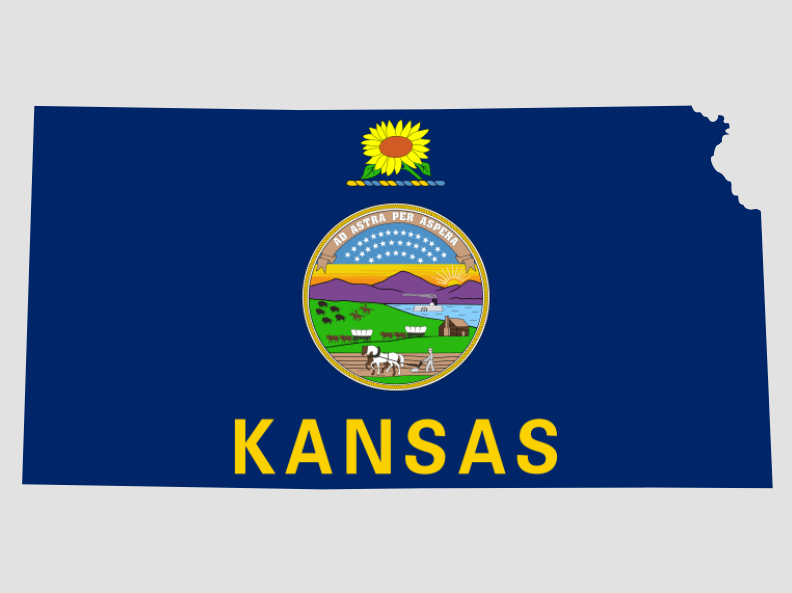
Kansas is a state in the midwestern region of the United States with the abbreviation of KS. Kansas became the 34th state on January 29, 1861, making the state 163 years old, as of January, 2024. The state of Kansas was named for the Kansas or Kanza tribe of the Sioux family that lived along a river in the area. The name Kansas translates to south wind people or wind people.
Kansas is the 15th largest state and the 34th most populous. The capital of Kansas is Topeka and its demonym is Kansan. The state is bordered by the states of Missouri, Oklahoma, Colorado, and Nebraska.
The motto of the state of Kansas is Per Aspera Ad Astra, which is Latin for Through Difficulties To The Stars.
The official nickname of Kansas is the Sunflower State; the sunflower is the State Flower of Kansas and it also appears on the Kansas State Flag and the Kansas quarter. The state of Kansas can also be called the JayHawker State, the Wheat State, and the Breadbasket of the World.
The landscape of Kansas is covered in plains, grasslands, flat expanses, badlands, rolling hills, cuestas, and canyons. The prairies and grasslands in Kansas grow many types of grasses, including buffalo grass, bluestem grass, switch grass, Indian grass, and blue grass.
Kansas is known for founding Pizza Hut, White Castle, Freddy’s Frozen Custard & Steakburgers, and ICEE, and for having the geographical center of the contiguous US in Smith County, for being Dorothy’s home in the Wizard of Oz, for being one of the largest producers of wheat in the United States, and for being quite flat, so much so that Kansas is often said to be flatter than a pancake; the state’s highest natural point, Mount Sunflower at 4,039 feet above sea level, does not appear to be a mountain at all, since the surrounding terrain slops so gradually. Kansas contains some gems, such as agates and opals, and minerals such as calcite, dolomite, and halite (salt). Kansas also possess lots of sulfur containing minerals (sulfides and sulfates) including barite, galena, gypsum, marcasite, pyrite, and sphalerite, which are salts of barium, lead, calcium, iron, and zinc.
Strangely, it appears that Kansas is in a struggle for its state symbols. While Kansas is the largest producer of wheat in the United States, North Dakota is a close second; Kansas produces fewer sunflowers than the states of North Dakota, South Dakota, Minnesota, Texas, and Nebraska; and Kansas is not the flattest state, the states of Florida, Illinois, North Dakota, Louisiana, Minnesota, and Delaware are flatter than Kansas. It seems that North Dakota is giving Kansas a run for its money, perhaps North Dakota could be called New Kansas. Poor Kansas.
On July 24, 1897, a woman named Amelia Earhart was born in Atchison, Kansas. Amelia Earhart and her sister received some homeschooling from their mother and governess, but Amelia later attended public school for the first time at seventh grade in Des Moines, Iowa. Earhart moved across the nation several times, even spending some time in Toronto, Canada, around World War I. She went on to pursue education from Columbia University, but her studies at the university were cut short due to financial struggles. Earhart eventually became involved in aviation, and during this career, she experienced many achievements, such as setting the woman’s altitude record at 14,000 feet, setting the woman’s nonstop transcontinental speed, setting the speed record over a 3k course at 181 MPH, being the first woman to fly across the Atlantic, being the first woman to fly coast to coast solo, being the first person to fly the 2,408 mile distance across the Pacific solo, being the first person to fly from Mexico City to Newark solo, being the first person to fly from the Red Sea to India, being awarded the National Geographic Society’s gold metal, and being awarded the Distinguished Flying Cross. On July 2, 1937, while attempting to become the first female pilot to circumnavigate the world, Earhart disappeared, only weeks before her 40th birthday. She was declared dead in absentia (Latin for in absence) on January 5, 1939.
William Coleman was born in Chatham, New York, in 1870, but his family moved to Labette County, Kansas, in 1871. Coleman started selling small goods as a child and he became a salesman later in life. While selling typewriters in Alabama, Coleman witnessed lanterns which burned gasoline rather than kerosene, after which he switched to selling lanterns. Coleman began crafting his own lanterns, which he marketed as the Coleman Arc Lamp. Coleman later moved to Wichita, Kansas, and developed his GI pocket stove; his business became known as the Coleman Lamp and Stove Company. The company has been selling gasoline lamps since 1900, but it also sells lots of camping gear today. William Coleman even served as the Mayor of Wichita from 1923 to 1924.
Between the years of 1854 and 1861, the series of confrontations known as Bleeding Kansas, Bloody Kansas, or the Border War occurred in Kansas Territory. These conflicts were fought between Antislavery settlers (Free-Staters) and Proslavery settlers (Border Ruffians); abolitionist John Brown was even involved in the war. Both sides attempted to sway the balance of Antislavery and Proslavery settlers in their favor, with the admission of Kansas into the Union on the horizon. The reason why the admission of the state of Kansas was so dire was because the number of Free and Slave States had been kept in a very delicate balance for decades, and with each additional state, the Free States worried that the Slave States would outnumber them and gain a majority in government, and the Slave States worried that the Free States would outnumber them and gain a majority in government. This was amplified in the case of Kansas with tensions building to what would soon become the Civil War. Bleeding Kansas resulted in an Antislavery settler victory with roughly a couple hundred casualties on both sides; Kansas was admitted as a Free State, but the Civil War began almost immediately after.
One interesting fact about Kansas is that the world’s largest hand-dug well is in Greensburg, Kansas. The well was built in 1888, and it measures 109 feet deep by 32 feet wide. The Greensburg Well was named one of the 8 wonders of Kansas in 2008. You can tour the well today and even walk down spiral stairs to descend into the well.
One strange fact about Kansas is that, while Kansas isn’t the flattest state, it is actually flatter than a pancake! A group of researchers from the universities of Texas and Arizona used a mathematical analysis to determine the flatness ratio of Kansas and a pancake they purchased from IHOP. They found that the flatness ratio of the pancake was 0.957 and the flatness ratio of Kansas is 0.9997, with 1 being a perfectly flat surface. Sure, Kansas does have hills, but if you take the pancake that was analyzed and scale it up to the same proportion of Kansas, the pancake’s peaks and valleys would be more extreme than those of Kansas.
What fact about Kansas most interests you?
Onward American 🇺🇸
Source: Origins of State Names
Source: Demonyms for US States

