
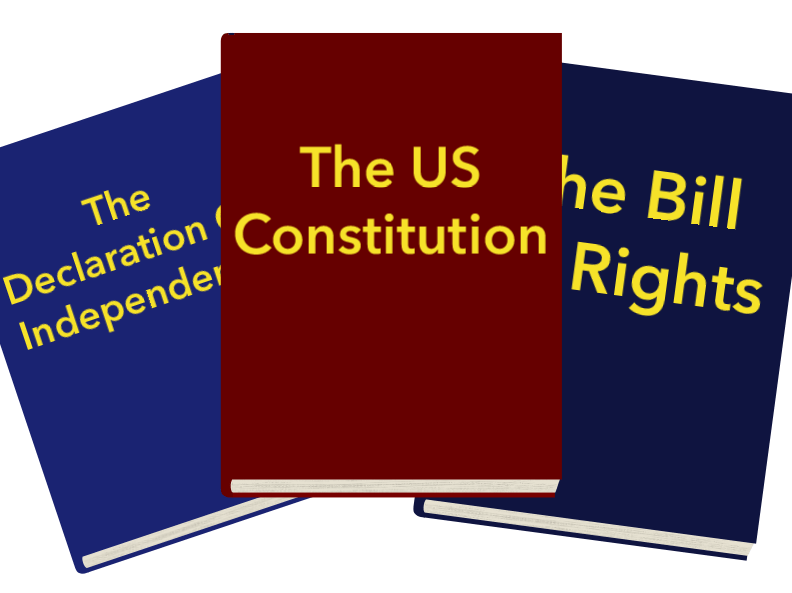
There are some documents that are fundamental to our nation and our way of life. Many people may not be able to say they have fully read them, but I highly recommend that every American reads them at least once in their lifetime.
Of these foundational documents, the following are my highest recommendations:
- The Declaration of the Causes and Necessity of Taking Up Arms
- The Declaration of Independence
- The US Constitution
- The Bill of Rights
- Common Sense by Thomas Paine
- President Washington’s Farewell Address
- President Lincoln’s Gettysburg Address
Perhaps you are asking yourself why these documents are important for every American citizen to read, and I suppose that question is valid, as we should manage our time wisely, since time is one of the most valuable resources we can ever possess, but I assure you that your time will not be wasted, in fact, understanding these documents and the information they present can greatly improve your outlook on life as an American and your function therein.
After reading these documents, I finally understood what it means to be an American, and to a much deeper level than the commercialized and trivial perception that many vaguely harbor; I finally had a glimpse into the heart and soul of the Founding Fathers and the unprecedented nation of liberty they had built and the astounding measures they took to defend it and keep it accountable. To say that the words of our Founding Fathers still apply to our lives today is an understatement; their words of wisdom are our guideline.
Here is my summary of each document:
The Declaration of the Causes and Necessity of Taking Up Arms
In this declaration, the Colonists attempted to reason with Great Britain and the world about why their actions of taking up arms against their aggressor, Great Britain, was justified and necessary.
They explained that they plead with the British throne for a decade to listen to their reasoning, and they described how the British had mistreated them, such as defying the obligations of treaties, marching through their homeland in warlike fashion while destroying lives and property, and bearing falsehoods against the Colonists as a basis for calling all Colonists rebels and traitors.
It appears that these cries for fairness and rationality fell on deaf ears, thus the inevitable ensued.
The Colonists went on to explain that they fought neither for glory nor for conquest, but that they fought as a people attacked by unprovoked enemies.
Perhaps my favorite part of this declaration is the part where they say “We are reduced to the alternative of [choosing] an unconditional submission to the tyranny of irritated ministers, or resistance by force — The latter is our choice.”
I also find it quite interesting how many of the first amendments to the Constitution would go on to prohibit grievances that are discussed in this declaration. The 1st amendment recognizes the Right of the People to petition the government for a redress of grievances; the King disregarded the Colonists’ petition for a redress of grievances. The 2nd amendment protects the People’s Right to keep and bear arms; the King tried to destroy the Colonists’ arms. The 3rd amendment disallows soldiers from being quartered in any house in time of peace without the consent of the Owner; the King quartered soldiers in houses in time of peace. Some of the actions of the King of Great Britain that are recorded in the declaration are also addressed in part by the 4th, 5th, 6th, 7th, and 8th amendments.
The Declaration of Independence
The Declaration of Independence was written by the Colonists during the early stages of their armed rebellion against Great Britain, which is often called the Revolutionary War or the War of Independence. In this declaration, the former British Colonists formally declared themselves completely disconnected from Great Britain as a new and sovereign nation.
The Declaration of Independence was also one of the first, if not the first, document in modern history to formally and publicly recognize that all men, meaning all humans, are created equal, and that we all have inherent, unalienable, God-given Rights. The writers went on to list a few examples of these Rights, being Life, Liberty, and the Pursuit of Happiness.
Think about it; it should seem reasonable that Life, Liberty, and the Pursuit of Happiness are unalienable Rights: we all have been given a Life to live by the Creator and therefore we have a God-given Right to live; our nation is built on the belief that all men are created equal, which suggests that there is no inherent nature of hierarchy or nobility to humanity, but instead we are all citizens with equal social status, meaning Liberty belongs to all of us; and the state of true happiness, not merely superficial happiness, is one of the healthiest qualities for one’s mind, body, and soul to exist within, and as free citizens, it is our Right to Pursue Happiness. Obviously, you must act within reason, and you should not infringe on the Rights of others, and in order to maintain justice, some individuals may be required to forfeit some of their Rights if they have committed atrocities against their fellow citizens.
In addition to standing up for our unalienable Rights, the Declaration of Independence also submitted a list of 27 of the grievances that the King of Great Britain committed against the Colonies which prompted the Thirteen Colonies to separate from Great Britain. The Colonists did petition the King for a redress of his grievances, in an attempt to peacefully resolve the issue, but the King refused, forcing the Colonists’ hands.
The US Constitution
The Constitution is one of the most important American documents that you can read. It was deliberately written to keep the Federal Government accountable, while intentionally structuring the government to serve the People and to protect their unalienable Rights.
Some constitutional amendments have slightly altered and perfected small portions of the Constitution, however, this well-written document is still the rulebook of the United States Government.
The Bill of Rights
The Bill of Rights are the first 10 amendments to the US Constitution. It would be beneficial for you to do your best to memorize at least the majority of the Bill of Rights, or even the summary of them, so that you know what Rights you have at your disposal.
Why should you know them? Well, imagine buying a house and never exploring the rooms that you have. Maybe you prepare your food in your living room, but you never bothered to notice the kitchen just around the corner, which could have given you the tools to cook more easily. In some sense, knowing the Bill of Rights can be similar to this crude example. You have these Rights, these tools, and they are for you to use right here and right now, not at some later date when you may no longer exist on this Earth and it is then too late.
Guard these Rights, and certainly do not hand them over of your own will. Many have laid down everything that they could have had by sacrificing their lives so that we may have these Rights. In comparison to their sacrifice, our sacrifice seems quite small; the most I have suffered for standing up for these Rights is the occasional scoff or look of disapproval.
In short, the Bill of Rights includes:
- The Right to freedom of religion, speech, and the press, and the Right to peaceably assemble and to petition the government for a redress of grievances.
- The Right to keep and bear arms.
- The Right against quartering of soldiers.
- The Right against unreasonable searches and seizures.
- The Rights in criminal cases.
- The Right to a fair trial.
- The Rights in civil cases.
- The Right against excessive bail, excessive fines, and cruel and unusual punishment.
- The Right against the construal of the Rights in the Constitution to deny or disparage the Rights of the People.
- The Right of the States or of the People to reserve the powers not delegated to the United States by the Constitution.
Keep in mind that this is only a summary of the rights, I highly recommend that you read the Bill of Rights to fully understand the Rights in context.
Common Sense
Common Sense was written by Thomas Paine and published as a 47 page pamphlet in early 1776, which questioned the corrupt British rule over the Colonies and advocated for American independence. Paine’s compelling reason and arguments helped the Thirteen Colonies to decide in favor of independence.
Common Sense is still a good document to read today; in the beginning, it goes into detail about what makes a society and how cooperation is clearly in everyone’s best interests when a settlement is small, and how everyone becomes disconnected with each other as the settlement grows; it also precisely highlights characteristics which are indicative of a government that is destructive to its own People.
It is said that history forgotten is bound to repeat itself, so I definitely recommend reading this one.
President Washington’s Farewell Address
This farewell address was written by President George Washington toward the end of his second term as President of the United States. In this document, Washington left the young nation with his final advice, which the nation has sadly forgotten. Washington’s life was tragically cut short only a few years after writing this address at the age of 67.
President Lincoln’s Gettysburg Address
In late 1863, President Lincoln publicly delivered his Gettysburg Address on the site where the fallen soldiers of the Battle of Gettysburg are now buried. The Battle of Gettysburg had the 3rd most US fatalities of any battle in American history, but until the end of World War I, it was the highest fatality battle in all of American history.
Lincoln’s brief and humble address served to recognize the sacrifice that these men had made and to dedicate some land from that battlefield as a final resting place for the fallen on both sides.
Which of these documents is your favorite?
Onward American 🇺🇸
Source: The Declaration of the Causes and Necessity of Taking Up Arms
Source: The Declaration of Independence
Source: Common Sense by Thomas Paine
 Onward American