
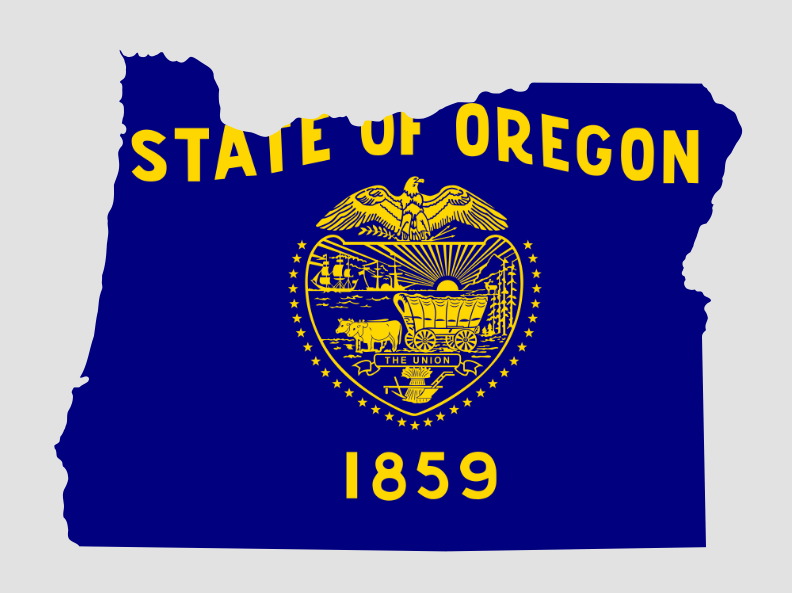
Oregon is a state in the western region of the United States with the abbreviation of OR. Oregon became the 33rd state on February 14, 1859, making the state 167 years old, as of February, 2026. There are several theories about where the name Oregon came from: some say the name is based on origanum, a species of wild sage that is abundant on the coasts of Oregon; others claim that the name comes from Oregones, a Spanish name for an Indian tribe in the area; Joaquin Miller even claimed the name came from the Spanish alura agua, which means gently falling waters.
Oregon is the 9th largest state and the 27th most populous; the capital of Oregon is Salem and its demonym is Oregonian. The state of Oregon is bordered by the states of Washington, Idaho, Nevada, and California as well as the Pacific Ocean.
The motto of Oregon is Alis Volat Propriis, which is Latin for She Flies on Her Own Wings.
The nickname of Oregon is The Beaver State, though this is unofficial. The beaver is Oregon’s official state animal and a golden beaver appears on the reverse of the Oregon State flag. Oregon’s nickname originates from the 19th century, when fur hats were fashionable and Oregon was an important source of beaver pelts.
The landscape of Oregon ranges from rugged coastline on the Pacific Ocean, to dense evergreen forests, to large volcanic mountain ranges.
Oregon is known for its natural beauty, for producing 90% of the world’s marionberries, and for being the destination of the Oregon Trail. Oregon’s land contains many metals, including large deposits of iron, copper, lead, zinc, mercury, silver, and gold.
In the city of Cove, Oregon, Dean Cullen Smith was born on September 27, 1899. In 1917, Smith enlisted in the Aviation Section of the United States Signal Corps and was promoted to master signal electrician soon after. At 17 years old, Smith became the youngest flight instructor in US Army history. Smith volunteered to serve on the front lines during WWI, but he was posted as a flying instructor at Fort Scott. In 1918, Smith was assigned to Gosport Instructor’s School in San Antonio, Texas, and he was later transferred to Rockwell Field in San Diego, California, before he was discharged in 1919. Following his military service, Smith flew as a barnstormer for carnivals and even gave five-minute plane rides for $5. Smith played a large part of the inauguration of the air mail service by the United States Postal Service (USPS) in 1919 — by this point, Smith was only 19 and had already logged over 900 hours of flying time. Smith’s first assignment with the USPS was to fly mail from Omaha, Nebraska, to California on a route that roughly followed the Oregon Trail — amazingly, it took Smith’s mother 2 years to travel the Oregon Trail from Council Bluffs, Iowa, to Cove, Oregon, by covered wagon in the early 1870s, but only 48 years later, Smith flew mail across the trail in under a week. By 1920, Smith became an official air mail pilot; this job was very dangerous as engines were unreliable, weather was unpredictable, and crashes were common. Smith served as an air mail pilot until 1927, and during his time with the USPS, he logged nearly 3,800 hours and 366,000 miles of flight. During the late 1920s, Smith had been chosen as one of the pilots for the Byrd Antarctic Expedition, during which he flew over Antarctica searching for land that had not yet been claimed by any country. Smith would go on to fly for various companies, including commercial airlines. Smith passed away in 1987 at the age of 87.
John P. Thompson of Portland, Oregon, invented a new type of screwdriver to fix issues with the standard screwdriver, but Thompson sold the design to Henry Phillips. This type of screwdriver would go on to be called the Phillips screwdriver; it was patented in 1932.
On December 26, 1866, the Battle of Owyhee River occurred in Malheur County, Oregon. In response to attacks from the Paiute along the Owyhee River earlier in 1866, Lieutenant Colonel George Crook set out with a company from the 1st US Cavalry until they reached the camp of Chief Howluck in southeast Oregon. On the morning of December 26, Crook’s troops attacked the Paiute camp while they were sleeping. The Paiutes were determined to fight back, but Crook’s men returned fire with deadly accuracy. The Paiute warriors were forced to take cover behind rocks until they eventually retreated. The battle ended in a US victory; after the battle, a Wells Fargo mail pouch was retrieved from the Paiutes who had taken it during their earlier raid.
An interesting fact about Oregon is that the city of Portland was given its name after the flip of a coin. The city was settled by Francis Pettygrove of Portland, Maine, and Asa Lovejoy of Boston, Massachusetts. These two men were unable to agree on the name of the city, and therefore, they flipped a coin to determine whether the city should be named Portland or Boston.
A strange fact about Oregon is that the state is home to the world’s smallest park, which is called Mill Ends Park. This park occupies an entire 0.00000011 square miles of land, which is aobut 3.1 square feet.
What fact about Oregon most interests you?
Source: Origins of State Names
Source: Demonyms for US States
Source: Oregon Inventions that Changed the World
 Onward American