

Around the year 1400 AD, there was a claim that a new element was discovered by an alchemist whose name is lost to history, but this new element would be unrecognized until the 18th century.
Finally, in the year 1753, French chemist Claude-François Geoffroy, who was assisted by the earlier work of Johann Heinrich Pott, formally identified this mysterious metal as a new element.
This new element was a dense metal with a very low melting point, which had been used by metallurgists for centuries to make a variety of alloys, but it had often been confused with lead, tin, and antimony because the properties and appearance of this metal are very similar to those of the aforementioned metals.
It is believed that this metal was named weiße Masse, which in German means white mass or white substance. Its German name later became Wismut, which eventually became the Latin name bisemutum, which then became bismuth in English.
Properties of Bismuth

Bismuth is a post-transition metal, meaning it is a metal found after the transition metals on the periodic table. Bismuth shares some properties with the other post-transition metals (aluminum, gallium, indium, thallium, tin, lead, and polonium) and the other elements in bismuth’s column (nitrogen, phosphorus, arsenic, and antimony).
Bismuth is a fragile metal with the symbol Bi, and like most of the post-transition metals, bismuth’s melting point is quite low (521ºF). Bismuth is steel-gray in color with either a slight golden or pinkish hue.
Bismuth is well known for its ability to form terraced crystals that are sometimes described as looking like hoppers, which are frequently coated in an oxide layer of varying thickness, causing the crystals to look like rainbows, ranging from lustrous golds, to deep violets, to vibrant aquas.
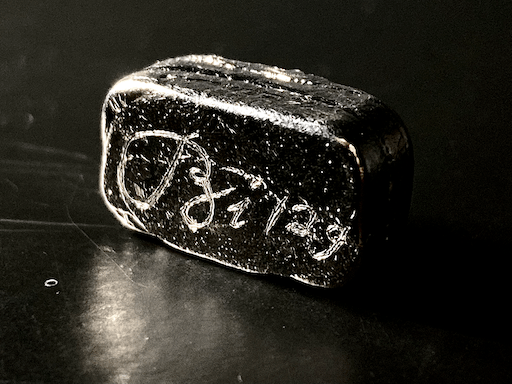
Conventionally, bismuth is considered the last stable element on the periodic table as every element after bismuth is radioactive, however, in 2003, it was discovered that bismuth is technically radioactive, but its half-life is an astounding 19 quintillion (19,000,000,000,000,000,000) years, compared to the 4.5 billion (4,500,000,000) year-long half-life of Uranium-238, in other words, the half-life of bismuth is 4 billion times longer than that of uranium, which means that the half-life of bismuth is the half-life of uranium squared. For this reason, bismuth is practically non-radioactive.
Bismuth is the second least thermally conductive metal and one of the least toxic metals.
Uses of Bismuth
Bismuth oxychloride is used in many cosmetics, such as eyeshadows, lipsticks, and nail polishes to give them a shimmering look.
Bismuth is sometimes used in medications, for instance, bismuth subsalicylate is an active ingredient in Pepto-Bismol, which is used as an antacid and antidiarrheal.
Because bismuth is nearly as dense as lead but much less toxic, bismuth can be used in place of lead in many applications, such as fishing sinkers, solders, and occasionally shotgun pellets.
Bismuth is sometimes used as a lubricant for machining aluminum and steel.
Bismuth is also sometimes used by manufacturers as a catalyst in the production of synthetic fibers and rubbers.
What do you like most about bismuth?
 Onward American