
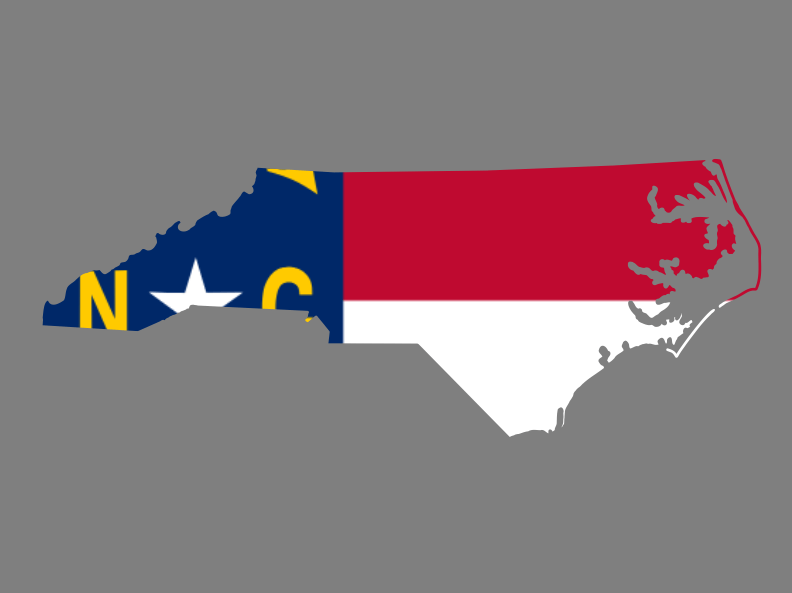
North Carolina is a state in the southern region of the United States with the abbreviation of NC. North Carolina became the 12th state on November 21, 1789, making the state 235 years old, as of November, 2024. North Carolina’s name is derived from the colony of Carolina. The land that is now part of North and South Carolina was referred to as Carolina in the early 17th century in some English newspapers, which was believed to have been named in honor of King Charles I of England. Around 1663, those who received a grant to establish the colony of Carolina named it in honor of King Charles II of England. In 1712, Carolina was split and the northern portion became the colony of North Carolina, which then formed the United States by declaring itself the state of North Carolina in 1776.
North Carolina is the 28th largest state and the 9th most populous; The capital of North Carolina is Raleigh and its demonym is North Carolinian. North Carolina is one of the thirteen original states. North Carolina is bordered by the states of South Carolina, Georgia, Tennessee, and Virginia and the Atlantic Ocean.
The motto of North Carolina is Esse Quam Videri, which is Latin for To Be, Rather Than To Seem.
The state of North Carolina can be called the Tar Heel State (which is believed to refer to the state’s history of being a major producer of naval stores including tar, pitch, and turpentine from its pine forests) and the Old North State (which came from the time when Carolina was split because the northern portion of Carolina was older than the southern).
The landscape of North Carolina is composed of the Appalachian Mountains, Piedmont Plateau, and the Atlantic Coastal Plain.
North Carolina is known for its natural beauty, the Blue Ridge and Great Smoky Mountains, for being the site where the first American gold rush began in 1799, for Roanoke island (the island where the first English North American colon was established in 1585), and for being the place where the Wright brothers performed the first flight. The land of North Carolina contains metals such as zinc, tin, lead, iron, titanium, lithium, cobalt, copper, tungsten, molybdenum, silver, and gold.
In the year 1732, Robert Howe was born in New Hanover County in the Province of North Carolina, British America. Around the year 1755, Howe captained a militia company in Bladen County, and in 1760, he was elected to the Province of North Carolina House of Burgesses from Bladen County; in 1764, the assembly created Brunswick County, and Howe was appointed its justice of the peace and re-elected to the assembly from Brunswick County several more times. In 1765, Howe helped found the Wilmington Sons of Liberty organization, which actively protested the Stamp Act of 1765. Howe served during the French and Indian War and he was even commissioned as a captain of militia and was given command of Fort Johnston. Howe also served as a commander of artillery and quartermaster general during the Battle of Alamance. On August 25, 1774, Howe represented Brunswick County when the First Provincial Congress convened to ban the exportation of goods including pitch, tar, and tobacco to England and the importation of British tea into North Carolina; Howe would even go on to demand reforms from Royal Governor Josiah Martin. When Howe received news of the Battles of Lexington and Concord which officially marked the beginning of the Revolutionary War in April of 1775, Howe began to drill local militia using the unusual combination of fiddles and drums rather than the standard fifes and drums. Howe served during numerous battles during the Revolutionary War, including the Burning of Norfolk, the Capture of Savannah, and the Battle of Stony Point; Howe was one of only five generals and the only major general in the Continental Army from North Carolina. In the summer of 1786, Howe was elected a member of the North Carolina House of Commons; on his way to one of those meeting, Howe became ill and, and on December 14, 1786, Howe died in Bladen County. Howe was buried on a property he owned in what is now Columbus County, North Carolina.
On December 17, 1903, brothers Orville and Wilbur Wright performed the first sustained flight by a manned heavier-than-air powered aircraft near Kitty Hawk, North Carolina. Though the Wright brothers were not the first to design a flying machine, they had invented the first powered machine that could fly while carrying a human. This machine, which is known as the Wright Flyer, was the forerunner of modern airplanes.
Between February 7 and 8, 1862, the battle of Roanoke Island occurred on Roanoke Island and in Croatan Sound, North Carolina. On the first day of the battle, Union gunboats exchanged fire with Confederate forts on the shores of Roanoke Island and Confederate gunboats, who were termed the Mosquito Fleet. Toward the end of the day, Union troops under the command of General Ambrose Burnside landed on Roanoke Island unopposed, however, shortly after landing, the Union troops camped for the night as it was too late in the day to fight. On the second day, the Union troops advanced on the forts, but were halted by Confederate artillery that was accompanied by Confederate infantry in the center of the island. The Confederates believed that their line was safely anchored by the impenetrable swamps, however, the Union troops flanked them on both sides. The Confederates retreated to the forts, but those were soon taken by the Union soldiers. Once Confederate Colonel Henry Shaw sensed defeat was inevitable, he surrendered in order to avoid unnecessary bloodshed, causing the battle to conclude in a Union Victory. It is interesting to note how a battle in the war that threatened to tear the United States apart was fought on the very soil upon which the first English colony was established — a colony that would ultimately fail, but eventually lead to the formation of the United States.
An interesting fact about North Carolina is that the state is home to the birthplace of the first English settler born in North America. North Carolina is home to the island of Roanoke, on which Roanoke Colony — the First English Colony — was established. On August 18, 1587, the granddaughter of the governor of Roanoke Colony was born in the colony and she was named Virginia Dare. The governor sailed back to England for supplies but was delayed for three years due to the war between England and Spain. By the time he returned to Roanoke in 1590, the inhabitants of the colony had disappeared. The fate of Virginia is still unknown to this day. Roanoke Island is now part of Dare County, North Carolina.
A strange fact about North Carolina is that the infamous pirate Blackbeard once lived in Bath, North Carolina, however, he was killed by British sailors on November 22, 1718, while hiding on Ocracoke Island, North Carolina.
What fact about North Carolina most interests you?
Onward American 🇺🇸
Source: Origins of State Names
Source: Demonyms for US States
 Onward American