

The design of the current US flag is defined as thirteen horizontal stripes alternating red and white; in the canton, one white star for each state arranged in horizontal rows (of alternating numbers of six and five) on a blue field. This is merely an adaptation of the Flag Resolution of 1777, which made the thirteen-star US flag — most famously the Betsy Ross — the national flag of the United States. The resolution read Resolved, that the flag of the thirteen United States be thirteen stripes, alternate red and white; that the union be thirteen stars, white in a blue field, representing a new constellation.
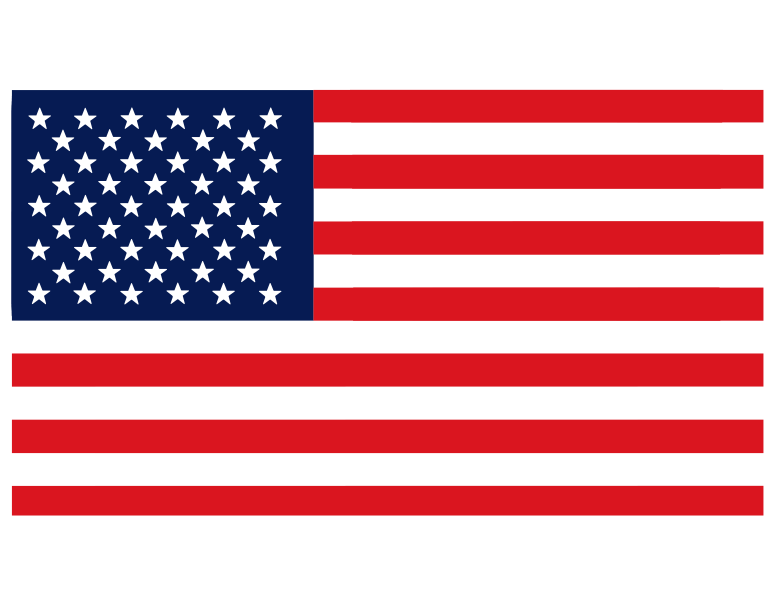
I feel that the current design is clearly defined, with 50 stars to represent the 50 states and 13 stripes to represent the thirteen colonies, but what if the definition was either vague or written differently? How would the flag have looked if its definition was slightly altered?
Here are a few examples of how I think the US flag could have looked if it was interpreted differently:
Fifty Stripes

As in the case of the fifteen-Star US Flag, the number of stripes could revert back to equalling the number of stars, which would elongate the flag to this ridiculous proportion. I think I now understand why it was decided that the number of stripes would always be 13.
Thin Stripes

If 50 stars and 50 stripes were used, but the height of each stripe was shrunken in order to maintain the 10 by 19 ratio of the current US Flag, then this would be the flag. From a distance, it almost looks like a blue field of stars on a pink flag.
Stripes Forever

While there isn’t any blue on this flag, it’s possible someone could have decided that the flag should have 13 stripes to represent the 13 colonies and 50 stripes to represent the current 50 states.
Stripes and Stars

Perhaps they could have inverted the stars and stripes, making a blue flag with 50 stars and a field of 13 stripes in the canton.
Ross Betsy

The Ross Betsy could have been used if they decided to invert the Betsy Ross. This flag not only inverts the placement of the stars and stripes, but also their quantities. There are 13 stars on a blue flag to represent the 13 colonies and 50, staggered stripes in the canton to represent the current 50 states.
After designing this flag, I discovered that the flag of Easton, Pennsylvania, looks very much like this one; the Easton Flag was adopted on July 8, 1776, making it nearly a year older than the Betsy Ross. I suppose this confirms that a flag similar to my Ross Betsy could have become the national flag of the US.
Blue Stars

This flag does away with the blue field; it is a flag of 13 stripes with 50 blue stars placed on top of the stripes.
Blue Stripes

This bizarre flag is a simple adaptation of the Blue Stars, this time, the white stripes have been made blue, allowing the stars to remain white.
Deconstructed

This is a simple flag that contains all of the components of the current US flag, but separated by kind. There are the 50 white stars stacked, next to the red stripes, next to the white stripes on top of the blue field. This is potentially what the US flag could have looked like if the components of the flag were specified but their placements were not; I suppose it would have also taken a very unimaginative designer.
Which version of the US Flag — actual or fictitious — is your favorite?
 Onward American
These are really fun explorations of a deconstruction flag. It’s cool to see how the significant numbers that make up the official flag result in some interesting reinterpretations.
LikeLiked by 1 person
I’m glad to hear that you also appreciated this concept. It really is quite interesting to see how those numbers could be reworked; I had no clue that there were so many ways to interpret them until I began altering the design. This certainly was a fun topic.
LikeLike