
In 1863, While examining zinc ore with the intent of discovering the presence of thallium, German chemists Ferdinand Reich and Hieronymous Theodor Richter viewed the spectral lines from a sample of their zinc ore.
Each element has its own distinctive spectral lines, which are the portions of the visible light spectrum that the element absorbs. Reich and Richter were expecting to find the spectral lines that would indicate the presence of thallium, however, they were amazed to find an unusual indigo spectral line, which suggested that there was an undiscovered element present in their sample.
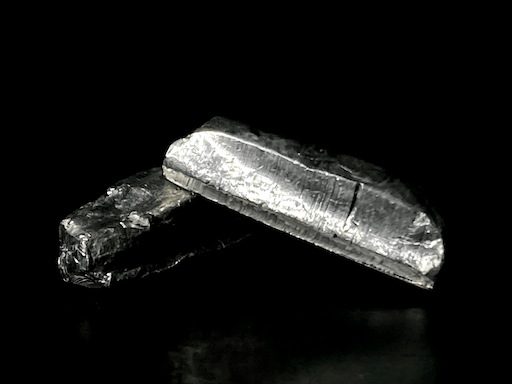
A few years later, Richter isolated the element, which turned out to be a silvery-white metal that was not only soft enough to be cut with a butter knife, but it could also be pulled apart by hand.
In reference to its indigo spectral line, this new element’s name was made by combining the Latin word indicum (meaning indigo) and the suffix for newly discovered metals -ium, making the element indium. Indium was given the symbol In.
Properties of Indium
Indium is a soft, malleable post-transition metal that has a very low melting point. On the periodic table, indium is in the same column as the metalloid boron; the post-transition metals aluminum, gallium, and thallium; and the synthetic element nihonium, whose properties are yet unknown.
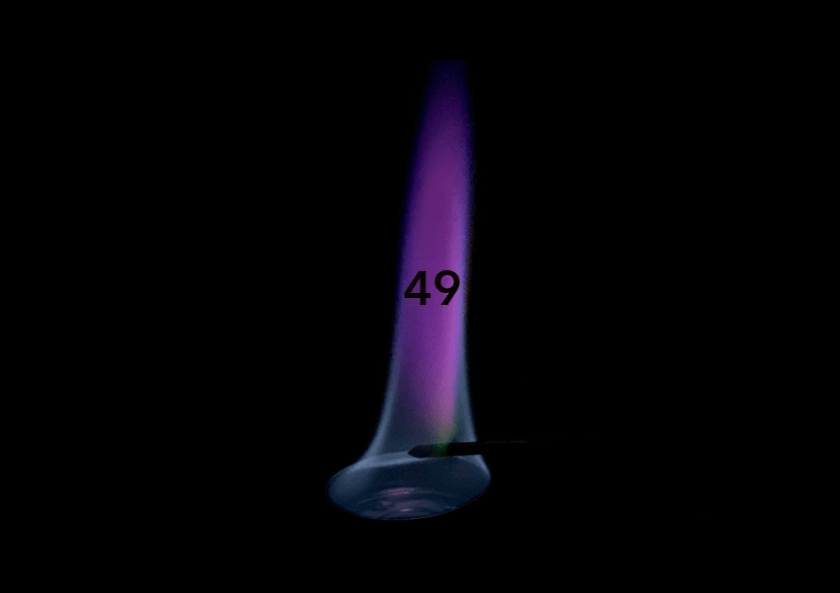
I have always been told that indium produces blue light in a flame test, however, I wasn’t exactly sure what to expect when I performed my flame test. I first attempted to make indium trichloride in hopes that it would be one of the best indium salts for producing color, like most other chlorides in my experience. After that attempt only proved to be slightly successful, I placed a fragment of indium metal in the flame and I was surprised to witness purple flames, which are pictured in this post’s featured image. Excited indium atoms appear to emit light in the indigo to violet portion of the visible light spectrum, which seems quite fitting considering the element’s name.
Uses of Indium
Just under a century after its discovery, indium was being used during World War II as a coating for the bearings in aircraft, and it is still being used today to coat bearings in high performance engines in order to increase oil retention.
Indium has been used in electronic components such as transistors and rectifiers.
Indium can be used to make alloys with low melting points for products such as solders, fusible links, and fire safety devices.
In the modern world, the place you are most likely to find indium is in the screen of your smartphone, as indium is combined with tin to make a compound known as indium tin oxide (ITO), which is used as a transparent electrode in touchscreens. The demand for electronic devices with touch screens is so high that a large percentage of all indium produced is used to make ITO.
What do you like most about indium?
 Onward American