
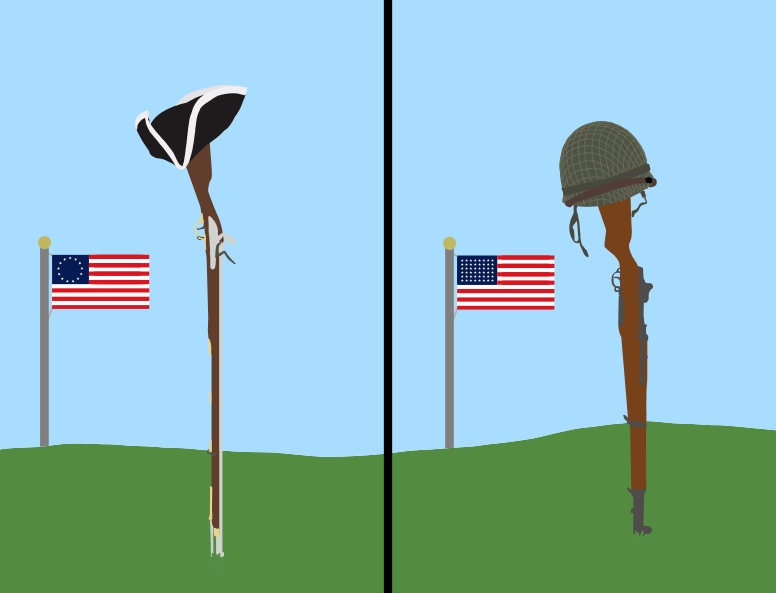
I recently composed a list of traditional patriotic music for celebrating patriotic holidays, however, that list contained many songs from the Revolutionary War, but not many from other time frames. It dawned on me that I should submit a list of music from some of the major wars that America faced to give a glimpse into our past in order to understand how America sounded throughout the stages of our development.
Here is a list of three songs per war that were popular during the war:
Revolutionary War
Chester
William Billings originally wrote the lyrics of Chester in 1770 for his book called the New England Psalm Signer. The song reflects Billing’s sentiment of gratitude for America’s deliverance from tyranny.
Free Americay
Written by Dr. Joseph Warren in 1774, Free Americay — sometimes called a Song on Liberty — is a song that Warren used to encourage Americans to resist the tyrannical British rule.
Yankee Doodle
Yankee Doodle is believed to have been originally written by a British army surgeon by the name of Richard Schuckburg in 1755. The song was originally intended to ridicule the Colonists during the French and Indian War, as they were perceived as a ragtag militia, however, the song gained popularity among the Colonists, especially during the Revolutionary War.
Civil War
The Battle Cry of Freedom
The Battle Cry of Freedom was written in 1862 by George F. Root as a Union war song. The song was particularly intended to encourage Americans to join the army in response to President Lincoln’s call for volunteers.
The Battle Hymn of the Republic
This song was written during the Civil War by Julia Ward Howe, who was inspired by the song John Brown’s Body. Howe wrote the Battle Hymn of the Republic to be a patriotic anthem for the Union cause; the song was first published in 1862.
Dixie’s Land
Dixie’s Land was written by Daniel Decatur Emmett in 1859 for a minstrel show which was performed in New York City. The song quickly gained popularity in the Confederate States during the Civil War and it was used as a rallying cry for the Confederacy, however, Abraham Lincoln, who was born in Kentucky, publicly expressed his fondness of the song; Lincoln had Dixie’s Land played during his presidential campaign and even at the White House toward the end of the Civil War in an attempt to unify the nation.
World War I
Let’s All be Americans Now
This song was written and composed by Irving Berlin, Edgar Leslie, and George W. Meyer; it was first published in 1917. The song was written in order to promote national unity.
Over There
George M. Cohan wrote Over There on April 6, 1917, which was the day on which the United States declared war on Germany; Cohan intended the song to be a patriotic call to arms to encourage Americans to enlist in the army, however, it could be argued that the song was also a warning to the enemies of America.
The Star Spangled Banner
The lyrics to the Star Spangled Banner were written by Francis Scott Key in 1814. Though the song didn’t become the national anthem until 1931, the song exploded in popularity once the United States entered World War I; several versions of the song were recorded in 1917.
World War II
American Patrol
American Patrol was first written in 1885 by Frank White Meacham. This song is a march that depicts a military band approaching, passing, and fading into the distance. Meacham incorporated themes and melodies from patriotic songs such as Columbia, the Gem of the Ocean; Dixie’s Land; and Yankee Doodle. In 1942, Glenn Miller and his orchestra recorded their version of American Patrol, which gained popularity during World War II.
Boogie Woogie Bugle Boy
Boogie Woogie Bugle Boy was written in 1941 by Don Raye and Hughie Prince for the 1941 musical comedy film Buck Privates. Originally, the song was supposed to have been performed by Lou Costello, but in the end, it was the Andrews sisters who performed the song in the film. According to the songwriters’ plan, the song resonated with many people and it became quite popular during World War II.
God Bless America
This song was first written by Irving Berlin in 1918 and it was originally intended for Berlin’s musical revue Yip, Yip, Yaphank, but Berlin later revised the song. God Bless America was first published in 1938 and it was popularized by Kate Smith.
Which era of American wartime music do you like the most?
 Onward American