
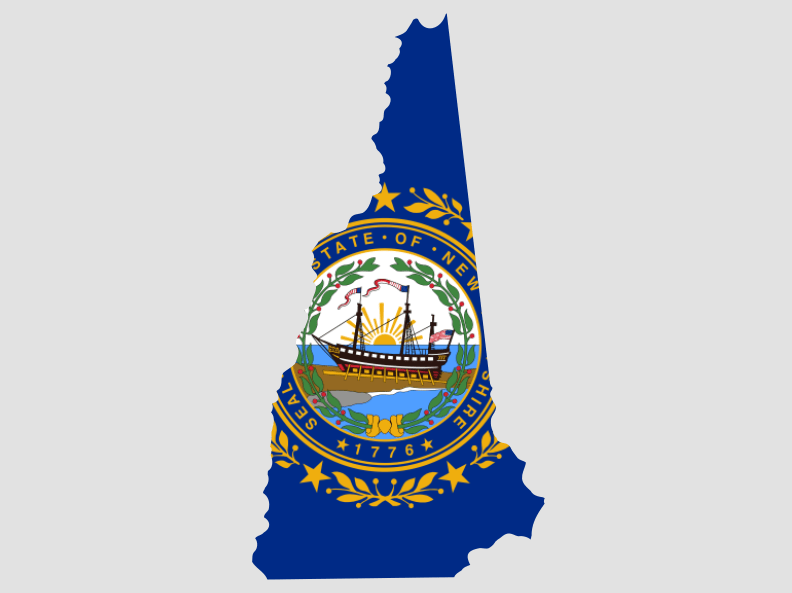
New Hampshire is a state in the northeastern region of the United States with the abbreviation of NH. New Hampshire became the 9th state on June 21, 1788, making the state 236 years old, as of June, 2024. The colony of New Hampshire was named after the English county of Hampshire in 1629 by John Mason; the colony of New Hampshire became the state of New Hampshire in 1776, and the state finally ratified the Constitution in 1788.
New Hampshire is the 46th largest state and the 41st most populous; the capital of New Hampshire is Concord and its demonym is New Hampshirite. New Hampshire is one of the thirteen original states. New Hampshire is bordered by the states of Maine, Massachusetts, and Vermont as well as the Atlantic Ocean and the Canadian province of Quebec.
The motto of New Hampshire is Live Free or Die. This phrase was coined in 1809 by General John Stark — a veteran of the Revolutionary War; in a toast commemorating the Battle of Bennington, Vermont, Stark said “Live free or die. Death is not the worst of evils.”
The nickname of the state of New Hampshire is the Granite State; granite is also New Hampshire’s state rock.
The landscape of New Hampshire is full of dense forests, rugged mountains, and lakes.
New Hampshire is known for its natural beauty, its outdoor recreation, the White Mountains, Mount Washington, and for being the first state to declare independence from Great Britain; New Hampshire is also the snowiest state in the lower 48. The land of New Hampshire possesses valuable metals such as iron, lead, copper, silver, and gold.
On February 11, 1704, Joseph Blanchard was born in Dunstable, New Hampshire Colony, which is now Nashua, New Hampshire. At the age of 20, Blanchard joined the New Hampshire Militia as a lieutenant. Joseph Blanchard was married in 1728 and he had 12 children with his wife, one of which was Johnathan Blanchard, who became a delegate to the Congress of the Confederation in 1784. Joseph Blanchard held many jobs, including surveyor of the state of New Hampshire and judge of the Superior Court of New Hampshire. Blanchard served in the French and Indian War, during which he oversaw the patrolling of the upper reaches of the Merrimack River valley, the attack on Crown Point on Lake Champlain, and the construction of Fort Wentworth in Northumberland, New Hampshire. Blanchard would neither witness the end of the French and Indian War nor the establishment of the United States as he passed away in 1758. A few years after his death, a more accurate map of New Hampshire that Blanchard prepared with Samuel Langdon was published.
In 1787, Levi Hutchins invented the first American alarm clock in Concord, New Hampshire. Hutchins’ alarm clock was not necessarily designed to be used by anyone other than himself, as the original device only rang at 4 AM to awake Hutchins for his job. It wasn’t until 1847 that the French inventor Antoine Redier patented an adjustable alarm clock.
It appears that no major battles have ever occurred in New Hampshire, however, the state provided many troops and supplies during many wars, namely the French and Indian War, the Revolutionary War, and the Civil War. New Hampshire contributed significantly toward many major battles including the battles of Bunker Hill, Bennington, Saratoga, and Gettysburg.
An interesting fact about New Hampshire is that the state is the site of the highest wind speed ever recorded in the United States. In 1934, the Mount Washington Observatory measured a 231 MPH wind gust! That is roughly a third of the speed of sound, which is also 4 times faster than the fastest Martian wind, 1.25 times faster than the fastest Venusian wind, and 2 times faster than the usual wind speed of Jupiter.
A strange fact about New Hampshire is that the early settlement that would become the colony of New Hampshire was originally named North Virginia by Captain John Smith of England. Later, John Mason gave the settlement the name New Hampshire after the English county of Hampshire.
What fact about New Hampshire most interests you?
Onward American 🇺🇸
Source: Origins of State Names
Source: Demonyms for US States
 Onward American