
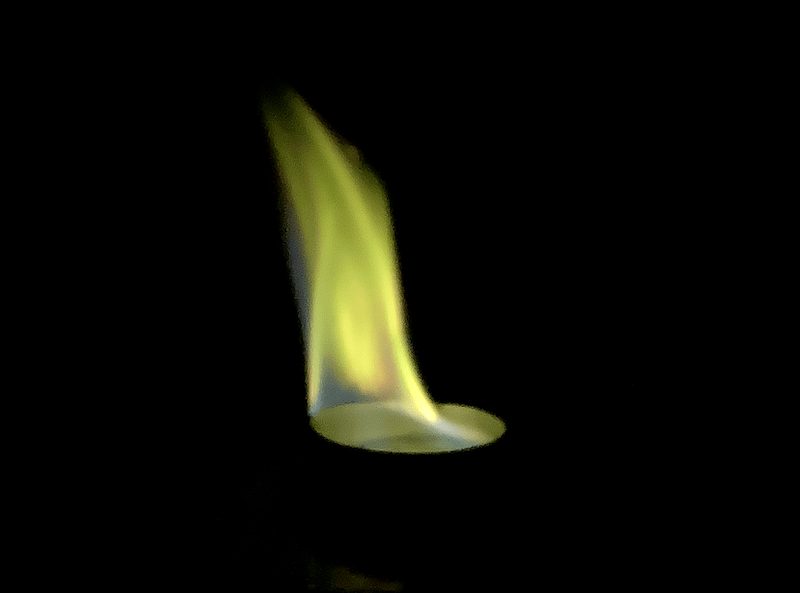
In the year 1603, some glowing stones were discovered near Bologna, Italy. These mysterious stones were given the name Bologna stones; the mineral that caused the stones to glow was one of the first luminescent materials discovered and the first material discovered that displayed persistent luminescence.
In 1774, Carl Wilhelm Scheele identified a material that was related to the mineral in the Bologna stones, which was given the name baryta.
It wasn’t until 1808 that the metal in these compounds was first isolated by Sir Humphry Davy using electrolysis. After isolating this unusual and reactive metal, Davy named the metal after the Greek word barys, meaning heavy; the element’s name became barium and it was given the symbol Ba.
The glowing mineral in the Bologna stones was simply barium sulfide and the baryta Scheele identified was merely barium oxide.
In Elemental Exploration No. 38, I mentioned that Adair Crawford was studying a newly discovered mineral — strontium carbonate — which he named Strontianite, but what I did not mention in that post is that the Witherite that Crawford was also studying is merely barium carbonate. What’s interesting about the fact that Crawford was studying Strontianite and Witherite around the same time is that both minerals are carbonates of an alkaline earth metal, meaning they both have similar properties.
Practical Uses for Barium
Barite (barium sulfate) is a vital component in drilling muds used to drill oil wells as the density of barite controls the wellbore pressure, however, barite is also used in medical imaging as a contrast agent when X-raying the digestive tract.
Some barium compounds, such as barium oxide, are used in glassmaking when glass with a high refractive index is necessary, like in the case of optical lenses.
Because barium is an alkaline earth metal, it may be found in your bones due to the fact that its properties are so similar to the calcium and magnesium that your body deposits into your bones.
Barium nitrate and barium carbonate are widely used in pyrotechnics to produce green flames and stars.
One of the most significant drawbacks of barium is its harmful nature. It is known to be severely irritating to your eyes, lungs, and skin. The only reason that barium sulfate is safe enough to be given to humans internally in the medical field is because barium sulfate’s solubility in water is so low that it is almost completely insoluble, and if barium minerals are not in solution, they cannot react with most substances.
Barium sulfate is also one of the few salts to emit a type of infrared light that cannot be reabsorbed by the atmosphere, therefore causing the heat it emits to escape the Earth entirely. This is why NightHawkInLight used barium sulfate to make a self-cooling compound in this video.
What do you like most about barium?
 Onward American