
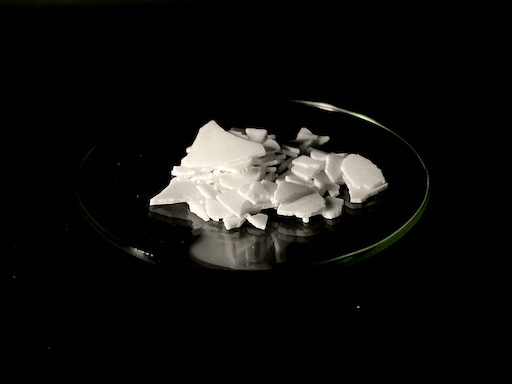
Several millennia ago, it was discovered that when wood or plant ashes were placed in a pot of water, a caustic solution was produced; the caustic compound that was produced was given the name potash, which referred to the ash that was placed in a pot. This potash, which is now also called lye, has been used for food preservation, cleaning, and even soap manufacturing ever since.
In the year 1807, an English chemist named Sir Humphry Davy became the first person to isolate the metal which is in potash. This newly discovered metal was named by adding the Latin suffix -ium to potash, but rather than calling it potashium, the name was slightly adapted, making it potassium. As we now know, the mysterious and caustic potash that people discovered long ago was nothing more than potassium hydroxide.
Potassium has the symbol K, which is derived from the Latin word Kalium, meaning potash.
Characteristics of Potassium
Potassium is an alkali metal, which means that it is related to lithium, sodium, rubidium, cesium, and francium.
As I mentioned in Elemental Exploration No. 38, Group 2 metals need to lose 2 electrons before they stabilize, but alkali metals, which are also known as group 1 metals, only need to lose 1 electron before they stabilize. This is because group 1 metals have one electron in their valence shells, meaning that when they lose one electron, their valence shell becomes empty, making the next highest shell the new valence shell, which is already filled with electrons and therefore making the alkali metal ion much more stable. This nature causes the alkali metals to be more reactive than every other metal, in fact, they are so reactive that they often explode in the presence of water.
The nucleus of every element, except for Hydrogen-1, consists of protons and neutrons. The type of atom is determined by the number of protons — meaning that if a nucleus has 19 protons, the atom is potassium — but each nucleus can have a different number of neutrons; the isotope of the atom is determined by the number of neutrons. An isotope is named by placing the number of nucleons (protons and neutrons in the nucleus) after the element name, for example, the most common potassium isotope, Potassium-39, has 39 nucleons, which also means there are 19 protons (element number 19) and 20 neutrons (39 nucleons minus 19 protons).
The most radioactive atom that is naturally found in the human body is Potassium-40, which only has 1 more neutron than Potassium-39 has, but that extra neutron is enough to make the potassium isotope unstable, causing it to decay into either Calcium-40 or Argon-40.
Potassium-40 can decay by converting one of its neutrons to a proton, electron, and antineutrino, in which case the electron and antineutrino are ejected and the proton remains in the nucleus, increasing the number of protons from 19 to 20, which makes it element number 20 (calcium). Potassium-40 can also decay by converting one of its protons to a neutron, positron, and neutrino, after which the positron and neutrino are ejected; this decreases the number of protons in the nucleus from 19 to 18, making it element number 18 (argon).
Fun Fact, the previously mentioned positron and antineutrino are both forms of antimatter, which are produced in your body 4,000 to 5,000 times per second! As cool as that sounds, you will never notice it because the antimatter is almost instantly destroyed, due to the fact that electrons and positrons obliterate each other on contact and neutrinos and antineutrinos obliterate each other on contact.
It is a well-known fact that bananas are rich in potassium, but because all sources of potassium contain a small amount of radioactive Potassium-40, bananas are inherently radioactive and therefore expose you to a small amount of radiation when consumed. This is why radiation is sometimes measured in bananas.
Biological Role of Potassium
Potassium is an essential mineral and electrolyte in your body. Potassium is necessary for muscle contraction, nerve function, blood pressure regulation, and kidney function. Along with sodium, potassium has many functions in your body, including maintaining fluid inside and outside your cells, regulating the fluid balance in your eyes — preventing dry eyes, controlling your cells’ intake of nutrients, helping to expel waste from your cells and blood stream, neutralizing acid in your blood stream, regulating your heart rhythm, enabling communication between the neurons in your brain, reducing calcium loss in your bones, and improving bone mineral density.
Potassium in Pyrotechnics
Potassium salts are essential in pyrotechnics. Some potassium salts are so reactive that they are a great oxidizer for pyrotechnic reactions. That quality, combined with that fact that potassium does not emit an overpowering color of its own, makes potassium salts a popular choice for pyrotechnicians, in fact, potassium salts can be found in nearly every firework.
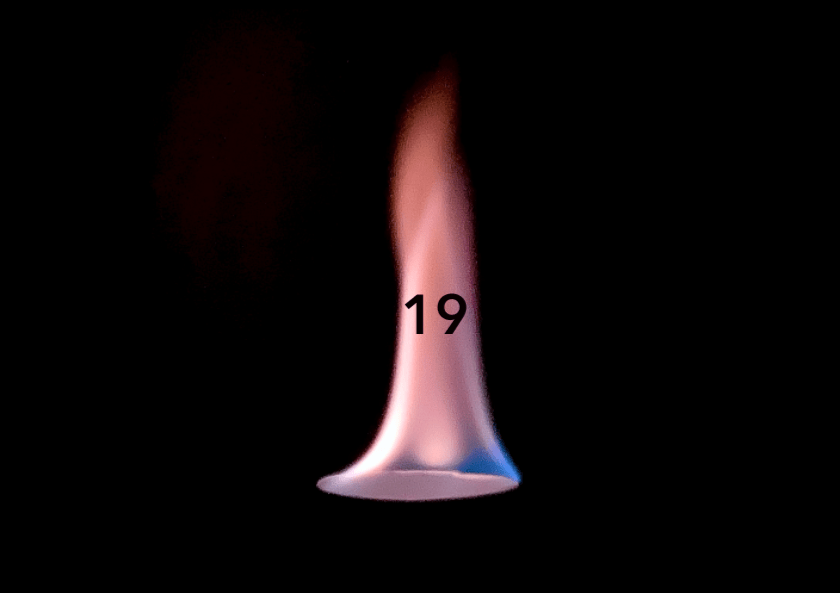
In flame tests, potassium emits a faint, purple flame, which is often described as lilac.
What do you like most about potassium?
 Onward American