
In the late 18th century, Adair Crawford was studying Witherite and a mysterious, new mineral which he named Strontianite. Crawford named the mineral in honor of Strontian, Scotland, because the lead mine in that village is the place where Strontianite was discovered.
Strontianite
A couple decades later, a man named Humphry Davy finally broke Strontianite down into its components via electrolysis, which revealed that Strontianite is a salt (an ionic compound consisting of an anion and a cation).
After performing electrolysis on strontianite, Davy noticed that he had isolated a peculiar metal which he had not seen before. This metal was observed, and it was soon realized that it was a new element. This element was given the name Strontium and the elemental symbol Sr; strontium is the only element named after a place in the UK.
It was also discovered that Strontianite is primarily composed of strontium carbonate. It turns out that Witherite is composed of barium carbonate, which means that the Witherite and Strontianite that Crawford was studying were related to each other: they are both carbonates of alkaline earth metals.
I wanted to show a sample of strontium carbonate, but I didn’t have any in my possession, however, I realized that there was one immediate cure for this predicament: a double displacement reaction.
A double displacement reaction is a chemical reaction in which the ions of two salts switch places with each other, in other words, one cation gives its anion to the other cation, and the other cation gives its anion to the first cation.
If I mixed two soluble chemicals that produced a soluble chemical and insoluble chemical, it would be incredibly easy to isolate both products of the reaction. This is precisely what I did in order to make some strontium carbonate. Here is a video of my performing this reaction.
And this is how milk is made! I’m joking; even though the resulting solution looks very similar to milk, it would be a terrible idea to drink it. Remember, NEVER consume the products of a chemistry experiment!
I am certainly not the first to perform this reaction or to write this reaction’s chemical equation, but while considering the chemicals that I had on hand and the desired products, this is the equation that I constructed for this reaction:
Sr(NO3)2 (aq) + Na2CO3 (aq) -> SrCO3 (s) + 2 NaNO3 (aq)
This means that a solution of strontium nitrate mixed with a solution of sodium carbonate will produce a solution of sodium nitrate and a precipitate of strontium carbonate. As you can see, the nitrate ion (NO3–) moves from the strontium to the sodium, and the carbonate ion (CO32-) moves from the sodium to the strontium.
I used 12.5 grams of strontium nitrate and 6.2 grams of sodium carbonate, which I estimated should produce 8.7 grams of strontium carbonate, but in the end, I only produced 6.2 grams of strontium carbonate, which suggests that my yield was only 71%. This isn’t a terrible yield for my crude system, however, my calculations were assuming that all chemicals were dry, but only my product was dry; I believe this means my yield is actually higher than 71%, but I don’t have a way to prove that.
I realized after the fact that I should have only used 4.9 grams of sodium carbonate with the 12.5 grams of strontium nitrate to have a perfectly stoichiometric ratio; in reality, I had a large excess of sodium carbonate.

I was surprised by how the strontium carbonate looked and acted much like limestone, which probably shouldn’t be surprising, given that limestone is calcium carbonate.
This strontium carbonate will definitely not go to waste, as these 6.2 grams of strontium carbonate will allow me to make about 78 grams of red star composition for my fireworks! I also have plans for the sodium nitrate.
Strontium
Strontium is element number 38. This does not mean that strontium is the 38th element to be discovered; technically, scientists do not number the elements, instead, the elements have already been numbered by their physical structure.
The nucleus of strontium always has 38 protons within it; if it had more protons or fewer protons, it would be a completely different atom. Strontium’s 38 positively charged protons attract 38 negatively charged electrons. This is what makes strontium the 38th element.
As strontium was observed, it was discovered that its properties are similar to those of beryllium, magnesium, calcium, barium, and radium; we could now predict this because these are all alkaline earth metals, which means they are all group 2 elements (existing within the 2nd column of the periodic table).
This also means that strontium, like all other group 2 elements, has 2 valance electrons. All atoms want to have their valance shells (the outermost shells) full of electrons. Their valance shells can hold 8 electrons (except for hydrogen and helium, which have valance shells that can only hold 2 electrons). In an attempt to have a full valance shell, strontium can give up its 2 valance electrons fairly easily, which causes its valance shell to be empty, making the shell lower than this now empty shell the new valance shell, which is filled with 8 electrons. This is why group 2 elements are very reactive.
After losing its 2 valance electrons, the strontium atom only has 36 electrons, but its nucleus still has 38 protons. Because there are 2 fewer electrons than there are protons, the atom’s charge isn’t balanced, causing the strontium atom to have a charge of +2. That means this strontium atom is now an ion, and because it is positively charged, it is more accurately a cation; we write this strontium ion as Sr+2.
Properties of Strontium
Many of strontium’s salts are boring, white salts, unlike the colorful salts of the transition metals.


We all know that the majority of the calcium in our bodies accumulates in our teeth and bones, and it is the calcium phosphate that gives our bones their strength, but did you know that there is also a lot of magnesium in your bones?
This is because magnesium is an alkaline earth metal just like calcium. It turns out that every alkaline earth metal is similar enough to each other that your body struggles to differentiate between them. There is naturally a small amount of strontium in the foods that we consume, and because strontium is so similar to calcium, our bodies mistakenly deposit this strontium in our bones, thinking it is calcium, in fact, whenever your body encounters beryllium, magnesium, calcium, strontium, barium, and radium, it is likely to deposit them into your bones.
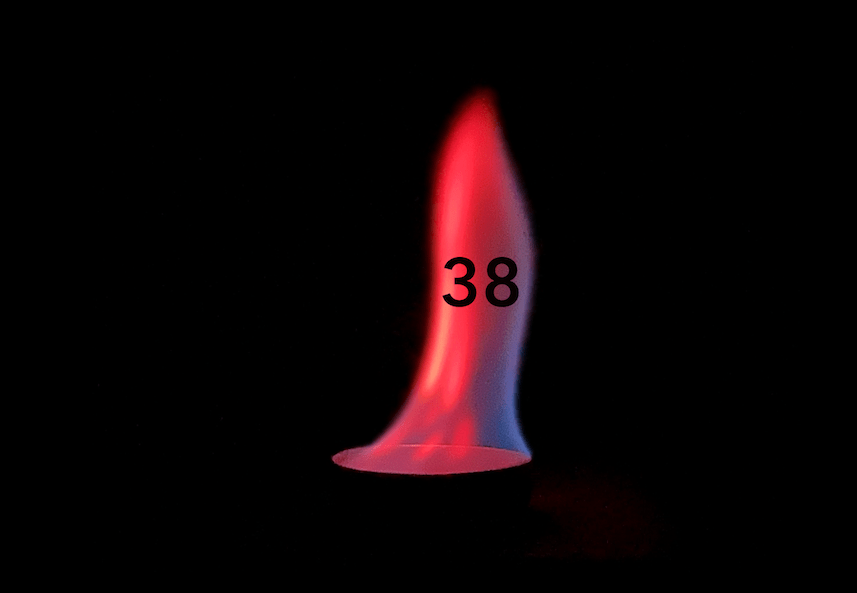
There are, however, some differences between the alkaline earth metals, if you recall my pyrotechnics series. When placed into flames and heated to high temperatures, strontium will produce bright red flames, whereas calcium produces orange flames and barium produces green flames.
If you remember my struggles with strontium salts in a flame test from my Atomic Colors post, then you will know that, for some reason, my strontium chloride burned with an orange flame, unlike the red flame that everyone else on the internet effortlessly produced by burning strontium chloride.
To fix this issue, I theorized that heating strontium chloride to around 350ºF would drive off any water in its crystal structure, but I don’t quite see how the small amount of water would change the color from red to orange. I’m starting to wonder if my strontium chloride sample is either impure or not even strontium chloride.
Either way, I resolved this issue by using a large heap of strontium nitrate, which had already proven to burn red in my fireworks, and I then poured methanol over it, which did produce this amazing red flame; finally!
What do you like most about strontium?
 Onward American