
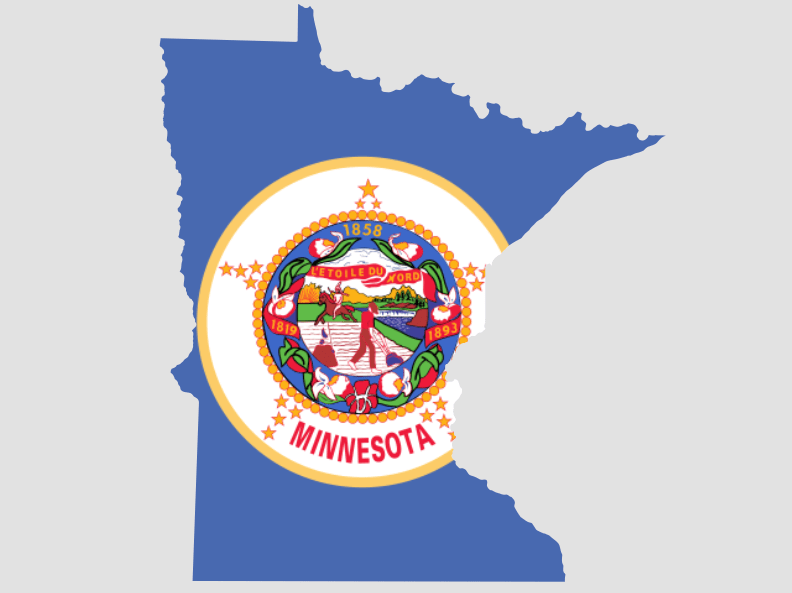
Minnesota is a state in the midwestern region of the United States with the abbreviation of MN. Minnesota became the 32nd state on May 11, 1858, making the state 166 years old, as of May, 2024. The state of Minnesota was named after the Minnesota River, whose name came from the Sioux word for cloudy water or sky-tinted water.
Minnesota is the 12th largest state and the 22nd most populous; Minnesota’s capital is Saint Paul and its demonym is Minnesotan. Minnesota is bordered by the states of Michigan (over water), Wisconsin, Iowa, South Dakota, and North Dakota; the Canadian provinces of Manitoba and Ontario; and Lake Superior.
The motto of Minnesota is L’étoile du Nord, which is French for the Star of the North.
The official nickname of Minnesota is the North Star State, which is derived from the state’s motto. Minnesota can also be referred to by several other nicknames:
- The Land of 10,000 Lakes, which alludes to the number of lakes in Minnesota (which is tThe landscape of Minnesota is full of fertile prairies, vast farmlands, expansive forests, numerous sloughs and wetlands, and many lakes and rivers.The landscape of Minnesota is full of fertile prairies, vast farmlands, expansive forests, numerous sloughs and wetlands, and many lakes and rivers.echnically closer to 12,000 or 15,000, depending on the source).
- The Gopher State, which comes from an 1850’s political cartoon that ridiculed the $5 million railroad loan that helped open up the West, in which devious railroad barons were portrayed as striped gophers pulling a railroad car which carried the territorial legislature toward the slough of despond.
- The Bread and Butter State, which was a nickname given to Minnesota during the 1902 Pan-American Exposition in Buffalo, New York, because of Minnesota’s superior wheat, flour, and dairy products.
- New England of the West, which was given to the state because of the large number of New Englanders that moved to Minnesota Territory.
The landscape of Minnesota is full of fertile prairies, vast farmlands, expansive forests, numerous sloughs and wetlands, and many lakes and rivers.
Minnesota is known for lots of things, such as:
- The Mall of America
- Prince
- Laura Ingalls Wilder, author of the Little House on the Prairie serieswho stayed in various places across Minnesota, including her family’s dugout sod house near Walnut Grove, Minnesota
- Tonka Trucks
- Nordic Ware, which invented the Bundt Cake Pan
- Walleye
- Wild Rice
- Hotdish
- Traditional Scandinavian foods, including Lefse and Lutefisk
- Itasca State Park and Lake Itasca, which is the place where the Mississippi River begins
- Inventing Spam
- Birthplace of Mayo Clinic
- Birthplace of Waterskiing
- Volunteering the first Union troops during the Civil War
- Supplying the majority of America’s iron during WWII
- America’s largest iron producer
- America’s largest turkey producer
Minnesota also possesses materials such as mineable quantities of iron, manganese, copper, nickel, platinum, and titanium, as well as gold, zinc, lead, and diamonds in quantities that are not yet known.
On July 15, 1951, James George Janos was born in Minneapolis, Minnesota, but he is better known by the name Jesse Ventura. Ventura served in the US Navy from 1969 to 1975, serving during the Vietnam War. Ventura did not see combat, but he served as part of the Underwater Demolition Team 12 (UDT 12); in 1983, UDT 12 was reorganized as SEAL Delivery Vehicle Team One. After his military service, Ventura became a professional wrestler with the stage name Jesse “The Body” Ventura; he retired from wrestling in 1986. Ventura has also acted in several movies since 1987, with his most recent movie in 2014. Ventura served as the mayor of Brooklyn Park, Minnesota, from 1991 to 1995, and he also experienced an unlikely victory in a 1998 election when he defeated both the Republican and Democratic candidates and served as the 38th governor of Minnesota in the Reform Party. During his service as governor, bumper stickers and T-shirts were seen throughout Minnesota with the phrase My governor can beat up your governor.
In 1902, a small company in Two Harbors, Minnesota, attempted to mine corundum, a hard abrasive that is used to make sandpaper and grinding wheels, however, the material that they thought was corundum was actually the lesser valuable anorthosite. The company was originally known as Minnesota Mining and Manufacturing Company, but today it is known as a simplification of those three M’s: 3M. A few years later, 3M moved south to Duluth, Minnesota, and focused on sandpaper manufacturing. In the year 1910, 3M moved to Saint Paul, Minnesota, and it began expanding rapidly, manufacturing countless products in numerous categories over the years, including abrasives, automotive parts and hardware, building materials, cleaning supplies, dental and orthodontic supplies, electrical equipment, insulation, lab supplies, medical supplies, PPE, tapes, and tools; 3M even provided products to help in the war effort during WWII. Some of 3M’s inventions include Scotch cellophane tape, Scotchgard, reflective signs, and Post-It notes. 3M now operates in 70 counties and sells products in 200!
From the 20th to the 22nd of August, 1862, the Battle of Fort Ridgely occurred in Nicollet County near Fairfax, Minnesota; this battle was one of the first battles of the Sioux Uprising, which is sometimes called the Dakota War of 1862. Only days after attacking US troops and civilians in nearby locations such as the Lower Sioux Agency in Redwood County, the Redwood Ferry on the border of Redwood County and Renville County, and the city of New Ulm in Brown County, Little Crow brought several hundred men to Fort Ridgely. Shortly after reaching the fort, Little Crow’s men launched a surprise attack on the fort, firing at the severely outnumbered troops. Lieutenant Gere was able to keep the Dakota at bay with his Howitzer cannon, which prompted the Dakota to attempt to force their way into the fort, but they were held off by Sergeant John Jones and his field gun, assisted by Lieutenants Norman Culver and James Gorman along with the Renville Rangers. By nightfall, the Dakota has still failed to enter the fort. The next day was rainy, which allowed the defenders to strengthen the fortifications. On the third day, the Dakota attacked again, but their numbers were about doubled this time. The Dakota managed to seize a couple buildings, but the buildings were ignited and the Dakota withdrew from them soon after. By the end of the day, the Dakota had entered the fort, but they were repelled by several field guns. The fighting had ceased on the night of August 22, but the garrison didn’t leave the fort until several days later, when Colonel Henry Sibley (who served as the first governor of Minnesota only a couples years prior) arrived with 1,400 troops from Fort Snelling. The battle resulted in an American victory.
An interesting fact about Minnesota is that its northern tip is the only portion of land in the contiguous US above the 49th parallel — neglecting any surveying errors; in other words, it is the northernmost point in the United States, besides Alaska. This tip, known as the Northwest Angle, has been claimed by the United States since July 4, 1776, and the Northwest Angle was confirmed as being part of the United States in the second article of the Treaty of Paris of 1783, which defines the northwestern boundary of the United States as stretching from Lake Superior, following a waterway to the northwestern point of Lake of the Woods, then heading to the Mississippi River and following the river south. The Northwest Angle was technically considered part of Virginia Colony since 1607, but then the state of Virginia ceded the Angle to the federal government in 1784; the Angle became part of the Northwest Territory in 1787, then part of Indiana Territory in 1800, then part of Illinois Territory in 1809, then it was transferred to Michigan Territory in 1818, then it became part of Wisconsin Territory in 1836, then part of Minnesota Territory in 1849, and it finally became part of the state of Minnesota in 1858.
A strange fact about Minnesota is that the state apparently has more shoreline than California, Hawaii, and Florida combined! Even though Minnesota has 0 miles of oceanic shoreline, the state does have 45,000 miles of lacustrine shoreline and 138,000 miles of riverine shoreline. This means that Minnesota has 183,000 miles of shoreline, which is greater than the 169,000 miles of combined shoreline of California, Hawaii, and Florida, however, Minnesota only has more shoreline than these three states combined if you include rivers and streams.
What fact about Minnesota most interests you?
Onward American 🇺🇸
Source: Origins of State Names
Source: Demonyms for US States
 Onward American