
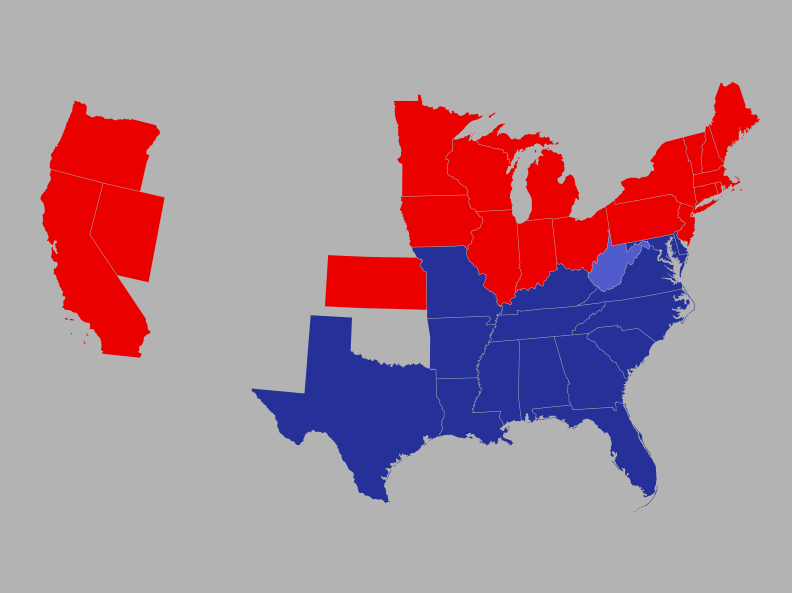
I should preface this post by saying that slavery is indeed a terrible thing, which should have never existed. I never have condoned, and never will condone, slavery in any way, shape, or form. I view slavery as a violation of the unalienable, God-given Rights of mankind, particularly the three which were acknowledged in the Declaration of Independence: Life, Liberty, and the Pursuit of Happiness.
The intention of this post is not to glorify or praise slavery or the fact that some states had legalized slavery, but merely to examine a struggle and a balance that existed in the United States for some time, which ultimately left its mark on the map, shaping and forming the states that we know today.
A Rift Develops
Tragically, slavery has occurred throughout the majority of history. Europe brought lots of tools and inventions to the New World, but with them, they sadly also brought slavery.
England brought slaves to their North American colonies, making slavery legal in each of the Thirteen Colonies. Once the colonies began fighting for independence, several of the northern colonies also started working on limiting or abolishing slavery.
During the time of the Treaty of Paris of 1783 — the treaty in which Britain formally recognized the United States’ independence — several northern states had prohibited slavery, becoming the first Free States. These newly formed Free States passed the first abolition laws in the Atlantic World.
While the northern states were prohibiting slavery, the southern states still relied on slaves to function, and, therefore, were not willing to relinquish slavery. This divergence of interests and beliefs in the states initiated a struggle to maintain a perfect balance of Free and Slave States.
The reason why a perfect balance was so important was because both sides feared that if the other side gained a larger number of states, they would secure a great advantage over them in the Federal Government; the Slave States didn’t want the Free States to federally prohibit slavery, and the Free States didn’t want the Slave States to federally legalize slavery.
For this reason, many states were admitted in pairs during that time; if a Slave State was admitted in the South, it was followed shortly after by a Free State in the North, and vice versa. This even allowed some states, which otherwise had little hope of becoming a state, to acquire statehood in order to maintain the perfect balance, for instance, Maine had been attempting to break away from the state of Massachusetts, but its petitions for statehood were not a high priority for the Federal Government, until it was realized that Missouri was going to become a Slave State without a Free State to offset it, at which point Maine was admitted as a Free State.
Here is a video showing how the balance of Free and Slave States transpired.
Interestingly, West Virginia (in light blue from 1863 to 1864 in the video) was admitted as a new state into the United States, but technically as a Slave State. At that point in the war, Lincoln had already issued the Emancipation Proclamation, meaning the Union wasn’t exactly interested in allowing new Slave States. West Virginia was likely a Slave State because it came from Virginia, a lifelong Slave State, and changing the structure of a state doesn’t exactly happen overnight. The reason why an exception was made for West Virginia is because the state had a gradual abolition plan.
Complete Abolition
Through God’s mercy, we finally resolved the issue of slavery with President Lincoln’s Emancipation Proclamation of 1863 and the ratification of the 13th Amendment in late 1865. These freedoms did not come freely, though, as many hundreds of thousands of Americans on both sides lost their lives in the struggle to conclude this disagreement. It’s pitiful that more Americans have fallen to our own hands than the sum of those who have fallen to the hands of foreign enemies; let not their sacrifice be in vain, hold fast to our Union and our Liberties.
In retrospect, the Civil War is often thought of as a war that revolved only around slavery, however, slavery was just one of the many factors which led to that complex war.
Maybe some Confederates fought to preserve slavery, but Confederate soldiers did not necessarily approve of slavery; some thought that the war was actually being fought for something much bigger: States’ Rights.
I found this recording of Julius Franklin Howell, a man who was raised in Virginia shortly before the Civil War. In the recording, Howell shares his experience fighting in the war for the Confederate Army and his perspective on the war. His entire story is quite interesting to listen to, but Howell makes a good point in the end of the recording (around 9:57) when he says:
“My friends, as a boy of sixteen and a half years old, I didn’t think about any of abolition of slavery. My mind wasn’t developed enough to take in what the politicians had in mind, and hence, there was no trouble as to the freedom of the slaves. The South did not fight for the preservation or extension of slavery. My friends, this was a great curse on this country, that we had slavery, and I thank God that I did not bring up my boys and girls under a system of slavery under which I was brought under. ‘What did you boys fight for then?’ Here’s what great many people do not know: that as a young man, that way I couldn’t understand it fully, but I look back now and see my heart in it, and so what we struggled for, and that was for States’ Rights.”
Julius Franklin Howell
What do you think about the balance of Free and Slave States?
 Onward American