
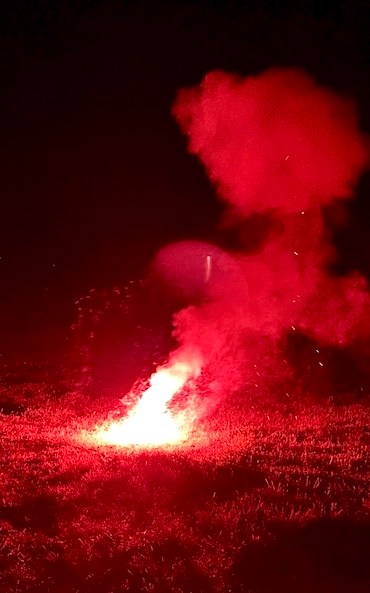
One of the latest pyrotechnic experiments that I performed was an attempt to make a rainbow flare. I designed this flare to burn brightly with one color at a time, but cycling through the colors of the rainbow, starting with red and ending with violet.
It took me roughly a month to make this flare, since there were seven layers, and I had to make one layer at a time; I also had to wait several days for each layer to cure before making the next layer.
Sadly, the colors were not as distinct in the video as they were in person, but if you watch the glare in the video, you may notice the tiny, upside down reflection of the flame. The color of that upside down flame in the glare appears to be much closer to the actual color of the flame than the flame itself. I’m guessing that the reason why the color is more noticeable in the glare than in the flame is because the flame burned too brightly and it became overexposed, but the glare is much dimmer than the flame.
When editing the video, I noticed that the several frames from the video which the timeline used as a preview caused the colors of the flare to be much more evident.

The purpose of this experiment was to demonstrate that only three colorant compounds can produce all of the colors of the rainbow, in other words, the entire visible spectrum. These three colorant compounds that I used were strontium nitrate, barium nitrate, and copper oxide, which, when burned, produce the colors red, green, and blue, respectively. You may notice that these colors are the same colors that the pixels in your screen use to mimic most colors in nature — I say mimic because your screen cannot produce any colors other than red, green, and blue; any other color that you see on your screen is actually an illusion.
Applying the same color theory that pixels use to pyrotechnics should hypothetically produce the same range of colors as that of your screen, but there are some unique challenges and limitation when it comes to pyrotechnics; it is relatively easy to produce any color, however, I still have not yet figured out how to produce darker shades of colors, if it is even possible. Producing a darker color with my flare is difficult because I am using fire, which emits intense light; in order to make a darker shade of a color, you need to reduce the amount of light that the color is emitting until it is significantly dimmer than the ambient light. Currently, this seems impossible to me because these flares are intended to burn in the night, which is a time when there is practically no ambient light, and the fire emits a huge amount of light; these two factors cause the flare to appear as a bright color, not a dark one. Another challenge is that the colorant is not the only compound in the flare to contribute color, since a flare must also contain a fuel, oxidizer, and chlorine donor, which all produce their own colors, even if faintly.

In the end, this rainbow flare did technically produce all of the colors of the rainbow, which looked pretty amazing, even though there were a couple issues. The most obvious issues were that the green color looked nearly white, and the indigo color was very dim. I believe that the green simply burned too hot, causing it to emit white light, but this effect could have been exacerbated by the fact that the surrounding foliage was also green, and the reason why the indigo was so faint was probably due to the fact that blue is a notoriously difficult color to produce in pyrotechnics, since copper is practically the only metal that burns with a decent blue flame, but it annoyingly doesn’t burn as brightly as strontium and barium do.
What is the next firework that I should attempt to make?
 Onward American