
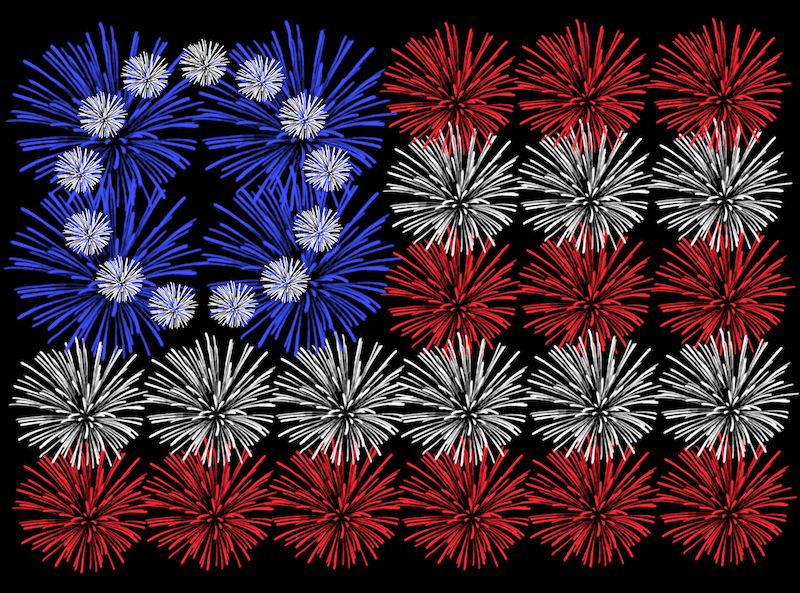
On this day, 248 years ago, the Continental Congress adopted the Declaration of Independence, which listed a couple dozen of the grievances that king George III committed against the Colonies and why it was necessary for the Colonies to separate from Great Britain.
This declaration allowed the United Colonies to become a new nation, which recognized the God-given Rights of the People, some of which are Life, Liberty, and the Pursuit of Happiness. This new nation would be given the official name of the United States of America only a couple months after it officially declared independence. Check this post out to see how the United States got its name.
Many of us will enjoy fireworks today as we celebrate the United States’ 248th birthday, but as the sparks and streams of color fly, how many of you will think about what makes the color inside the fireworks?
I wasn’t even aware of what caused the colors to shine in fireworks until last year, when I discovered that the colors are produced by metals; when a metal atom inside the flame is heated in the right condition, typically in the presence of chlorine to adjust and intensify the desired color, some of its electrons will absorb energy, which causes them to jump to higher orbitals. When the atom cools down, it reemits the energy in the form of a photon of light, which allows the electrons to jump back down to lower orbitals; the frequency of the light, which dictates the color of light that is perceived, is determined by the difference in energy levels of the higher and lower orbitals.
In short, different metals in fireworks will produce difference colors.
The following is a list of common colors in fireworks and what metals, or nonmetals, produce the colors. For each color, I will provide a list of elements that can produce that color, arranged from more commonly used to less commonly used.
Don’t try making your own fireworks unless you are a trained pyrotechnician who understands the local laws and how to safely handle chemicals and pyrotechnic material; remember, always study Safety Data Sheets for each chemical, wear proper Personal Protective Equipment (PPE), use fuses to ignite all chemicals and stay far away from the burning material, and heed all warnings; don’t be cheap or lazy, preserve your health. If you ever decide to burn any pyrotechnic material, including blackpowder, I strongly recommend starting with no more than a gram of material; I do this to reduce the damage done by a burning composition if it is more violent than I anticipated.
Red

- Strontium
- Lithium
Strontium is by far the most commonly used metal to produce red flames. The strontium salts used are typically strontium nitrate or strontium carbonate, but strontium sulfate is sometimes used. Strontium emits vibrant red flames, even with very little chlorine donors present, at least in my experience with strontium nitrate. Strontium is moderately harmful to your body, because it acts very much like calcium and it will accumulate in your bones, so avoid inhaling or ingesting it.
Rarely, lithium salts, such as lithium carbonate, might be used to make a red flame or to enhance a red flame, but there is scarcely any reason to use lithium in red fireworks, besides, lithium burns with a magenta flame, not a red flame; strontium is practically the only metal that burns red. It is also wise to reduce your exposure to lithium, because moderate to large quantities of lithium can lead to coma, brain damage, or even death.
Green

- Barium
- Boron
- Copper
Barium nitrate or barium carbonate are almost exclusively used to produce green flames in pyrotechnics, though barium sulfate (barite) can also be used; caution should be used when handling barium compounds, as barium can be a serious irritant.
Sometimes boron containing compounds are used for green flames, however, boron is a very toxic metalloid and it should generally be avoided in pyrotechnics.
Rarely, people may attempt to use copper to produce a green or teal flame, since copper compounds will often produce greenish flames when not enough chlorine donor is present. Besides this, some copper compounds, such as cupric sulfate, will burn greenish more often than blue. Copper salts are often toxic to humans and animals and extremely toxic to plant life; copper salts are also know for staining surfaces.
Blue

- Copper
Blue is quite possibly the most difficult color to produce in pyrotechnics, since copper is basically the only metal that is not exotic or very dangerous and that will produce a blue flame; sadly, copper can be a little finicky even when it works, and many pyrotechnicians argue over which composition burns with the best blue. For these reasons, the chemistry of blue fire is a little more particular. Cupric oxide and cupric carbonate are frequently used to produce blue fire, however, cupric benzoate, cupric oxychloride, and cupric sulfate can also be used. Remember, copper salts are often toxic to humans and animals and extremely toxic to plant life, and they may stain surfaces, also bear in mind that metal oxides, such as cupric oxide, burn very hot and therefore may react much more violently than you may expect.
Yellow

- Sodium
- Barium + Strontium
Sodium salts, such as sodium nitrate, sodium oxalate, and even sodium chloride (table salt) may be used to make yellow fire, since they produce intense, yellow flames; pros for sodium salts are that they are usually cheap, ubiquitous, and sometimes much safer than other chemicals used in pyrotechnics.
If you recall back to the green and red colors, you may be wondering how barium (green) and strontium (red) can produce yellow. This is because fire emits light, which makes it additive color (like the pixels on this screen), unlike pigments that absorb light, which are subtractive color (like paint). In additive color, when green and red are combined, the resulting color appears as yellow. In my experience, this works quite well, but I would suggest using slightly more green than red, especially since the red tends to be very intense.
Orange

- Carbon
- Calcium
- Strontium + Sodium
Carbon is the element responsible for nearly all orange flames. In pyrotechnics, charcoal (which is practically pure carbon) is used to make orange glitter and sparks, but the unintentional orange flames from the blackpowder in fireworks are also caused by the charcoal within the blackpowder (charcoal is also what causes blackpowder to look black). Most of the fires that we witness in our lives, such as bonfires, are orange; this is due to the presence of carbon within the fuel, since most fuels that we encounter on a daily basis contain carbon, such as wood and other plant materials, papers, oils, waxes, and hydrocarbons (i.e. gasoline, propane, and butane).
Apparently, some calcium salts, such as calcium chloride, can make an orange flame, but I have not yet tried to make an orange flame with calcium.
Again, using the additive color trick, you could produce an orange flame by using mostly strontium (red) and a little bit of sodium (yellow), but this seems like a waste of the more expensive strontium when you could simply use much cheaper and more ubiquitous materials like calcium salts and charcoal, though there may be practical uses for strontium and sodium in orange flames.
Purple

- Copper + Strontium
- Potassium
Besides the lavender flame of the very expensive and explosive metal cesium, there really aren’t many metals that burn with a purple flame. The only way I know to produce a good purple is using the additive color trick again. Combining copper (blue) and some strontium (red) can give you decent purples.
Potassium burns with a very soft, lilac color, however, it is easily overpowered by other colors, and there is often orange contamination in the flame, depending on what materials are used. I have had minor successes with potassium salts, but I have yet to make a recipe that produces a lilac flame worthy of recommendation.
Pink

- Strontium
- Lithium
- Calcium
There aren’t a lot of metals that produce a pinkish flame, and not many pyrotechnicians focus on the color pink. One trick is to produce pink is to include a small amount of strontium into a white flame, which may give the illusion of pink.
Lithium salts, such as lithium carbonate, can be used to make pink fireworks; this would seem like the best place for lithium, since it burns with a magenta flame, but lithium isn’t very common in fireworks and it is fairly toxic, as I mentioned in the red category.
Another way to produce pink flames is to use calcium slats, such as calcium sulfate (gypsum) or calcium carbonate (limestone), to produce a pinkish flame, but there can be some orange contamination within the pink flame. I have enjoyed this version of pink fire, since I feel it is distinct enough from the red and orange flames once it is in the air. Another thing that I like about this method is that the calcium salts are quite easy to acquire; I ground down a piece of scrap drywall for the relatively pure gypsum.
White
- Magnesium
- Titanium
- Aluminum
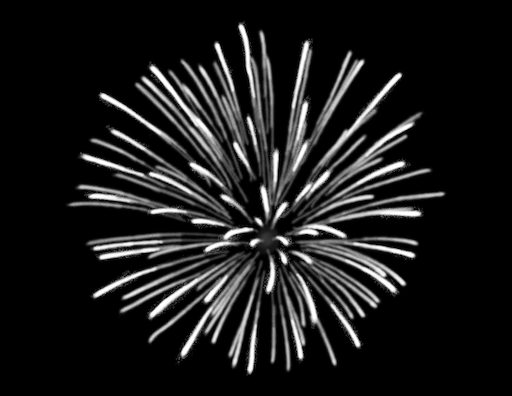
White sparks and flames often come from burning metal powders; magnesium and titanium are some of the most common metal powders used in fireworks to make white sparks or fire, however, metal powders are extremely dangerous. Magnesium powder is highly reactive, and stored fireworks containing magnesium have been known to spontaneously explode, but all burning metal powders are highly energetic; you should always keep lots of distance between yourself and burning metals, in fact, I would recommend to never try this, leave it up to the professionals with the professional equipment. Typically, pyrotechnicians will treat magnesium powder with a chemical that reduces the risk of spontaneous explosion, but often times this chemical will be potassium dichromate, which is fatal if inhaled, harmful to the environment, potentially carcinogenic, and a severe skin and eye irritant. Not to mention that all metal powders are very damaging to your lungs if you inhale them.
Aluminum can be used to produce white sparks, but I have found that it will sometimes produce orange sparks. The benefit of aluminum is that it comes without a severe risk of spontaneous explosions, but it should still be handled with great respect, as metals powders can be more dangerous than they advertise. Metal powders, including aluminum, are not for beginners. Always be skeptical about and avoid mixtures that use metal powders as either the primary or sole fuel. You should almost never use more than 5% aluminum by weight, but only use it in relatively tame mixtures, like slow burning blackpowder or organic-fuel-based star compositions.
Silver
- Magnesium
- Aluminum
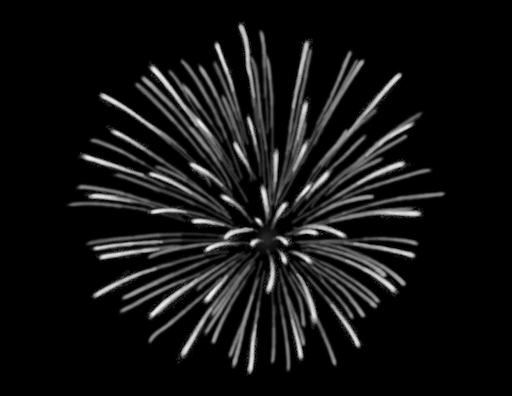
Silver flames and sparks in fireworks can come from white-hot metals. These metals will usually either be magnesium or aluminum. Just like I mentioned with the white fire, metal powders are extremely dangerous, especially magnesium, with the risk of spontaneous explosions. Aluminum is generally not as reactive as magnesium is, but all chemicals and metal powders should be handled with great respect, in fact, do not work with them unless you are a professional with professional equipment. Remember, these white-hot metals can be over 5,600ºF. If you are considering working with these metals, I highly recommend that you read through the previous category, since I described some of the dangers and things to keep in mind there.
I find it fascinating to think about what metals cause which colors; I have actually used most of these metals in my fireworks to produce most of these colors, however, it should be noted that some of these metals and compounds may be illegal to use in fireworks depending on your nation, state, county, and city; for instance, I am not allowed to use titanium in fireworks in my area.
Happy Independence Day, and God bless the USA!
 Onward American