
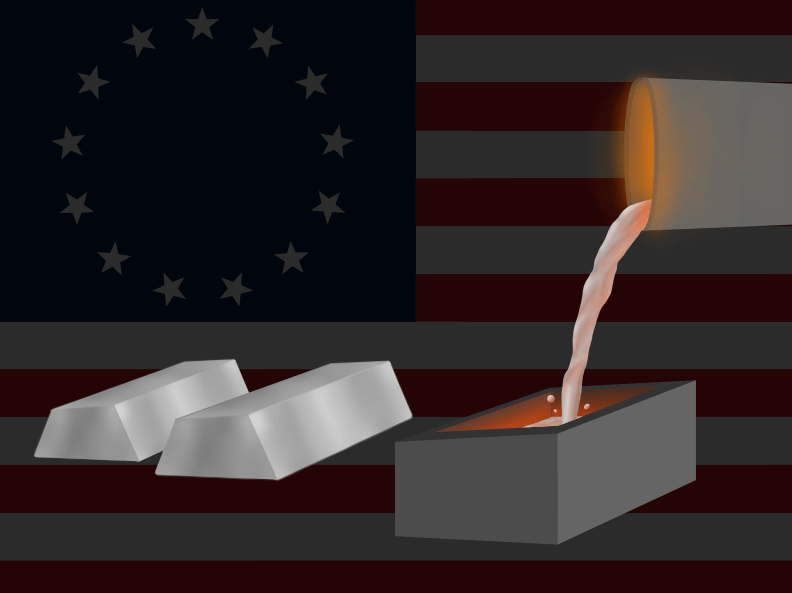
As you may already realize, there weren’t factories in colonial America to mass produce crucial metallic items such as horse shoes, axes, skillets, dutch ovens, firearms, cannons, buckles, buttons, bells, nails, rivets, hinges, chains, and sewing needles, yet the Colonists certainly needed all of these items, so how did they procure them?
The first people to settle the colonies obviously did not arrive in the New World to find forges and foundries already built for them; they would have had to bring their first cookware, cutlery, tools, and hardware with them from the old country. After arriving in the settlement, the Colonists had to import these metal items from Europe in exchange for lumber, tobacco, rice, and dried fish, until they managed to build their own functional forges and foundries.
Once these workshops were operational, smiths and metallurgists were relied upon for producing, casting, and forging metal across the colonies. These craftsmen were vital to the war effort during the revolution, producing and repairing the firearms necessary to win our independence.
This career was so prevalent that one of the most well known Founding Fathers was a silversmith: Paul Revere. I guess this should not be surprising, since he was from Boston, which was one of the three leading cities in silver production during the colonial era, along with New York City and Philadelphia.
The story about the life of the fictional character Johnny Tremain is a good read to provide an idea of how silversmiths in Boston lived during that time.
It is clear that smiths and metallurgists were necessary in early America, but you may be asking yourself how these professions apply to our lives today. Why do we still need to learn to forge and cast metal?
We are still dependent on metal items for their durability, longevity, electric conductivity, and even beauty, in fact, we will almost certainly be reliant on metal items for the rest of human history.
Smiths and metallurgist are still necessary in today’s world to produce items with these characteristics; we still mine ore, refine metal, and craft items, even if our processes are a bit more automated than they used to be.
Our dependence on these metal items is ever increasing, just think about it, how many man-made items do you have near you right now that have no metallic components whatsoever? If you do manage to find any, it is very likely that they were made using metallic tools.
Besides the factor of necessity, there is an inexplicable thrill that I feel whenever I successfully craft my own items. There is a sense of accomplishment and resourcefulness that comes with building custom items with your own hands. Not only is this skill elating, but it is also handy, since it enables you to make numerous custom items which you may not be able to purchase; it expands your possibilities greatly. Time spent acquiring skills and knowledge is never spent in vain. The more skills you obtain, the more independent you can be, but also the more experienced you will be, which increases the likelihood that you can perform a task with more confidence and finesse.
Which do you prefer, forging or casting?
 Onward American