
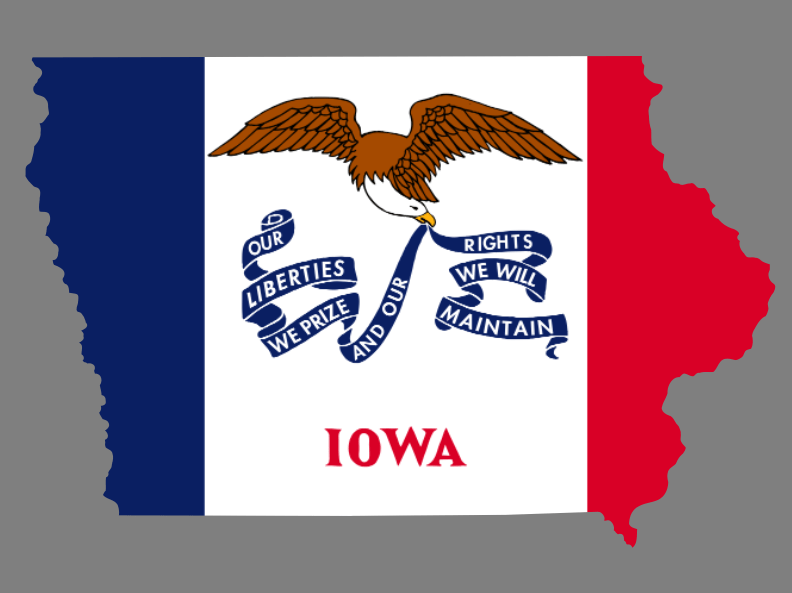
Iowa is a state in the midwestern region of the United States with the abbreviation IA. Iowa became the 29th state on December 28, 1846, which makes the state 177 years old, as of December, 2023. The name Iowa comes from the name of an Indian tribe which was called the Ah-hee-oo-ba, meaning sleepy ones or drowsy ones. The name was then given to the river of the valley in which they lived, and later the state was also given the name.
Iowa is the 26th largest state and the 31st most populous; the capital of Iowa is Des Moines, and its demonym is Iowan. Iowa is bordered by the states of Wisconsin, Illinois, Missouri, Nebraska, South Dakota, and Minnesota.
The motto of the state of Iowa is Our Liberties We Prize and Our Rights We Will Maintain.
Iowa’s official nickname is the Hawkeye State. Some claim Iowa was given this nickname as a tribute to chief Black Hawk, leader of the Sauk tribe, while others believe that it comes from the novel The Last of the Mohicans, in which the fictional character Hawkeye was a skilled woodsman and warrior. Iowa is sometimes called the Corn State, because 90% of the state is devoted to agriculture.
The landscape of Iowa was originally covered in grasslands, forests, and savannas, but now most of that land has been made into farmland, which has made Iowa one of the largest agricultural producers in the United States.
Iowa is known for agriculture, producing more corn and eggs than any state, being the state that raises more pigs and poultry than any other, and inventing sliced bread. Iowa is also the only state bordered on two sides by navigable rivers. Many materials can be found in Iowa, such as jasper, barite, selenite, calcite, copper, and even pearls.
On February 26, 1846, William Frederick Cody, better known as Buffalo Bill, was born in Le Claire, Iowa Territory. Cody’s parents were born in the 1810s; his farther was born in Toronto Township, Upper Canada, and his mother in Trenton, New Jersey. In 1853, Cody’s family moved to Fort Leavenworth, Kansas Territory. In 1860, at the age of 14, Cody heard about the Holcomb Valley Gold Rush; he was on his way to the goldfields when he met an agent for the Pony Express and became involved in the service. In 1863, during the Civil War, Cody enlisted into the Union Army with the rank of private in Company H, 7th Kansas Cavalry; he was discharged at the end of the war. Cody cofounded the settlement of Rome, Kansas; it was around this time that he received the nickname Buffalo Bill for his contract of supplying Kansas Pacific Railroad workers with buffalo meat. In 1868, Buffalo Bill returned to serve in the Army, and during this time, he completed an amazing feat of riding as a lone dispatch courier from Fort Larned to Fort Zarah, escaping brief capture, then from Fort Zarah to Fort Hays to Fort Dodge to Fort Larned and, finally, to Fort Hays; he crossed these 350 miles through hostile territory in only 58 hours, even covering the last 35 miles on foot. In 1872, he was awarded the Metal of Honor for his gallantry above and beyond the call of duty during his time as an Army scout, however, this award was revoked in 1917, along with the metals of 910 other recipients, when Congress decided to form a hierarchy of metals, making the Metal of Honor the highest possible military honor, but Congress was eventually persuaded to restore the Metal of Honor to Buffalo Bill and several other scouts in 1989. Buffalo Bill died on January 10, 1917, in Denver, Colorado, at the age of 70.
From 1939 to 1942, the first automatic electronic digital computer was built by physics professor Dr. John Atanasoff and his graduate student, Clifford Berry, at the Iowa State University in Ames, Iowa. They named their invention the Atanasoff Berry Computer, which was later named the ABC.
The Battle of Athens occurred on August 5, 1861, during the Civil War on the Des Moines River. The portion of the river on which the battle was fought happens to be the Missouri-Iowa border, therefore the battle took place near Athens in Clark County, Missouri, and Croton in Lee County, Iowa. Confederate Colonel Martin Green and his roughly 2,000 pro-Confederate Missouri State Guard troops attempted to take the town of Athens from US Colonel David Moore and his 300 to 500 Missouri Home Guard troops, however, the State Guard troops were unsuccessful, resulting in a Union victory. During the battle, some Iowa militiamen fired long range shots across the river at the Confederates. This was the northernmost battle of the Civil War west of the Mississippi River and the only Civil War Battle fought on Iowan soil.
One interesting fact about Iowa is that the town of St. Donatus was settled by immigrants from Luxembourg; the town has one of the only, if not the only, Luxembourgish restaurant in the United States. St. Donatus has a mere 121 residents, however, the town is quite unique if the majority of its population is at least partially of Luxembourgish descent, because there were only 45,000 self reported Luxembourgish Americans during the 2000 Census, including those of partial Luxembourgish descent, which was only 0.016% of the US population in 2000; this is made even more unique due to the fact that the nation of Luxembourg only had a population of 436,000 in the year 2000, which was slightly less than the population of Wyoming at the time, the least populous state.
One strange fact about Iowa is that, in the year 1910, a 380 mile long road running from Council Bluffs to Davenport, known as the River to River Road, was constructed in a single hour. This was accomplished by having 10,000 men, lined up from one side of the state to the other, working simultaneously; theoretically, this should have given the average man about 200 feet of road to construct.
What fact about Iowa most interests you?
Onward American 🇺🇸
Source: Origins of State Names
Source: Demonyms for US States
Source: The Battle of Athens (1861)
 Onward American