
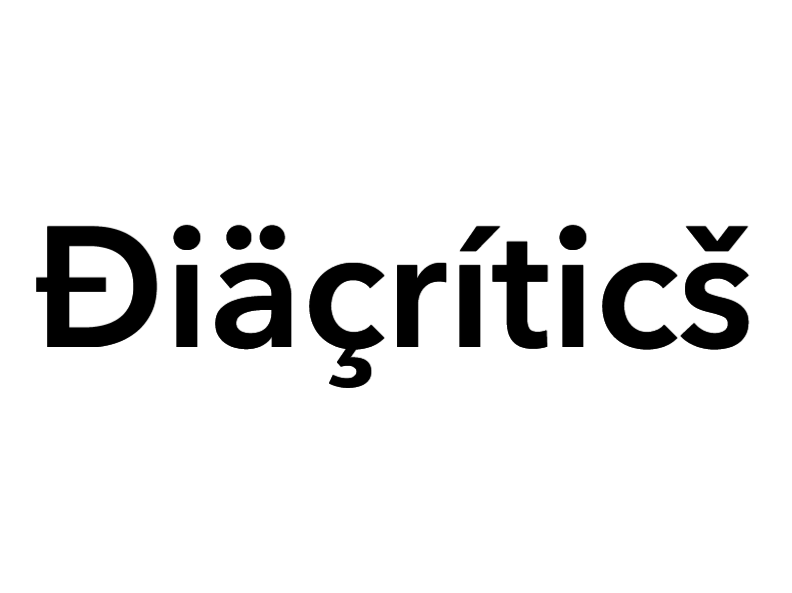
Have you ever looked at the word café and wondered why there is that fancy mark above the E? If you read my post about foreign words in English, you may already know that café has this mark above it, which is called a diacritic, because it came from French word for coffee or coffee house, but why does that letter have a diacritic?
Common Diacritics in European Languages
In the case of the word café, the letter E has a diacritic known as an acute accent placed above it. This usage of the acute accent comes from French because the word itself is French, therefore it is not native to English. The French language uses several more diacritics, such as the grave accent, the circumflex, the cedilla, and the trema, the last of which looks much like an umlaut—don’t worry, we will discuss what an umlaut is in a moment.
French is not the only European language to use diacritics, in fact, there are many diacritics in foreign languages, here are some of them.
Acute and Grave Accent ( Á, À )
The acute accent appears as a forward stroke above several letters: Á, á, Ć, ć, É, é, Í, í, Ń, ń, Ó, ó, Ś, ś, Ú, ú, Ź, ź; the grave accent appears as a backward stroke above vowels: À, à, È, è, Ì, ì, Ò, ò, Ù, ù.
Circumflex ( Â )
The circumflex is an angled arch above vowels: Â, â, Ê, ê, Î, î, Ô, ô, Û, û.
Macron ( Ā )
This diacritic is a horizontal line above vowels: Ā, ā, Ē, ē, Ī, ī, Ō, ō, Ū, ū.
Umlaut ( Ä )
An umlaut appears as two dots above vowels: Ä, ä, Ë, ë, Ï, ï, Ö, ö, Ü, ü.
Cedilla ( Ç )
The cedilla is a small hook under the letter C: Ç, ç.
Tilde ( Ã )
The tilde is a wavy line that sits above some letters: Ã, ã, Ñ, ñ, Õ, õ.
Háček ( Č )
The háček, or caron, looks like an upside down circumflex above some consonants: Č, č, Š, š, Ž, ž.
Crossed L ( Ł )
The crossed L simply is a forward stroke through the letter L: Ł, ł.
Crossed D ( Đ )
This is the letter D with a horizontal line through it: Đ, đ.
Crossed H ( Ħ )
The crossed H is an H with a horizontal line through it, which is fairly crazy looking in its capital form since a capital H already has a horizontal line: Ħ, ħ.
In my opinion, the capital crossed H looks like a fence.
Crossed O ( Ø )
A crossed O looks like a forward slash through the letter O: Ø, ø.
Overring ( Å )
An overring appears as a small circle above the letter A: Å, å.
Comma S ( Ș )
The comma S is the occurrence of a comma underneath the letter S: Ș, ș.
Diacritics in Modern English
Believe it or not, a few diacritics have found their way into English over the centuries, and a couple of them are in use each day. I even used one diacritic 10 times in the previous sentence alone: the tittle.
That’s right, even though Modern English has very few of these fancy marks on its letters, it still has a couple of them that are apparently purely English in nature; the tittle is by far the most common English diacritic, which is present on the letters i and j. If you look closely, you will notice that the dots on these two letters are diacritics; they are the only English letters to have tittles.
What’s even more strange is that these are not the only surviving diacritics that are present on native English words! For example, the diaeresis is a symbol that appears as two dots above a letter, which again looks very much like an umlaut. The diaeresis is placed over the second of two vowels in a hiatus, or the occurrence of two adjacent vowels that are not part of the same syllable. In modern times, this symbol is almost always omitted or replaced with a hyphen. The diaeresis could be used in words like daïs, coöperate, and reässert.
The acute accent is also sometimes used in English in poetry and lyrics to clearly mark which syllable is stressed in a word where it might be ambiguous, such as in rébel and rebél.
What is your favorite diacritic?
 Onward American