

On December 31, 2022, I glanced at the clock and noticed that it read 11:54 PM. Realizing that there were only several minutes left of the year 2022, I hastily prepared to celebrate the arrival of 2023. As I brought a container of desserts to the table, a question flashed through my mind: which piece of land witnesses the first rays of sunlight of the new year?
With only 6 minutes left until the calendar flipped to 2023, I was left without the ability to write a post describing this concept in the year 2022, but I now find myself only days away from 2024, which I believe is the perfect opportunity to explore this concept that I devised in the final moments of 2022.
The International Date Line
To answer this question, it is imperative that we consider the International Date Line, which is the imaginary line the world uses to define where a day begins and ends. Just east of the line is the last time zone, and therefore the last place where a day exists, and west of the line is the first timezone, or the place where a day first exists. The International Date Line is opposite of the Prime Meridian, which is the meridian where the world’s central time zone, UTC+0, is located. UTC stands for Coordinated Universal Time, and the number indicates how many hours ahead (+) or behind (-) the specified time zone is relative to the Prime Meridian.
Because a day has 24 hours, there should be 12 one-hour time zones east of the Prime Meridian and 12 west of the Prime Meridian, making the International Date Line the place where the two directions meet. This simplification is partially accurate, UTC+12 and UTC-12 do meet in places along the International Date Line, however, the line protrudes east near the equator, not to mention that UTC-9, UTC-10, and UTC-11 meet UTC+12 in other places. This irregularity has produced two extra time zones: UTC+13 and UTC+14. This causes Howland Island (UTC-12) to be 26 hours behind Kiritimati Island (UTC+14), even though there are only 24 hours in a day.
Regardless of the fact that some people are constantly living a full day ahead of others, the effect is not actually due to time travel, but instead the illusion is formed by our establishment of time zones. We are all existing in the same moment in time, no one has actually time traveled, well, except for Sergei Krikalev, who actually traveled 0.2 seconds into the future by spending 803 days in orbit.
Because we consider a new day, and therefore a new year, to arrive at exactly 12 AM on January 1, we have to use time zones and the International Date Line to define when and where a new year arrives, rather than the rotation of the earth. Even though this makes the concept a little abstract, it allows the question to be definitively answered. This is not to say that the rotational and orbital periods of the earth are insignificant.
The Latest of Time Zones
As previously mentioned, UTC+14 is the most advanced time zone in the world. This time zone reaches January 1 before any other time zone each year, so you can just place a perfect meridian on this time zone to find where the first glimmer of sunlight will land, right? Well, not exactly. Remember, because the new year arrives only a few days before the earth’s perihelion, the point in the earth’s orbit when the earth is closest to the sun, the line of sunlight is not perfectly vertical, but it is slanted with an angle of about 23.5 degrees. This means that most of the arctic will not see any sunlight on the first day of the year, and most of the antarctic will see no darkness on that first day.
Let’s look at a map with a couple time zones and sunlit sections highlighted.
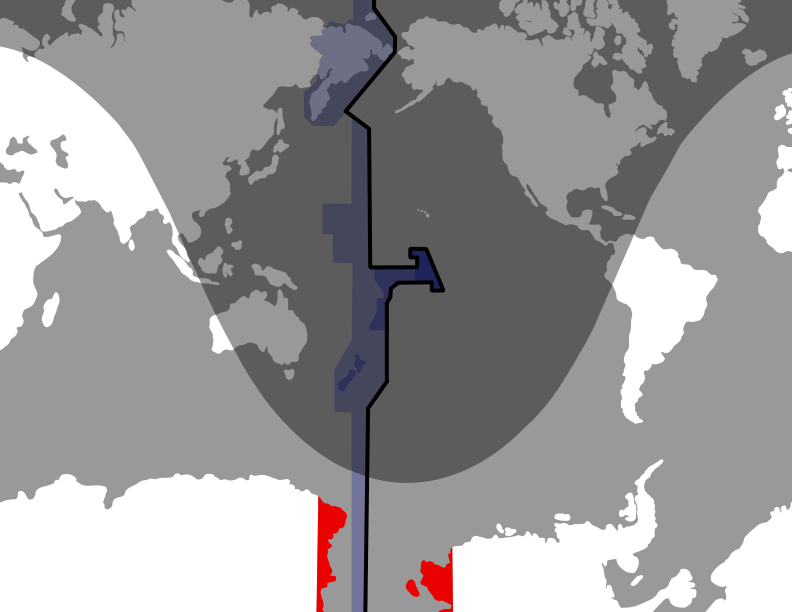
All right, that clarifies some things. The entirety of UTC+14 is dark for the first several hours of the year, which gives UTC+13 some time to move into the new year. Because Antarctica is in perpetual light, and because a section of this frozen continent is in UTC+13, Antarctica becomes the first place on earth to see the light of day in the new year, if my calculations are correct; I suppose it is ironic to call this first light the light of day since it occurs at midnight. This moment will happen at 6 AM Eastern, 5 AM Central, 4 AM Mountain, 3 AM Pacific, 2 AM Alaska, or 1 AM Hawaii Aleutian on December 31.
So the first light lands in Antarctica, a desolate place where there are practically no humans to observe the light of the new year. Well, some nations do have claims in Antarctica, so which nation owns this area?
Antarctic Claims
There are seven nations that claim the majority of Antarctica: New Zealand, Australia, France, Norway, the United Kingdom, Argentina, and Chile. The sliver of Antarctica that sees the first light of a new year just so happens to be mostly claimed by New Zealand, which includes the Ross Ice Shelf. Many nations, including the United States, do not recognize the seven nation’s claims to Antarctica; the United States does maintain a basis to claim territory in Antartica, but it does not have current claims.
There is one other way to divide Antarctica: the frontage theory. This method proposes that the corresponding Antarctic territory of any line running north from the south pole is owned by whichever nation where the line makes landfall. This would suggest that the sliver of Antarctica where the sun first shines would be mostly owned by the United States, since the Pacific states are directly north of that wedge.
The year 2023 has been full of fun ideas and significant milestones for Onward American, it is definitely a year I will fondly remember, but it is now time to embrace 2024. Happy New Year!
What is your favorite post or series from Onward American in 2023?
Onward American 🇺🇸
Source: Coordinated Universal Time (UTC)
 Onward American