
It is quite easy to understand shapes in the three dimensions of our world, and even in the dimensions below ours: anything zero dimensional is a point, one dimensional objects are line segments, and the second and third dimensions often combine both points and line segments to form shapes.
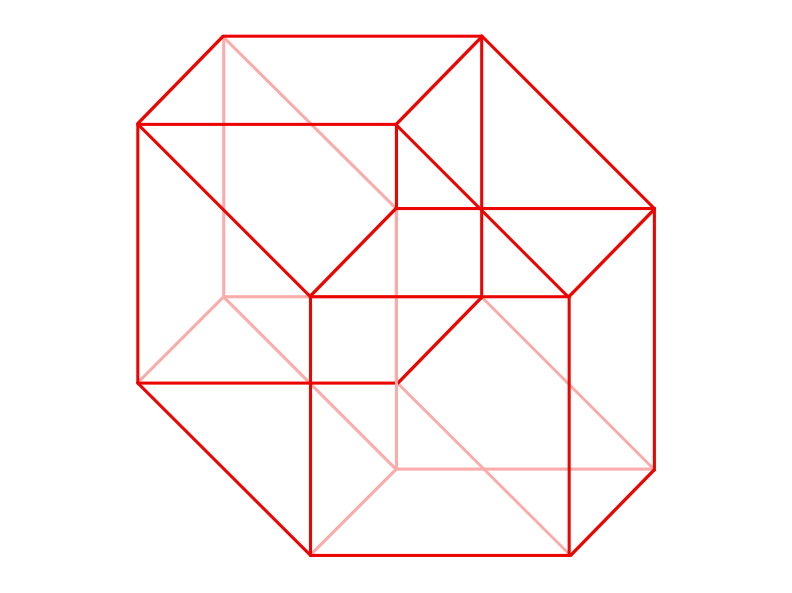
One fact that seems obvious with hindsight, but of which I was not consciously aware, is that shapes exist throughout every dimension, not exclusively the ones we understand. For instance, if you take a square and add another dimension, you get a cube, and if you add yet another dimension, you get a tesseract. Shapes have a distinct name for each dimension, but they will sometimes be labeled by their three dimensional shape name preceded by their dimensional level, meaning a tesseract could also be called a 4-cube.
If all dimensions have their own shapes, what are they? I will give you a shape in the following dimensions from a family of shapes known as hypercubes; I will also do my best to describe each shape’s structure in a way that is relatively easy to understand, however, I couldn’t give a comprehensive explanation if I wanted to, since my three dimensional mind struggles to grasp the concepts of this unworldly geometry. If you want more information on hypercubes, this website explains them in detail.
0 Dimensional Shapes
Objects in the zero dimensional world do not exist within any axes and they have no length, width, or depth.
The 0-cube is the zero dimensional form of a cube; its shape is simply a point. A 0-cube has 1 vertex, 0 edges, and 0 faces.
1 Dimensional Shapes
Objects in the one dimensional world exist within one axis, which is frequently called length.
The 1-cube is the one dimensional form of a cube; it is also known as a line segment. A 1-cube has 2 vertices, 1 edge, and 0 faces.
2 Dimensional Shapes
Objects in the two dimensional world exist within two perpendicular axes, which are frequently called length and width.
The 2-cube is the two dimensional form of a cube; it is also known as a square. A square has 4 vertices, 4 edges, and 1 face.
3 Dimensional Shapes
Objects in the three dimensional world, such as our world, exist within three perpendicular axes, which are frequently called length, width, and depth.
The 3-cube is unsurprisingly the hypercube name for a cube. A cube has 8 vertices, 12 edges, and 6 faces.
4 Dimensional Shapes
Some scientists will say that time is the fourth dimension, while others theorize that alternate universes are the fourth dimension. I personally think there is some validity to the former theory, especially when considering that time is a 1 dimensional medium through which we, 3 dimensional beings, are constantly traveling and that space and time are known in physics to be intertwined (1D + 3D = 4D), but I will stick to a purely geometric definition of dimension for this post, therefore, I will consider each dimension as an axis in space.
Objects in the four dimensional world exist within four perpendicular axes.
The 4-cube is the four dimensional form of a cube; it is also known as a tesseract. A tesseract has 16 vertices, 32 edges, and 24 faces.
5 Dimensional Shapes
Objects in the five dimensional world exist within five perpendicular axes.
The 5-cube is the five dimensional form of a cube; it is also known as a penteract. A penteract has 32 vertices, 80 edges, and 80 faces
6 Dimensional Shapes
Objects in the six dimensional world exist within six perpendicular axes.
The 6-cube is the six dimensional form of a cube; it is also known as a hexeract. A hexeract has 64 vertices, 192 edges, and 240 faces.
7 Dimensional Shape
Objects in the seven dimensional world exist within seven perpendicular axes.
The 7-cube is the seven dimensional form of a cube; it is also known as a hepteract. A hepteract has 128 vertices, 448 edges, and 672 faces.
8 Dimensional Shapes
Objects in the eight dimensional world exist within eight perpendicular axes.
The 8-cube is the eight dimensional form of a cube; it is also known as an octeract. An octeract has 256 vertices, 1,024 edges, and 1,792 faces.
9 Dimensional Shapes
Objects in the nine dimensional world exist within nine perpendicular axes.
The 9-cube is the nine dimensional form of a cube; it is also known as an enneract. An enneract has 512 vertices, 2,304 edges, and 4,608 faces.
10 Dimensional Shapes
Objects in the ten dimensional world exist within ten perpendicular axes.
The 10-cube is the ten dimensional form of a cube; it is also known as a dekeract. A dekeract has 1,024 vertices, 5,120 edges, and 11,520 faces.
It is possible to continue beyond the tenth dimension, however, many sources end at the tenth dimension. This could be due to the fact that some scientists theorize that there are ten dimensions in the universe or it could be because ten is an even number.
What is your favorite dimension?
 Onward American