
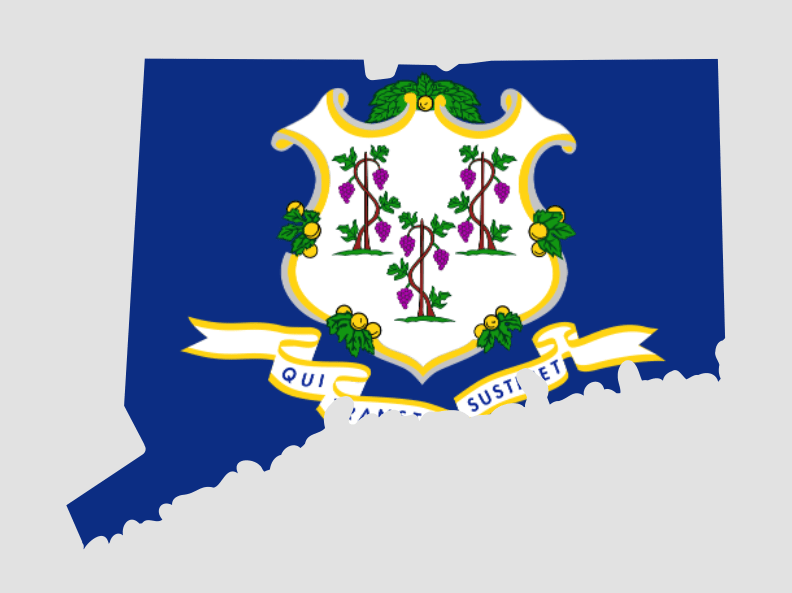
Connecticut is a state in the northeastern region of the United States, and its abbreviation is CT. Connecticut became the 5th state on January 9, 1788; this makes Connecticut 235 years old, as of January 2023. The name Connecticut appears to have come from the American Indian word Quonoktacut, or Quonecktacut, which some interpret to mean river whose water is driven in waves by tides, but the word can also be interpreted as the long river or long river place.
Connecticut is the 48th largest state and the 29th most populous; the capital of Connecticut is Hartford. Connecticut is one of the thirteen original states. The state’s demonym is Connecticuter and the state borders New York, Massachusetts, Rhode Island, and the Atlantic Ocean.
The motto for the state of Connecticut is Qui Transtulit Sustinet (Latin for He Who Transplanted Sustains).
Connecticut’s official nickname is The Constitution State; it is believed that the ideas for writing the US Constitution were derived from the first constitution of Connecticut; the state was also one of the first states to ratify the US Constitution. Connecticut is sometimes called the Nutmeg State, and during the Revolutionary War, it was called the Provisions State.
The landscape of Connecticut mostly consists of coastal plains and a central valley that are relatively flat, which is where the state’s larger cities reside; the remainder of the state consists of hills that are covered in hardwood forests.
Connecticut is known for its sublime fall colors, scenic coastline, and manufacturing industry. Connecticut has also gained some recognition for making Yankee Doodle its state song, which is a song that was written by a British Army surgeon during the French and Indian War to mock the Colonists with whom they fought, since they were viewed as inferior and foolish; the song became popular among the Americans as a song of defiance, and they added verses that mocked the British. By the end of the Revolutionary War, Yankee Doodle had been changed from an insult to a song of patriotism.
Connecticut’s land contains minerals such as copper, silver, lead, cobalt, tungsten, iron, garnet, uranium, graphite, and gold.
On October 16, 1758, Noah Webster was born in Hartford, Connecticut Colony. Webster’s most well known achievement quite possibly is publishing the dictionary that is often called Webster’s Dictionary. In 1806, Webster published his first dictionary, which he titled A Compendious Dictionary of the English Language. The following year, Webster began compiling a fully comprehensive dictionary, called An American Dictionary of the English Language, which he published after 26 years of work at the age of 70. Webster even learned 28 languages to evaluate the etymology of words; the languages Webster learned included, Old English, Gothic, German, Greek, Latin, Italian, Spanish, French, Dutch, Welsh, Russian, Hebrew, Aramaic, Persian, Arabic, and Sanskrit. It is believed that Webster helped standardize the American spellings of English words, such as center, color, and check.
In 1919, a man by the name of Igor Sikorsky moved to the United States from Russia. Sikorsky founded the Sikorsky Aircraft Corporation in 1923, and in 1939, his company completed the first successful powered helicopter flight, making Stratford, Connecticut, home to the first helicopter flight. The machine used by the company was the Vought-Sikorsky VS-300.
During the Revolutionary War, the Battle of Ridgefield occurred in the cities of Danbury and Ridgefield, Connecticut. On April 27, 1777, several hundred Patriot militiamen in Ridgefield under the command of Brigadier General Benedict Arnold confronted thousands of British troops who had recently destroyed Continental Army supplies in Danbury. The militiamen were chased away in a running battle that moved down Ridgefield’s main street. The British succeeded in destroying the Americans’ supplies, but they received more casualties than the Americans and their raid had turned Patriots in Connecticut against the British. After the battle, the British no longer launched raids that extended far beyond the coasts of Connecticut.
An interesting fact about Connecticut is that it was the first state to pass a law regulating the speed of motor vehicles, in other words, Connecticut was the first state to have a speed limit. This law was passed in May of 1901, and the original speed limit was 12 MPH in cities and 15 MPH on rural roads; those lawmakers would have likely been astounded to see the speed limits of our modern roads and highways.
A strange fact about Connecticut is that the colony of Connecticut had two capitals since 1701; the cities of New Haven and Hartford were named co-capitals and each city had a separate capitol building. The two cities remained as co-capitals until a public vote was held in 1875 and Hartford became the official capital of Connecticut.
What fact about Connecticut most interests you?
Onward American 🇺🇸
Source: Origins of State Names
Source: Demonyms for US States
Source: Connecticut State Nickname
Source: Things for which Connecticut is Known
 Onward American