
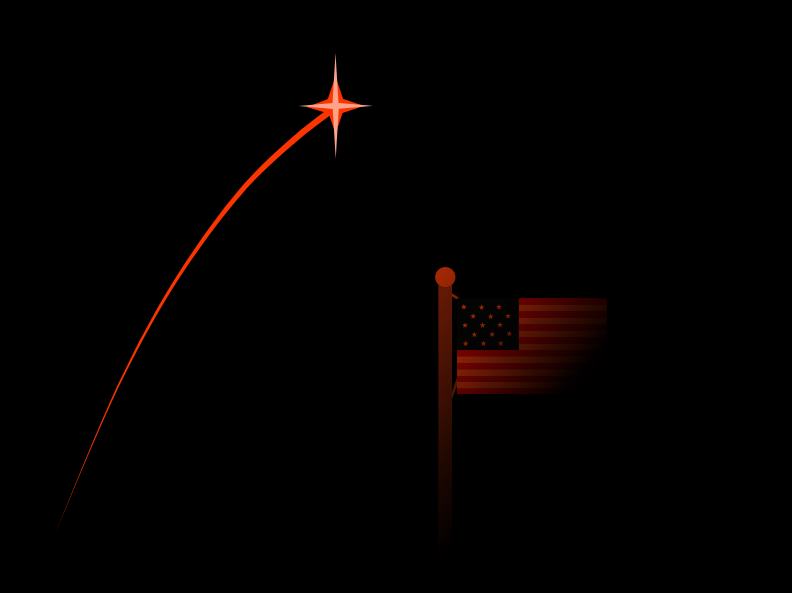
The Star Spangled Banner has been the National Anthem of the United States for 92 years, and it has been a foundational symbol of our identity as Americans since it was written. Every Independence Day, millions of Americans from coast to coast are filled with patriotism as the Star Spangled Banner is sung; it is one of the most widely known songs among Americans, but what isn’t as widely known is how the song was written.
I was embarrassed to discover that I knew less about our very anthem than I should have known. It is clear that the words of the Star Spangled Banner describe our struggle during a battle, but I had wrongly assumed that this battle occurred during the Revolutionary War. This battle had actually occurred during the War of 1812; this was the Battle of Fort McHenry.
Tensions Rise
On August 24, 1814, British forces under the command of Major General Robert Ross and Admiral George Cockburn invaded Washington D.C. and burned the United States’ capital. This attack and occupation of the American capital had shocked the Americans and brought the British closer to winning the war, which had already been raging for two years.
A couple weeks after the Burning of Washington, on September 5, British ships were in the Chesapeake Bay, near Baltimore, Maryland, roughly 40 miles north of Washington. Sailing into the Baltimore Harbor to meet with British Admiral Cockburn was an American merchant ship containing Colonel John Stuart Skinner and a lawyer named Francis Scott Key, who intended to discuss the release of Dr. William Beanes. Beanes was a colleague of Key who had been captured by the British and scheduled to be hanged for refusing to give food and drink to British soldiers who unexpectedly came to his house in Upper Marlboro, Maryland.
The negotiations for Beanes’s freedom were successful, but because these men were now aware of the positions of the British Navy and their plan to attack Baltimore, they were not yet allowed to return to shore.
On September 12, British forces landed and attempted to attack Baltimore; they pushed toward the city, but they were attacked by American forces on their way, which resulted in the death of British Major General Ross. Later that day, the British continued their attack, causing the Americans to retreat to Baltimore.
That night, thousands of American forces gathered to block the British advance to Baltimore. The defenses were much greater than what the British had expected, and the British decided to focus on launching a naval attack on Fort McHenry.
The Bombardment Commences
As the sun rose over the horizon on the morning of September 13, British ships began to mercilessly fire on Fort McHenry. Explosive mortar shells were fired high into the air to bypass the American fortifications, and newly invented Congreve rockets glowed as they rushed toward the fort.
During the bombardment, 1,200 British troops were sent on shore to attack the fort from the rear, which did divert some of the American fire from the British ships for a time, but the Americans kept the British troops from advancing into the fort. The bombardment lasted for more than 24 hours, and more than 1,500 cannonballs, shells, and rockets were fired at the fort.
The British attack was far less effective than anticipated due to a number of factors: the British gunners had poor aim, compounded by the fact that their ships were unable to get close to the fort because of the American cannons and the line of sunken merchant ships that American Major George Armistead ordered to block the entrance to Baltimore Harbor. The attack was also made difficult for the British because of a storm that brought driving rain, which caused some malfunctions of their shells and rockets.
The Dawn of Victory
On the morning of September 14, Major Armistead had the battered storm flag, which was in use due to the storm, lowered, but rather than surrendering, he had a 30 by 42 foot American flag raised at reveille, which was customary, but this raising of a large, fresh flag signaled that the Americans were ready to continue the fight.
The exhausted British, who were now low on ammunition, ceased the bombardment and realized they could not defeat the American fortifications; were forced to retreat and repair their ships, sending Beanes, Key, and Stuart back to shore and heading for New Orleans instead.
If the British had successfully captured Baltimore, they would have defeated and occupied two of America’s most vital cities, which, alone, could have caused America to lose the entire war, but the British attempt to capture Baltimore had completely failed.
The Writing of The Star Spangled Banner
Key was inspired after witnessing the battle to write a poem that he titled The Defense of Fort McHenry. Within this poem, he described the heroism of the Americans who withstood the fearsome barrage and the unbelievable victory.
From the surprising sight of the unwavering flag in the morning light, which had survived the attack, Key wrote: o say, can you see, by the dawn’s early light, what so proudly we hailed at the twilight’s last gleaming? In reference to the uncertainty of the battle and the flag’s presence over the defenses they manned: whose broad stripes and bright stars through the perilous fight, o’er the ramparts we watched were so gallantly streaming. He described the rockets and shells that the British fired at the fort by saying: and the rocket’s red glare, the bombs bursting in air, gave proof through the night that our flag was still there. He continues by expressing the pressing question on the minds of the Americans, who were captive at sea, as the sun began to rise and the guns fell silent: o say, does that star spangled banner yet wave o’er the land of the free, and the home of the brave?
Key’s poem was published to the Baltimore Patriot on September 20, 1814, and the poem was turned into a song soon after; the song finally became the National Anthem of the United States in 1931. The lyrics to the Star Spangled Banner are only one of four verses that Key wrote following the battle. You can read the full poem online.
I wish everyone a happy Independence Day; happy 247th anniversary, America!
What is your favorite Independence Day tradition or activity?
Onward American 🇺🇸
Source: Star Spangled Banner History
 Onward American