
Almost a year ago, I wrote a post talking about the most frequently used letter in English and I even compared all of my previous posts to the statistics that I found. Though my blog was new and lacking enough resources to conclusively compare, my blog interestingly followed the statistics very closely.
With that topic in mind, it would only seem appropriate to talk about the most commonly used word in the English language, especially since I now have a lot more posts for data.
What is the most common word in English?
When I was in a class maybe a dozen years ago, our class was confronted by a trivia question: what is the most used word? The answer should not have been so difficult to deduce, especially since it was hidden within the very question, but none of us correctly guessed the answer. Most kids guessed the most common word was one of various nouns, but my guess was a. I was not correct, but I soon discovered the correct answer.
If you have not yet figured out which word it is, this will be your last opportunity to make your guess.
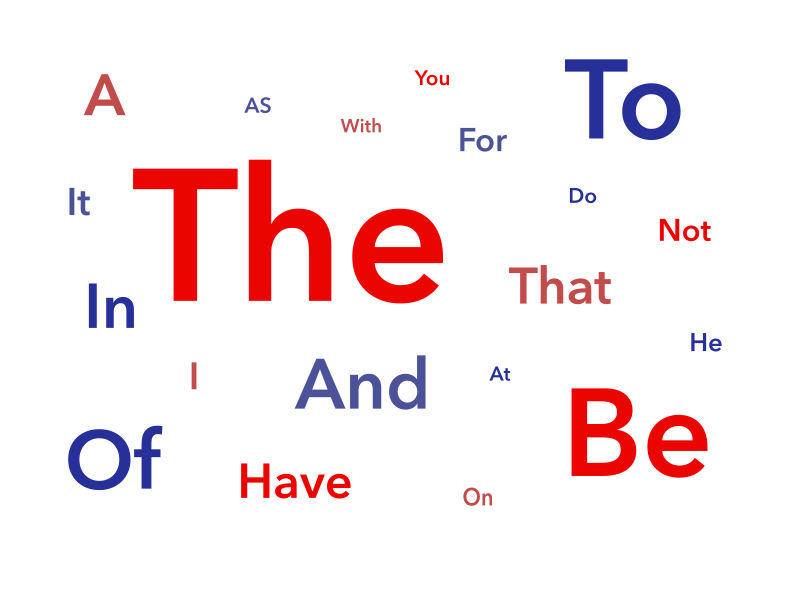
Though I was incorrect and everyone appeared to pay little attention to my guess, I was on the right track. The word that I guessed, a, is an article and, if my title did not make it too obvious, the most common word is also an article: the. Yep, the is the most common word in the English language. We use the word often, yet we scarcely consider it. This seems so clear now, but hindsight is 20/20.
Onward American Vs. the Oxford English Corpus
Excluding sources, sign-offs, and others’ opinions on beverages, I compiled every word that I have typed in the last 65 posts and compared them to the statistics provided by Wikipedia from the Oxford English Corpus. I also converted all numbers in the numeric form into words.
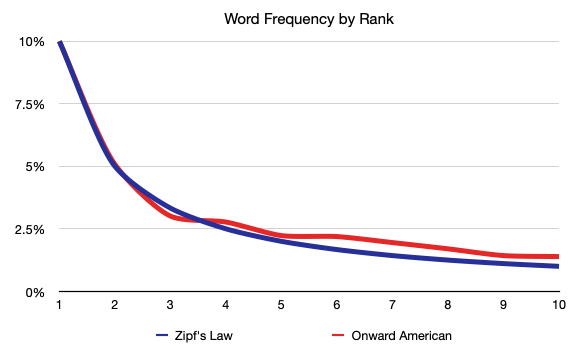
Of my 40,000 words from the past 65 posts, I did in fact use the more than any other word. In terms of rank, my usage of words is even remarkably similar to that of the Oxford English Corpus!
Ten Most Frequent Words: Onward American (Oxford English Corpus)
- The (The)
- Of (Be)
- To (To)
- And (Of)
- A (And)
- Is (A)
- In (In)
- That (That)
- Was (Have)
- This (I)
Fun fact: during the time of my post about the most common letter, I had only used 25,000 letters. Up until this post, I have written approximately 200,000 letters on this blog; 25,000 is now merely the number of times I have used the letter E.
While looking at the frequency with which I have used words, I can’t help but hear a single phrase echoing through my mind: Zipf’s Law.
Onward American Vs. Zipf’s Law
Zipf’s Law predicts that in a typical text you can expect to find the second most common word half as often as the most common, the third most common a third as often, the fourth a fourth, and so on. Each letter should appear about as often as 1 divided by the letter’s rank times the frequency of the most common word: (1 ÷ rank) x maximum frequency. This means that my second most common letter, of, should have appeared 1/2 times as often as my most common word, and in my calculations, it did occur half as often!
When this concept was first described to me, I truly did not believe that virtually every form of language complied with this bizarre pattern, and it shocked me to discover that even I failed to break out of this box of linguistic patterns to which we are all seemingly confined. Even in blogs with specific topics in which the authors exercise their free will to express their personality in their choice of words, there is still an uncanny correlation to Zipf’s Law; at least, this apparently applies to the first 1,000 ranks, after which Zipf’s Law begins to fall apart.
If you had a guess, what did you think the most common word was?
Onward American 🇺🇸
Source: Most Common Words in English
 Onward American