
The Japanese attack on Pearl Harbor, Hawaii, was an attack on noncombatants as the US had not entered World War Two, that is, until this event that provoked the United States to join the war. This is a widely known tragedy, however, the Japanese seizure of Alaskan soil is not as well known.
The Japanese Attack on Alaska
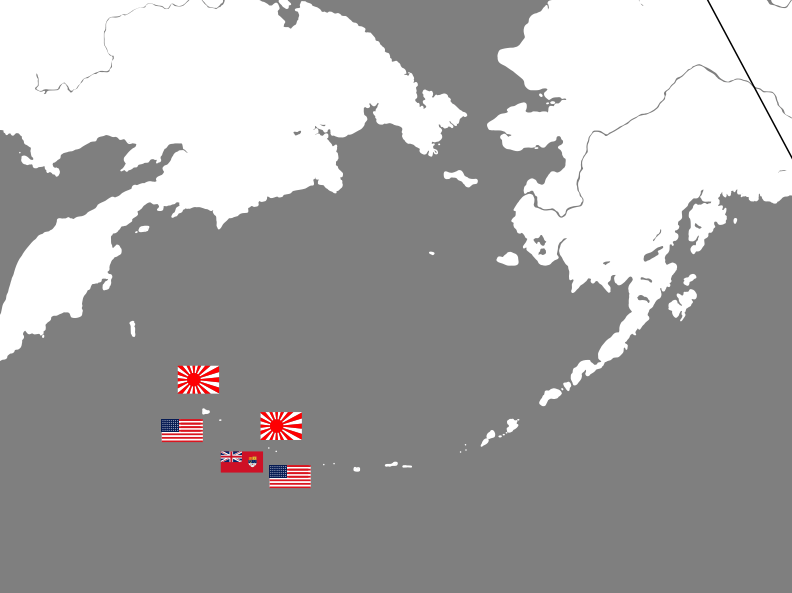
In mid 1942, only six months after Japan’s unexpected bombing of Pearl Harbor, Japanese forces moved north to the sparsely inhabited and perilous chain of Alaskan Islands known as the Aleutian Islands. Once the Japanese had reached the Aleutian Islands, they carried out air strikes on Dutch Harbor on the island of Amaknak and then landed on the beaches of a couple of the westernmost islands, Attu and Kiska, quickly overrunning the under manned US station. The Japanese immediately began establishing garrisons on both islands; this was the first time in almost 130 years that the mainland US had been attacked.
About a month before the Japanese attack on Attu, the United States Navy made an offer to evacuate Attu’s population of more than 40 Aleuts, which was declined by the Aleut chief. This resulted in Japan’s taking the Aleuts prisoner; regrettably, 35% of the Aleuts would not survive this captivity.
It is uncertain why Japan chose to seize those islands since they appeared to have little military or strategic value because of their barren and mountainous terrain that experiences harsh weather including dense fogs, high winds, and frequent snow. Some believe that Japan’s sole motive was to divert the US Pacific Fleet during Japan’s attack of Midway Island.
Americans across the nation were outraged by the Japanese attack on Alaska, though the American war planners initially paid little attention to the Japanese presence in Attu and Kiska as they were preoccupied with the process of building up forces in the South Pacific besides preparing for war in Europe. The Japanese acclimated to the unforgiving weather of the Aleutians during the American absence.
The Retaking of Attu
The United States was unprepared to address the Japanese garrison on American soil, until seven months after the Japanese attack, in January of 1943, when the US Army forces in the Alaska Command had been increased considerably and new bases on other Aleutian Islands had been constructed.
In March of 1943, a US blockade had been placed around Attu and Kiska to restrict the stream of supplies to the Japanese occupiers that had previously been well supplied. The Japanese Navy, likely foreseeing the impending American attack, attempted to deliver supplies and reinforcements to Attu. The US Navy spotted and engaged the Japanese supply ships; the outnumbered US ships sustained more damage than the Japanese, though after several hours, the Japanese abruptly fled, perhaps fearing the arrival of US bombers. This is known as the Battle of the Komandorski Islands.
For several weeks, American ships and planes bombed Attu and Kiska, and on May 11, 1943, 11,000 US troops landed on Attu. The Japanese did not fight the Americans while they landed, as they were greatly outnumbered, but resorted to guerrilla warfare; they used booby traps, snipers, and dug in positions to fight. Sadly, the United States suffered a couple thousand casualties from enemy fire and a couple thousand more from harsh weather and disease.
A few weeks after the first American landings, without warning, the remaining Japanese on Attu made an all out attack, which was one of the largest banzai charges of the Pacific campaign; the enemy crashed deep into the US echelon, engaging in fierce, hand to hand combat. After the fighting had ceased, there were only 28 Japanese that survived to be taken prisoner.
The Retaking of Kiska
American commanders learned bitter lessons from the invasion of Attu, which guided their plans for the invasion of Kiska, making sure that their soldiers had better equipment and proper clothing. A larger force of troops was sent to Kiska as they were expecting several times more enemy forces than they faced on Attu.
On August 15, 1943, more than 27,000 American troops, 5,000 Canadian troops, and 2,000 American-Canadian commandos landed on Kiska. The Allies’ landings were unopposed, similar to the landings at Attu. The troops spent several days scouring the island for enemies, likely expecting pockets of Japanese to begin firing at them from every nook and cranny, however, they were nowhere to be found; it was discovered that the entire Japanese garrison on Kiska had evacuated weeks prior under the cover of fog.
The US troops declared Kiska Island secured on August 24, which ended the Battle of the Aleutians. The retaking of Kiska did not come without casualties, despite the fact that there were no Japanese troops present. The Allies suffered 313 casualties during the invasion of Kiska from friendly fire, vehicle accidents, booby traps, mines, timed bombs, frostbite, and disease.
Whether it was intentional or not, the Japanese technically did not attack any land within the official borders of the US, though they bombed and seized portions of Hawaii and Alaska, because the lower 48 States were the only admitted US States at the time; Alaska and Hawaii were merely territories until 1959. Well, that would be true if the Japanese hadn’t bombarded Ellwood Oil Field in Santa Barbara County, California, and Fort Stevens in Clatsop County, Oregon, during the first half of 1942; the former bombardment actually occurred before the Japanese attacked the Aleutian Islands.
Did you already know about the Battle of the Aleutian Islands?
 Onward American